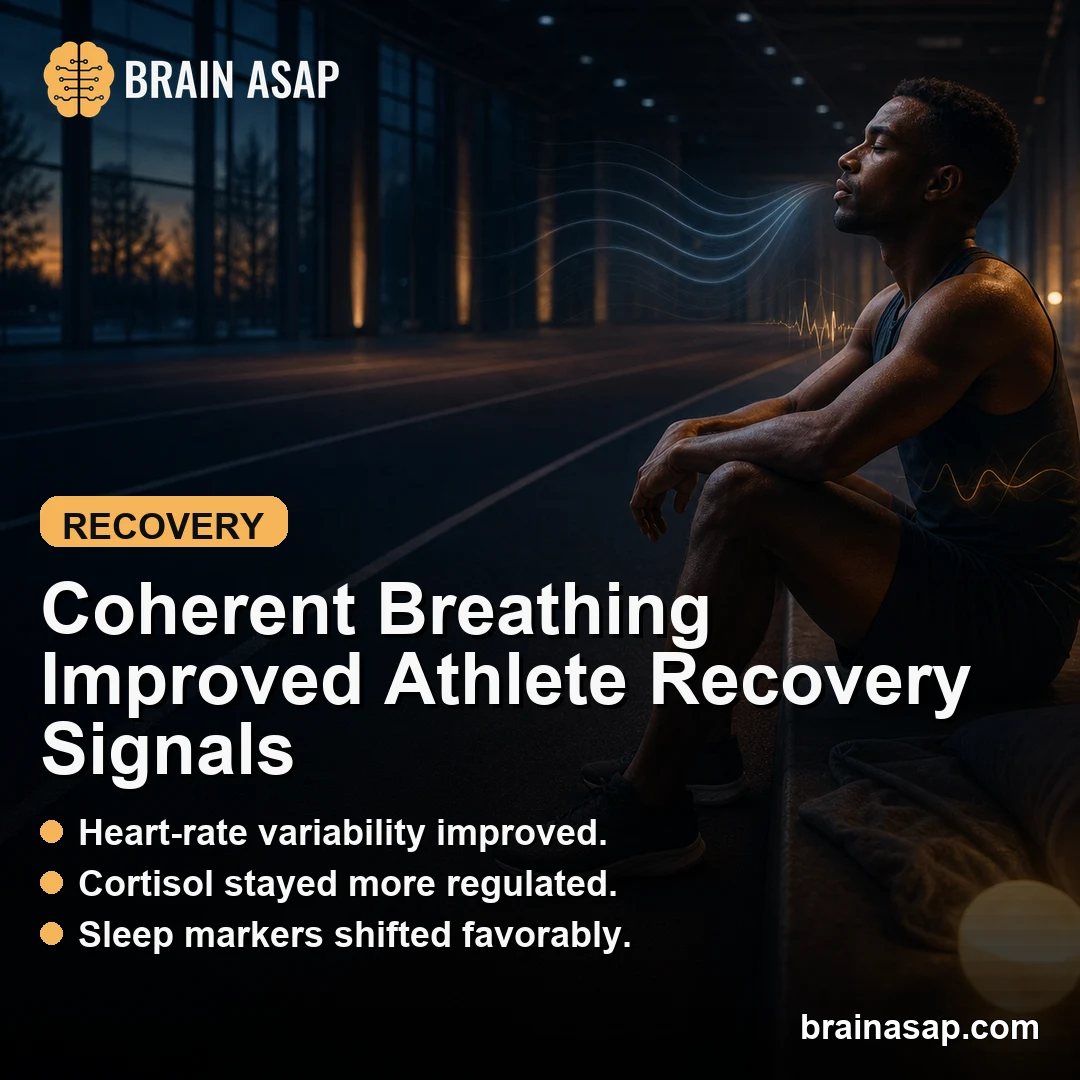
TL;DR: A 2026 randomized study in The Journal of Strength and Conditioning Research found that coherent breathing, a slow 6-breaths-per-minute breathing routine, improved several recovery markers in highly trained 400-meter athletes under repeated race stress without improving race times.
Key Findings
- 22 trained athletes: Researchers randomized 11 athletes to usual recovery and 11 athletes to coherent breathing during an 8-day simulated competition protocol.
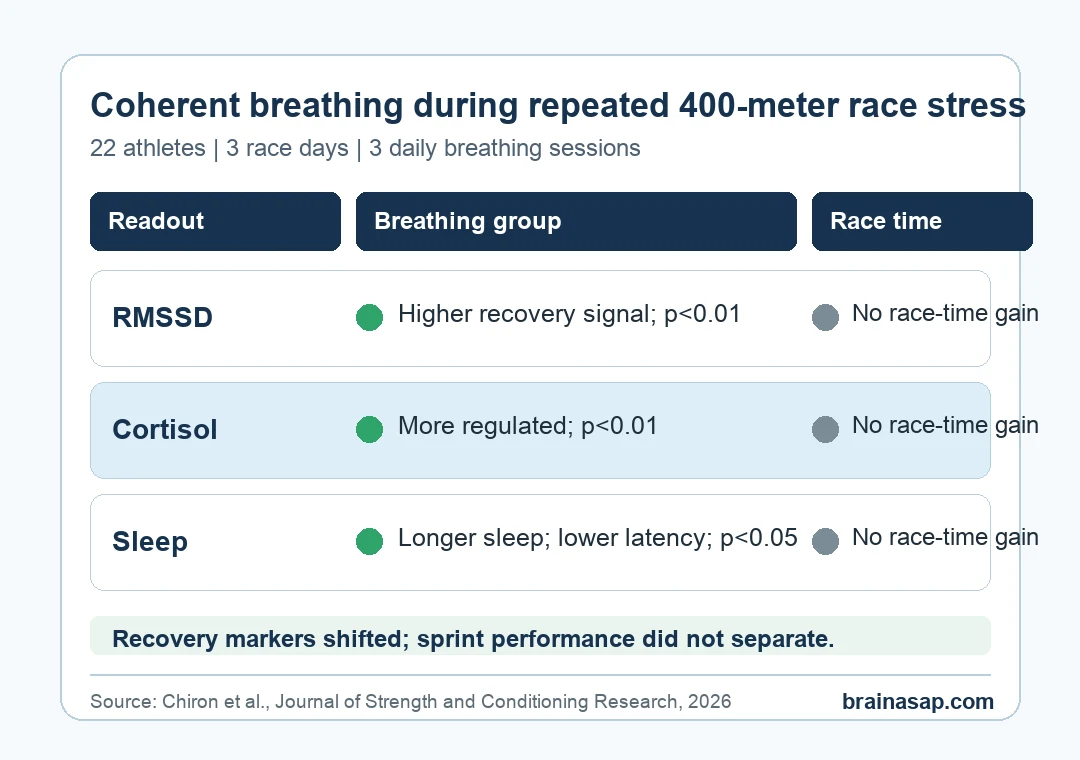
- Higher vagal recovery marker: Root mean square of successive differences (RMSSD), a heart-rate-variability marker of parasympathetic activity, increased more in the breathing group (p < 0.01).
- More stable cortisol response: Salivary cortisol, a stress-hormone marker of hypothalamic-pituitary-adrenal (HPA) axis activity, stayed more regulated in the breathing group (p < 0.01).
- Better sleep pattern: The breathing group showed longer total sleep duration and lower sleep latency, both reported at p < 0.05.
- No race-time advantage: Three consecutive 400-meter races did not differ significantly between groups, so the finding centers on recovery physiology rather than acute performance gain.
Source: The Journal of Strength and Conditioning Research (2026) | Chiron et al.
Coherent breathing is a simple paced-breathing routine: inhale for 5 seconds, exhale for 5 seconds, and repeat for 5 minutes. In this trial, researchers tested whether that rhythm could change the stress physiology of athletes facing repeated high-intensity efforts.
The important point is narrow. The breathing routine did not make athletes faster over three 400-meter races, but it was linked to a more favorable recovery profile across heart-rate variability, salivary stress markers, inflammation, and sleep.
Coherent Breathing Was Tested During Simulated Race Stress
Researchers enrolled 22 national-level athletes from the French Athletics Federation. The group included 15 men and 7 women who specialized in 400 meters, 400-meter hurdles, or 800 meters.
The athletes were randomly assigned to either usual recovery or a coherent-breathing group. The breathing group practiced three 5-minute sessions per day: after waking and saliva sampling, after lunch, and before bedtime.
The competition simulation was designed to stress recovery rather than measure one isolated workout. Athletes completed three 400-meter races on consecutive days, with 24 hours between races, while researchers tracked physiological and sleep measures across the full protocol.
- Autonomic nervous system: Researchers measured heart-rate variability, including RMSSD, which is commonly used as a vagal or parasympathetic recovery marker.
- Stress hormones: Salivary cortisol and alpha-amylase were used to track stress-axis and sympathetic activity.
- Inflammation: Interleukin-1 beta (IL-1 beta), an inflammatory signaling molecule, was measured in saliva.
- Sleep: Total sleep duration, sleep latency, light sleep, deep sleep, and rapid eye movement sleep were tracked through the protocol.
RMSSD Increased More With Slow Breathing
The clearest autonomic result involved RMSSD, short for root mean square of successive differences. In practical terms, RMSSD is a heart-rate-variability measure that tends to rise when parasympathetic, or vagal, activity is stronger.
The breathing group showed a significant increase in RMSSD compared with controls (p < 0.01). Slower respiratory pacing can strengthen the link between breathing and heart-rate oscillation, shifting the body toward a more recovery-oriented state.
The athletes were still challenged by the races. Blood lactate, anxiety measures, and race performance remained broadly comparable between groups, so the breathing routine appears to have changed recovery physiology around the stressor rather than removing the stressor itself.
Cortisol and IL-1 Beta Pointed Toward Better Stress Regulation
Saliva markers gave the study a broader stress picture than heart-rate variability alone. Cortisol is part of the HPA axis, the hormonal stress-response system connecting the hypothalamus, pituitary gland, and adrenal glands.
The coherent-breathing group had a more stable cortisol response than controls (p < 0.01). Repeated maximal efforts can push stress hormones around even when the athlete is trained and physically capable of the workload.
Inflammation followed a similar direction. The breathing group showed lower IL-1 beta levels (p < 0.05), while the paper interpreted the absence of strong IL-1 beta modulation in the breathing group as a possible protective inflammatory pattern during repeated race stress.
- Autonomic pathway: Slow breathing may increase vagal activity, which can support parasympathetic recovery after hard efforts.
- Hormonal pathway: A steadier cortisol response suggests less disruption in the stress-axis pattern across repeated competition days.
- Immune pathway: Lower IL-1 beta suggests the breathing routine may reduce part of the inflammatory response to accumulated physical stress.
Sleep Improved Without a Clear Performance Gain
Sleep is one of the most relevant outcomes in this paper because competition stress can shorten sleep, delay sleep onset, and interfere with recovery between repeated events. The breathing group showed longer total sleep duration and reduced sleep latency, both reported at p < 0.05.
Deep sleep also increased within the breathing group between the pretest period and day 4. Researchers reported deep sleep rising from 8,772 seconds before testing to 9,821 seconds on day 4, a change that fits the broader recovery pattern.
Race times did not significantly separate the groups. Control athletes averaged about 55.6 to 55.8 seconds across the three race days, while the breathing group averaged about 54.4 to 54.6 seconds, with no statistically significant group or race-day difference.
- Recovery finding first: The best-supported finding is better physiological and sleep recovery, not faster sprinting.
- Short intervention window: The breathing group practiced across the protocol, but longer familiarization might be needed for larger or more durable effects.
- Small sample: With 22 athletes total, the study can show a coherent pattern but cannot settle how well the result generalizes across sports, training levels, or real championships.
Coherent Breathing Fits Recovery Support, Not Performance Claims
For athletes, coaches, and clinicians, breathing drills should not replace training, sleep planning, nutrition, or medical recovery support. In this protocol, a low-cost routine was associated with better recovery physiology during repeated high-intensity efforts.
The routine was also simple enough to fit around competition: 5 minutes after waking, 5 minutes after lunch, and 5 minutes before bed. Recovery tools that require equipment, staff, or long sessions are harder to use consistently during event weeks.
The study is still a small randomized trial in a specific athletic setting. Coherent breathing may help regulate stress markers and sleep under repeated high-intensity load, while any claim about improved performance needs stronger evidence.
Citation: DOI: 10.1519/JSC.0000000000005377. Chiron et al. Exploring the influence of coherent breathing on psychophysiological stress during a simulated 3-day 400-m race. The Journal of Strength and Conditioning Research. 2026;40:e460-e471.
Study Design: Randomized controlled comparison during an 8-day simulated competition protocol.
Sample Size: 22 national-level athletes, with 11 assigned to usual recovery and 11 assigned to coherent breathing.
Key Statistic: Coherent breathing was associated with higher RMSSD (p < 0.01), more stable cortisol response (p < 0.01), lower IL-1 beta (p < 0.05), longer total sleep duration (p < 0.05), and reduced sleep latency (p < 0.05).
Caveat: The sample was small, the competition was simulated, and race performance did not significantly improve.