TL;DR: In a 2026 lab study, male mice were put in a cage with a bigger, aggressive mouse for 10 minutes a day for 10 days, which left many of them less interested in rewards and worse at remembering objects.
Both diabetes drugs improved object-memory performance. The reward-seeking benefit was clear for liraglutide and uncertain for glyburide; neither clearly reduced social avoidance.
Key Findings
- Blood sugar shifted: A first stressful session raised blood sugar in 2 types of lab mice. After 10 days of stress, that rise mostly disappeared, and a third, more fragile type of mouse showed a drop instead.
- Different results by behavior: Both glyburide and liraglutide improved object-memory performance compared with a dummy injection. For interest in a reward, the result was clear for liraglutide and uncertain for glyburide.
- Not social fear: Neither drug clearly reduced how much stressed mice avoided an unfamiliar mouse.
- Prevention only: Drugs were given before each stressful session. Whether they help once depression-like changes have set in wasn't tested.
Source: International Journal of Neuropsychopharmacology (2026) | Qiu et al.
Depression and type 2 diabetes often show up in the same people, and each seems to raise the risk of the other. That has made researchers wonder whether blood sugar control plays a part in how stress turns into depression.
A 2026 study in the International Journal of Neuropsychopharmacology, by Wenran Qiu, Hirotaka Nagai, Tomoyuki Furuyashiki and colleagues in Japan, tested that idea in mice.
How Do You Stress a Mouse?
Researchers used a standard method called social defeat. Each day for 10 days, a male test mouse was placed for 10 minutes in the home cage of a larger, aggressive male mouse, a different one each day.
Afterward, the team looked for 3 depression-like changes:
- Avoiding others: how much time a mouse spent far from an unfamiliar mouse kept behind mesh.
- Losing interest in a reward: how long a male mouse sniffed a swab with female mouse urine, which male mice normally find very interesting.
- Memory for objects: whether a mouse spent more time exploring a new object than a familiar toy block it had seen 4 hours earlier.
They compared 3 common strains of lab mice. Two strains handle this stress fairly well. A third, called BALB/c, is known to be more fragile.
That showed: only 19 of 42 BALB/c mice survived the 10 days, compared with 77 of 85 and 20 of 22 in the other 2 strains.
What Happened to Blood Sugar Under Stress?
Blood sugar was measured before and up to 1 hour after the first stressful session, and again after the 10th.
- After the first session: blood sugar jumped in both sturdier strains, then returned to normal within an hour
- After the 10th session: that jump was much smaller in both sturdier strains
- Fragile BALB/c mice: no jump after the first session, and blood sugar fell during the hour after the 10th
A normal blood sugar rise during a threat gives the body quick energy. After repeated stress, that response faded or flipped, which the researchers called a "hypoglycemic shift," meaning a shift toward lower blood sugar.
Many hormones that control blood sugar, such as insulin and glucagon, also changed with stress, along with 2 markers of inflammation. In a separate cohort, food intake measured over 3 hours did not differ by strain or stress condition; this limited check did not support eating less as the explanation.
Did Diabetes Drugs Prevent the Changes?
Next, the team gave mice from the sturdiest strain 1 of 3 injections 30 minutes before each of the 10 sessions:
- Glyburide: an older diabetes pill that pushes the pancreas to release insulin (15 mice got a dummy injection, 13 got glyburide, 14 got liraglutide)
- Liraglutide: a newer injected drug, related to drugs like semaglutide, that mimics a gut hormone called GLP-1
- Dummy injection: the same liquid with no drug
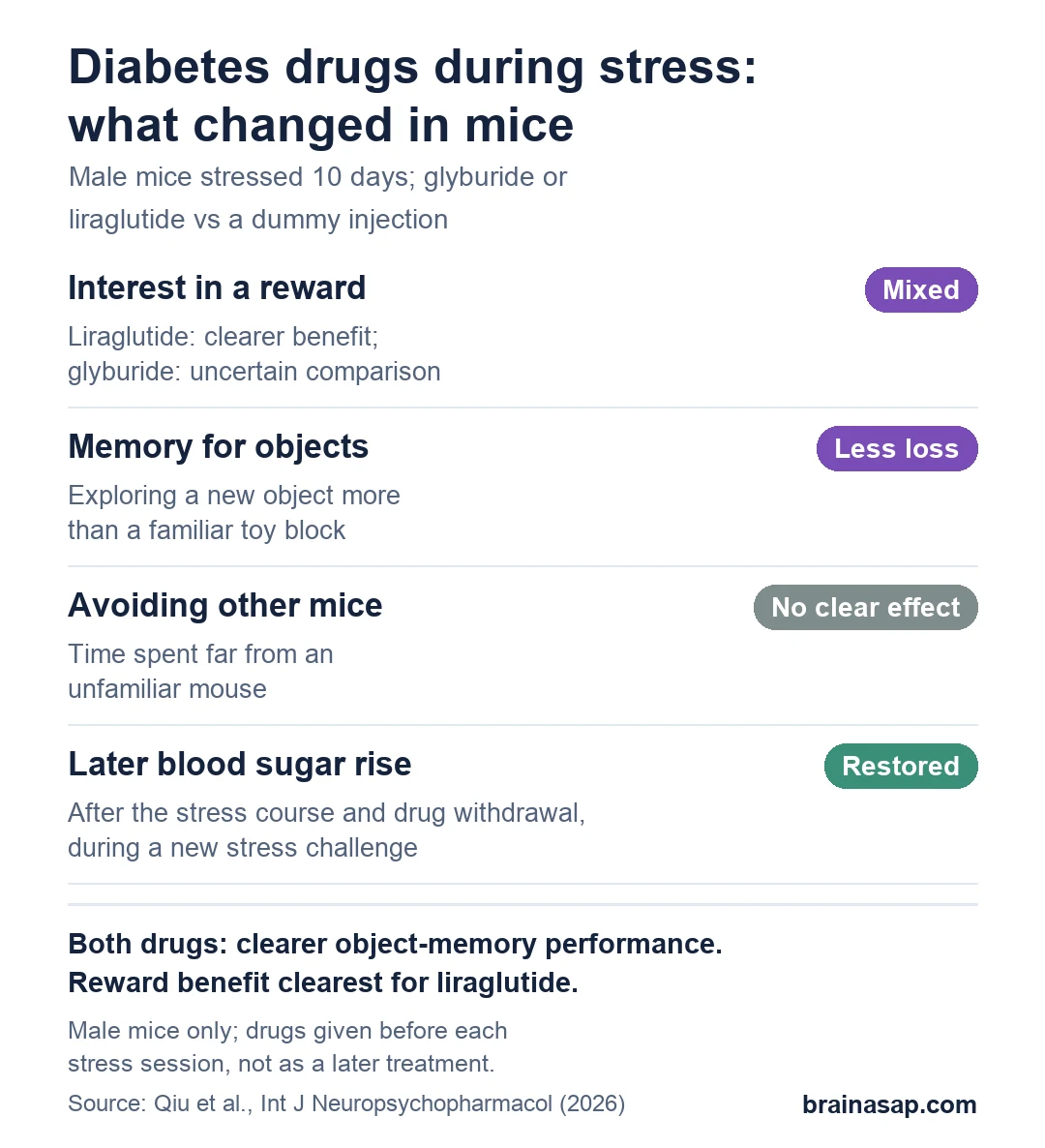
The result? Both drugs improved object-memory performance compared with the dummy injection. Liraglutide also clearly increased female-urine sniffing. Glyburide's sniffing result was uncertain: the figure marks it as a trend, not a clear difference. Neither drug clearly reduced avoidance of an unfamiliar mouse.
In a later stress challenge after the drugs were stopped, both treated groups showed a restored blood sugar rise.
In a small follow-up test with 4 to 6 mice per group, done after the drugs were stopped, drug-treated mice still showed a rise about as large as the one seen after a first stressful session. A smaller test in fragile BALB/c mice, 6 or 7 per group, also showed a clear object-memory benefit with both drugs and a clear reward-seeking benefit with liraglutide; glyburide's reward result remained uncertain.
Why Would Two Different Drugs Do the Same Thing?
This part puzzled the team. Glyburide lowered the blood sugar jump right after a stressful session; liraglutide didn't. At these doses, only glyburide clearly raised insulin.
Both improved object-memory performance and the blood sugar response measured after the stress course and drug withdrawal, despite the less clear reward-seeking result for glyburide. Nagai, Furuyashiki and colleagues suggested the drugs share some other effect on blood sugar control that this study didn't measure, such as after-meal sugar levels. Liraglutide also acts directly on the brain, which could matter too.
What These Mouse Results Can't Show
- Male mice only: Stress, blood sugar and depression-like behavior often differ by sex.
- Prevention, not treatment: Drugs were given before each stressful session. Whether they reverse changes that have already set in wasn't tested.
- Survivors only: Over half of BALB/c mice died during the stress, so the blood sugar drop was measured only in mice that survived.
- Small groups in places: Some blood sugar and hormone tests had only 4 to 6 mice per group.
- Mouse behavior isn't depression: Sniffing and object tests are rough stand-ins for low mood and poor concentration in people.
Could Diabetes Drugs Help People With Depression?
The authors describe early human research on GLP-1 drugs as showing neutral to modest effects on depressive symptoms. That is background cited by the paper, not a treatment benefit established by this mouse experiment.
This mouse study adds a clue: keeping the body's blood sugar response to stress working may help protect against some depression-like changes. What's still unknown is whether that holds in people, and in women as well as men, once stress has already taken its toll.
Citation: DOI: 10.1093/ijnp/pyag046 | Qiu W, Nagai H, Ota K, Nagai M, Furuyashiki T. Chronic social defeat stress induces a hypoglycemic shift and depression-related behaviors, both prevented by antidiabetic drugs. International Journal of Neuropsychopharmacology. 2026;29(9):pyag046.
Study Design: Mouse experiments using 10-day chronic social defeat stress in 3 male strains (C57BL/6N, C57BL/6J, BALB/c); blood glucose, serum hormone/cytokine panels and behavior tests; glyburide (10 mg/kg) or liraglutide (20 nmol/kg) given intraperitoneally 30 min before each stress exposure.
Sample Size: Drug experiments: C57BL/6N vehicle 15, glyburide 13, liraglutide 14; BALB/c 7, 7 and 6. Survival through chronic stress: C57BL/6N 77/85, C57BL/6J 20/22, BALB/c 19/42.
Key Statistic: Both drugs improved novel-object preference (p<0.05 in C57BL/6N). Female-urine sniffing improved clearly with liraglutide (p<0.05); glyburide showed only a trend (p<0.1). These are Figure 3b Holm-Sidak comparisons versus vehicle, not equivalent evidence for both reward effects. Neither clearly reduced social avoidance. Restored glucose responses were measured after drug withdrawal (Figure 4c–d).
Caveat: Male mice only; drugs given during stress, not after; BALB/c chronic-stress data from survivors only; some measures with 4–6 mice per group.