TL;DR: In a 2026 study, 12 healthy volunteers wore a brain-wave cap and silently imagined singing a song, moving a hand or their feet, or doing both at once. A computer told all 8 mental tasks apart about half the time, far better than the 1-in-8 expected by guessing, but still too unreliable for everyday control of a device.
Key Findings
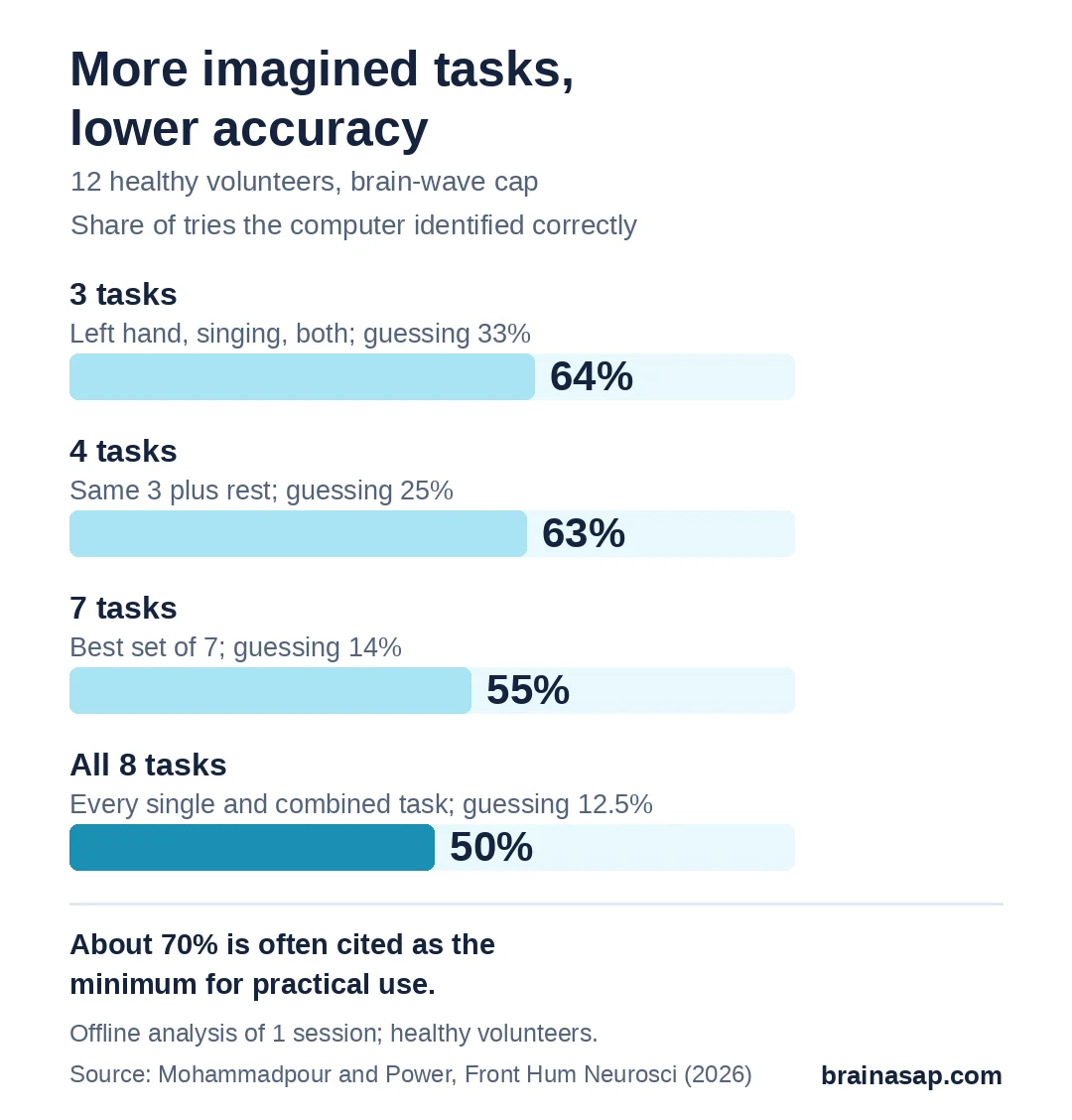
- Combined tasks were recognizable: imagining singing while tapping the left hand could be told apart from singing alone and tapping alone 64% of the time, vs 33% by guessing.
- All 8 tasks, about half right: with every single and combined task plus rest, the computer was correct 50% of the time, vs 12.5% by guessing.
- Below the usual bar for practical use: about 70% accuracy is often cited as the minimum for a usable brain-computer interface; no 7- or 8-task setup reached it.
- Combined tasks felt harder, but got easier: volunteers rated singing-plus-movement as the hardest, though ratings dropped over the session.
- Most still preferred simple tasks: 10 of 12 volunteers said they would rather use a single imagined movement for daily computer use.
Source: Frontiers in Human Neuroscience (2026) | Mohammadpour and Power
Brain-computer interfaces let people control a device just by thinking, which could matter most for people who can’t move. Most systems that read brain waves from a scalp cap rely on imagined movements, such as picturing a left-hand or right-hand movement.
One catch is that each imagined movement gives only 1 command, and there are only so many body parts to imagine.
A 2026 study in Frontiers in Human Neuroscience, by engineers at Memorial University of Newfoundland in Canada, asked whether doing 2 imagined tasks at once could create extra commands.
What Volunteers Imagined
Fourteen healthy, right-handed volunteers wore a 64-electrode brain-wave cap for a single session. Two got too tired and stopped early, so results come from 12. Each person silently imagined 8 different things:
- Single tasks: moving the right hand, the left hand or both feet; singing a song in their head; or resting.
- Combined tasks: singing the song while tapping the right hand, the left hand or the feet to its rhythm.
Why singing? Singing along and tapping to a beat is something most people do naturally, so it might be easier than pairing 2 imagined movements.
Could a Computer Tell the Combined Tasks Apart?
First, the team checked whether each combined task looked different from its 2 parts. For example, could the computer tell singing plus left-hand tapping from singing alone and left-hand tapping alone?
It could, more often than chance. With 3 choices, guessing would be right 33% of the time:
- Left hand + singing: 64% correct
- Right hand + singing: 62% correct
- Feet + singing: 59% correct
Adding rest as a fourth option barely changed accuracy (58% to 63%, vs 25% by guessing).
Singing on its own was the easiest task to recognize. Combined tasks were the hardest: the computer often confused singing-plus-right-hand with right hand alone.
How Many Commands Could This Give?
With all 8 tasks in play, the computer was right 50% of the time on average, compared with 12.5% by guessing. Dropping the task it most often confused, singing plus right hand, raised accuracy to 55% across 7 tasks.
That is far above chance, but not yet good enough to control a device reliably. Researchers often cite about 70% as the minimum for practical use, and none of the 7- or 8-task setups reached it.
Accuracy also varied a lot from person to person, with a typical spread of about 16 percentage points around the 50% average.
What Volunteers Thought of the Tasks
- Combined tasks felt harder: on a 1-to-5 scale, volunteers rated them about 2.6 to 2.9, vs about 1.9 to 2.1 for single tasks.
- They got easier with practice: difficulty ratings fell over the session, more for combined tasks than single ones.
- Feet + singing was the favorite combination, and 9 of 12 preferred using their dominant right hand over the left.
- Single tasks still won overall: 10 of 12 said they would choose a single imagined movement for daily use.
Limits of This Early Test
- 12 healthy volunteers: no one with paralysis took part, and brain signals can differ after injury.
- One session, little training: accuracy might rise with practice, but that wasn’t tested.
- Offline analysis: brain waves were sorted after recording, not used to control anything live.
- Only singing-plus-movement pairs: combinations of 2 imagined movements weren’t tested.
Could Practice Push Combined Tasks Past 70%?
That is the key question for this approach. If several sessions of training, perhaps with live feedback, can lift accuracy above that bar, combined tasks could double the number of commands a simple brain-wave cap offers.
A natural next test would repeat the same tasks over several sessions, including in people who have lost movement.
Citation: DOI: 10.3389/fnhum.2026.1912998. Mohammadpour H, Power SD. Dual imagery tasks for EEG-based brain–computer interfaces: a feasibility study of combinatorial mental state classification. Front Hum Neurosci. 2026;20:1912998.
Study Design: Single-session EEG feasibility study (64 channels); filter bank common spatial patterns with regularized LDA; 3-, 4-, 7- and 8-class offline classification.
Sample Size: 14 healthy right-handed volunteers recorded; 12 analyzed.
Key Statistic: 8-class accuracy 50.3% ± 16.1% (chance 12.5%); 3-class up to 64.1% (chance 33.3%).
Caveat: Healthy volunteers, single session, offline only; accuracies below the ~70% practical threshold.