Sensory-Guided Joint Learning Improved EEG Motor Imagery BCI Accuracy in Healthy Adults

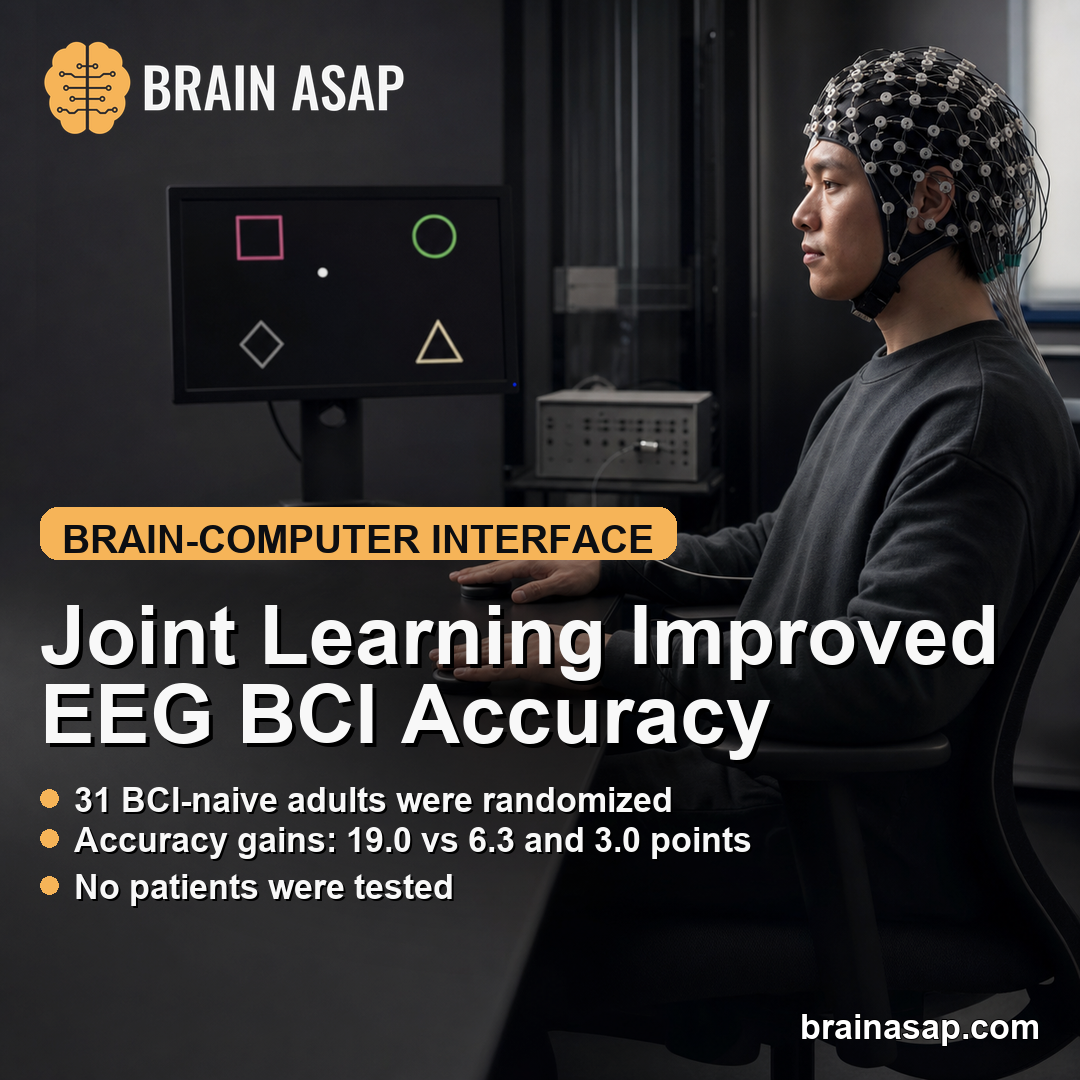
Sensory-Guided Joint Learning Improved EEG Motor Imagery BCI Accuracy in Healthy Adults

TL;DR: A 2026 randomized training study in Nature Communications found that sensory-guided joint learning—a combination of performance-triggered wrist vibration, Copy/New strategy cues, and an adaptive electroencephalography (EEG) decoder—produced a 19.0-percentage-point improvement in motor-imagery brain-computer interface (BCI) accuracy in healthy BCI-naïve adults, versus 6.3 and 3.0 points in two control groups. Key Findings Thirty-one healthy adults …

Read more

Neuropixels Opto Combined Electrophysiology and Optogenetics

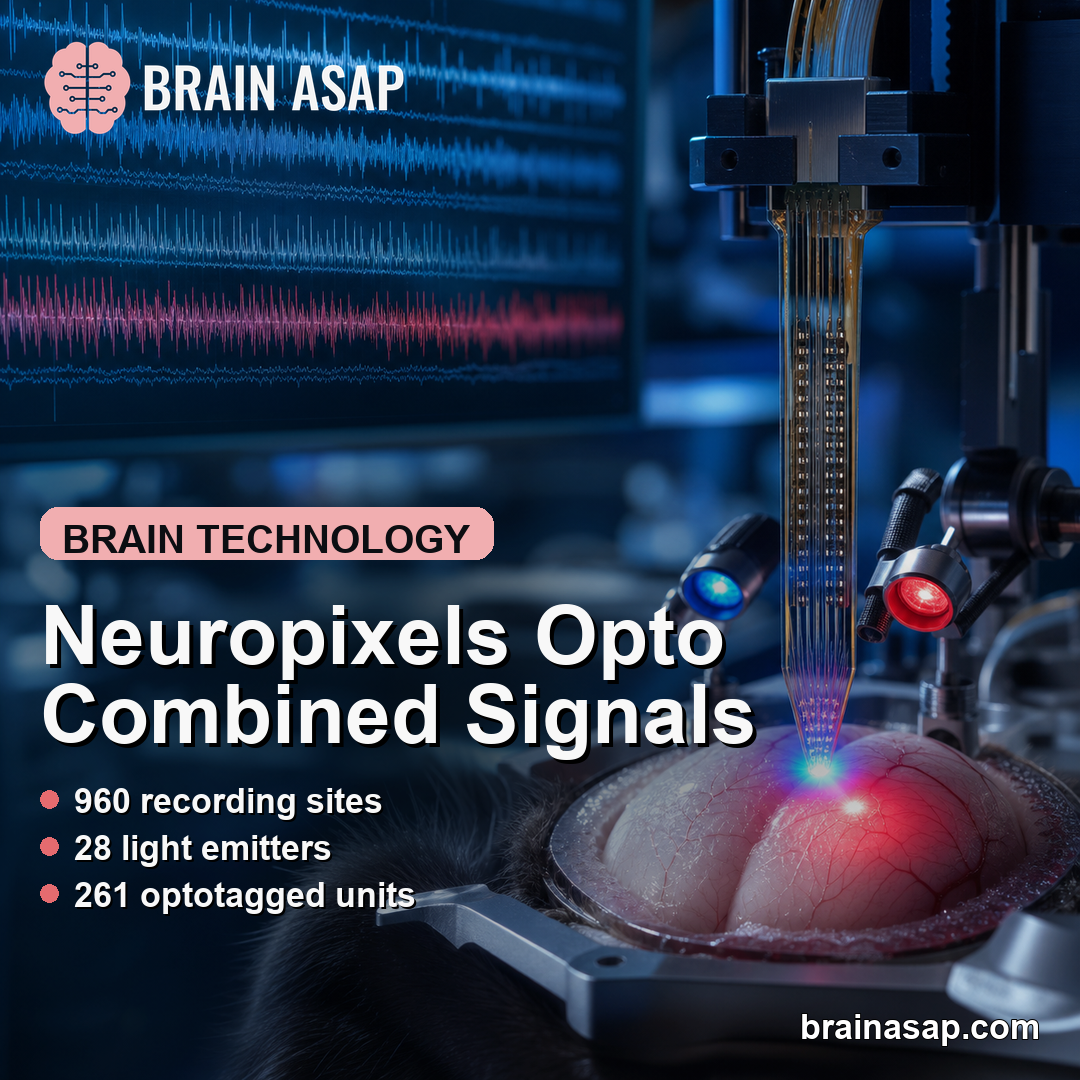
Neuropixels Opto Combined Electrophysiology and Optogenetics

TL;DR: A 2026 methods paper in Nature Methods describes Neuropixels Opto probes that combine high-density neural recording with spatially addressable blue and red optogenetic stimulation in 1 mouse-brain device. Key Findings 960 recording sites: Each prototype probe packed 960 electrical sites on a 70-micrometer-wide, 1-centimeter-long shank. 28 light emitters: Two sets of 14 emitters delivered …

Read more

MoS2 Artificial Neurons Triggered Responses in Living Brain Slices

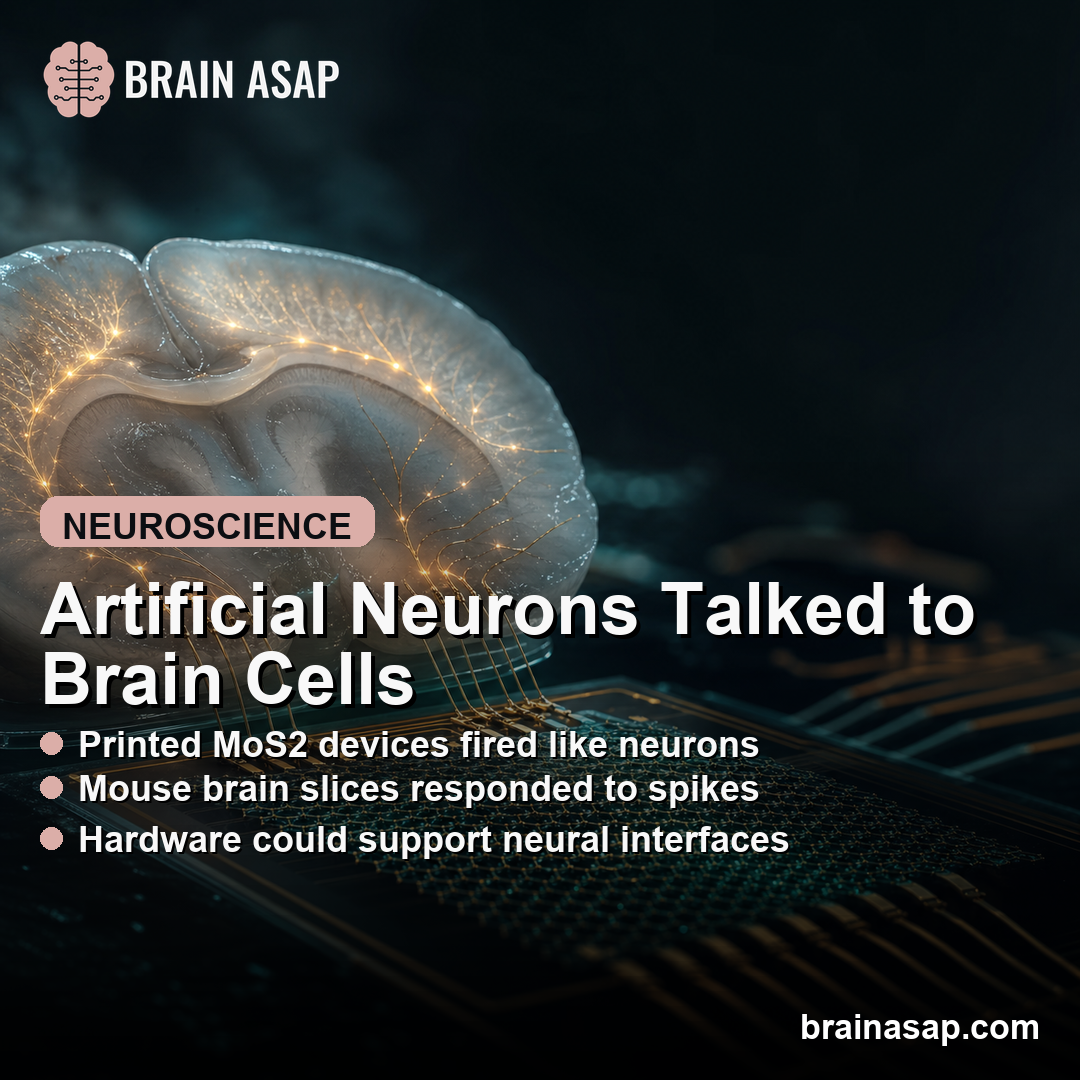
MoS2 Artificial Neurons Triggered Responses in Living Brain Slices

TL;DR: A 2026 study in Nature Nanotechnology reported that printed MoS2 memristive nanosheet networks, electronic devices that can produce neuron-like spikes, triggered responses in living mouse brain slices. Key Findings Artificial spiking neurons: Researchers built printed MoS2 memristive nanosheet networks that generated electrical activity resembling neural spikes. Living-tissue response: In mouse brain-slice experiments, the artificial …

Read more

A Wireless Brain Implant Smaller Than a Grain of Salt Just Recorded Neurons for an Entire Year

The Tiniest Neural Recorder: How Light-Powered Implants Can Monitor the Brain for a Year TL;DR: A nanometer-scale wireless implant (MOTE) powered by light recorded stable brain activity in mice for a full year without tethers or degradation. Recording brain activity for days is routine. Recording for weeks is impressive. Recording for an entire year from …

Read more

Neural Activity in Brain-Machine Interface Manual Reaching Task (Rhesus Monkey Study)

Researchers have gained new understanding of how the brain controls movement using both overt motor control and brain-machine interface (BMI) control. Their findings provide insight into the distinct neural processes involved in BMI control compared to natural movement. Key Facts: Rhesus monkeys were trained to control a cursor using either overt arm movements or a …

Read more

Advances in Electrical Neural Interfaces for Brain Augmentation & Neuroscience Research

Electrical neural interfaces are unlocking new possibilities for studying, restoring, and augmenting brain functions. These devices provide direct communication pathways to connect the nervous system with the external world. Recent innovations in neural electrode design, electronics, wireless transmission, integration of electrical and optical modalities, and neural data processing are rapidly advancing the capabilities of electrical …

Read more

Brain Machine Interfaces: Progress, Applications, Ethical Considerations

Brain-machine interfaces (BMIs) are emerging devices that connect the human brain to computers and machines, enabling an unprecedented two-way flow of information and control. BMIs offer extraordinary new capabilities but also present profound ethical dilemmas we must confront. Key Facts: BMIs acquire brain signals, analyze them via algorithms, and translate them into commands that control …

Read more

Brain-Computer Interfaces: Advances, Applications, Ethics (2023)

Invasive brain-computer interfaces (BCIs) allow for direct communication between the brain and external devices, offering immense potential for restoring lost functions and even enhancing brain capabilities. Recent advances are bringing this emerging technology closer to widespread clinical use. Invasive BCIs involve surgically implanted electrodes to record from or stimulate the brain. This allows for much …

Read more

Neuralink Brain-Machine Interface: High-Bandwidth Connection to Neurons?

Neuralink, a neurotechnology company founded by Elon Musk, has developed a novel brain-machine interface system with unprecedented electrode density and bandwidth. In a recent white paper, Neuralink scientists describe their progress towards a scalable, high-performance implantable device for interfacing with the brain. The key facts: Neuralink’s device has over 3,000 electrodes per array, an order …

Read more

Neuralink & Brain-Computer Interfaces: Future Uses to Consider

Neuralink, a neurotechnology company founded by Elon Musk in 2016, is developing an innovative brain-machine interface (BMI) device that aims to enhance brain function and revolutionize neurosurgery. Early testing on animals shows promise, but human trials are still needed to determine safety and efficacy. If proven viable, Neuralink’s technology could transform treatment for neurological disorders. …

Read more