
TL;DR: In a 2026 study in South Korea, 53 older women with memory problems had a blood test for signs of Alzheimer's disease and a brain scan. Among women with 7 or more years of school, worse blood results went with a thinner outer layer of the brain, as expected; among women with 6 years or less, there was no clear link.
Key Findings
- Women with 7 or more years of school: a higher Alzheimer's blood marker went with a thinner brain cortex in all 5 regions measured.
- Women with 6 years or less: no clear link between the blood marker and cortex thickness in any region.
- No sign of protected thinking: keeping a thicker cortex didn't translate into better scores on a short memory and thinking test.
- Small, one-time snapshot: 53 women from 1 Seoul clinic, measured once.
Source: Journal of Clinical Neurology (2026) | Moon et al.
Doctors often check brain scans for thinning of the cortex, the folded outer layer of the brain, as a sign that Alzheimer's disease is doing damage.
A 2026 study in the Journal of Clinical Neurology, from Konkuk University Medical Center in Seoul, suggests that sign may not read the same way in everyone. How much schooling a woman had changed how closely her brain scan matched her blood test.
Why Schooling Matters in Korea's Older Women
Years of education are often used as a stand-in for cognitive reserve, the idea that a well-trained brain can cope with more damage before problems show.
In South Korea, many women now in their late 70s had little chance to stay in school. In this study, 93% of people with 6 years of school or less were women, so schooling and sex were hard to separate.
To get around that, the team ran its main analysis in women only.
A Blood Test, a Brain Scan and a Memory Test
The study enrolled 80 people (58 women, 22 men), average age 78, who came to a memory clinic between late 2021 and early 2022. Each person had:
- A blood test for 2 proteins linked to Alzheimer's: a form of tau and amyloid-beta. A higher ratio of tau to amyloid points to more Alzheimer's-type change in the brain.
- An MRI scan measuring cortex thickness in 5 regions.
- A short memory and thinking test, the Mini-Mental State Examination (MMSE), scored out of 30.
53 women had complete blood and scan results. They were split into 2 groups by schooling:
- Less schooling: 6 years or less, about elementary school
- More schooling: 7 to 16 years, from middle school up
Worse Blood Results, Thinner Cortex, but Only With More Schooling
Among women with more schooling, a higher tau-to-amyloid ratio went with a thinner cortex in all 5 regions, the pattern doctors would expect.
Among women with less schooling, that link wasn't there. Their cortex stayed about as thick whatever their blood results showed, and the estimates even leaned the other way, though not clearly.
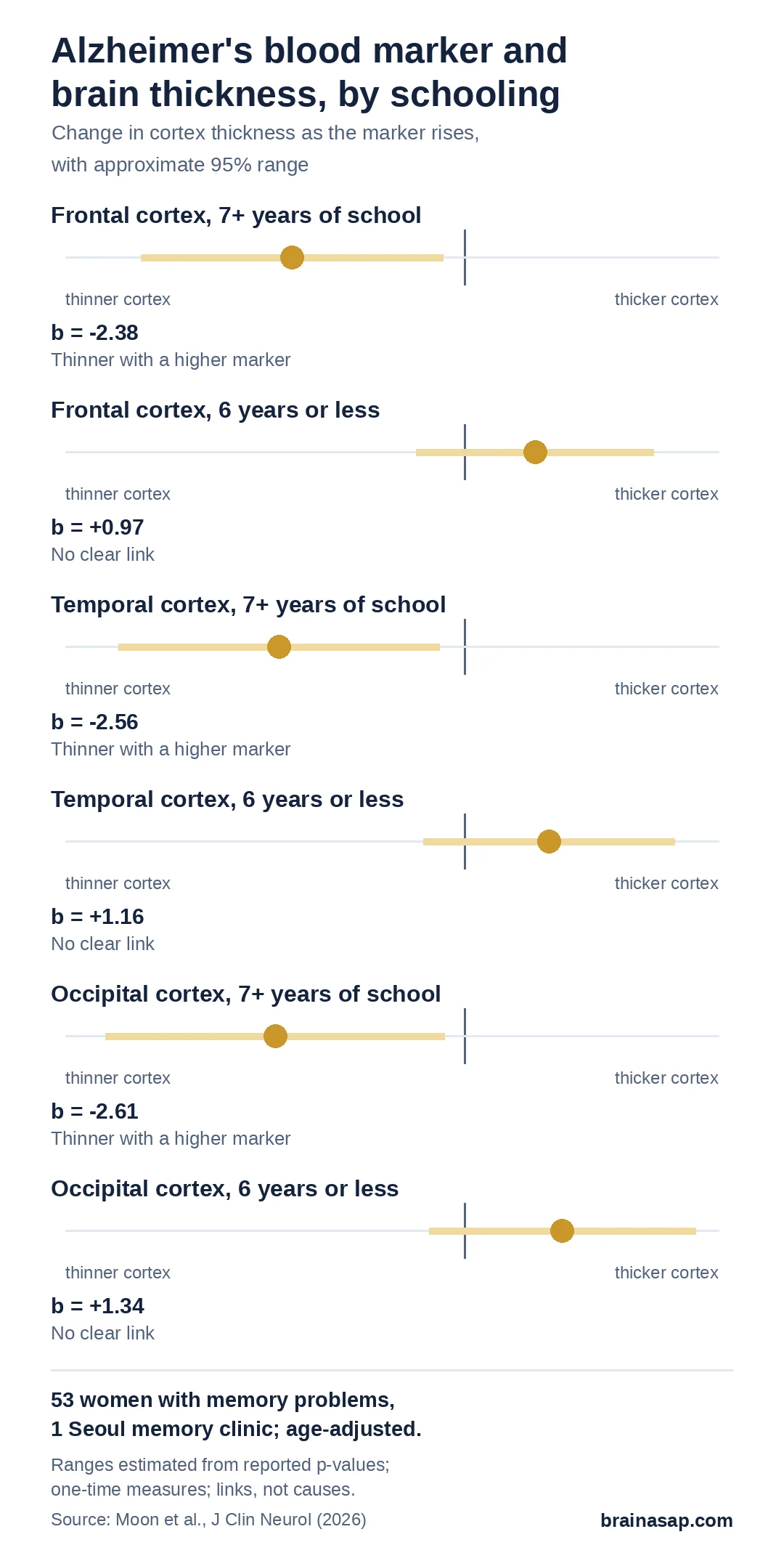
This gap between women with more and less schooling was statistically clear in every region. It held up when the team tried other ways of grouping years of school.
A Thicker Cortex Didn't Mean Better Thinking
If the women with less schooling were truly resisting damage, you might expect their thicker cortex to help their test scores. It didn't: cortex thickness wasn't clearly linked to MMSE scores in any region.
Moon and colleagues suggested the brain's shape may simply lag behind the disease in these women, or that swelling and blood-vessel changes could hide early tissue loss on scans. Neither idea was tested here.
If that's right, a normal-looking scan could underestimate Alzheimer's damage in older women with little schooling.
Limits of a Small Clinic Study
- Small groups: 53 women in the main analysis, from 1 memory clinic in Seoul.
- One snapshot: blood and scans were taken once, so the study can't show whether thinning comes later.
- Rough thinking test: the MMSE is a quick screening tool and may miss subtle changes.
- Men left out: only 3 men had 6 years of school or less, too few to test the same pattern in men.
- Schooling stands in for more: in this generation, years of school also reflect childhood wealth and living conditions.
Reading Scans With Schooling in Mind
The practical point is a caution for doctors: in older women with little formal schooling, a cortex that looks fairly normal on an MRI may not rule out Alzheimer's changes that blood tests can pick up. Following women like these over several years would show whether their cortex eventually thins and when.
Citation: DOI: 10.3988/jcn.2025.0686. Moon Y, Jeon HJ, Kim HJ, Noh MY, Kim SH, Han SH, Kim H, Moon WJ. Education moderates the biomarker–cortical-thickness relationship in females with cognitive decline: a descriptive study with sex comparisons. Journal of Clinical Neurology. 2026;22(5):552-559.
Study Design: Cross-sectional single-center memory-clinic cohort; plasma Aβ42, p-tau181 and total tau (SIMOA); 3T MRI regional cortical thickness; MMSE and CDR-SOB; PROCESS model 7 moderated mediation in females, age-adjusted, 10,000 bootstraps.
Sample Size: 80 patients (58 females, 22 males); 53 females with complete MRI and plasma data in the main analysis.
Key Statistic: Education × p-tau/Aβ42 interaction on cortical thickness significant in all 5 regions (b from −0.569 to −0.918, p from 0.026 to 0.049). High-education conditional effects b −1.95 to −2.61 (p ≤ 0.028); low-education effects not significant. No significant indirect effect on MMSE in any region.
Caveat: Small, single-center, cross-sectional; sex and education heavily confounded (93% of low-education group female); global cognitive screening only.