TL;DR: In a survey of final-year medical students in France, taken right after their 2025 national exam that decides where and in what specialty they train, about 8 in 10 said stress had hurt their concentration that year, and nearly as many said it hurt their sleep.
About 1 in 7 had taken anti-anxiety pills called benzodiazepines, and the calmest students didn't clearly rank better on the exam than the most anxious.
Key Findings
- Stress spilled over: 92% of 192 students said exam-year stress affected daily life, most often concentration (83%) and sleep (79%).
- Professional help and pills: 32% had seen a psychologist or psychiatrist that year, and 15% had used benzodiazepines.
- Women reported more effects: Women more often said stress hurt their concentration (92% vs 63% of men), sleep and learning.
- No clear rank difference: The comparison of students with very low versus high everyday anxiety did not establish a clear difference in national rank.
Source: BMJ Open (2026) | Mathé et al.
In France, a single national exam at the end of medical school ranks about 9,000 students. The higher a student ranks, the more choice they get over their specialty and the hospital where they train.
How do students cope with that kind of pressure? A 2026 study in BMJ Open, by Amandine Mathé, Etienne Riviere and colleagues at the University of Bordeaux, asked them minutes after the last part of the exam.
A Survey Handed Out in the Exam Exit Room
The national exam has 2 parts: a written knowledge test in October, and a hands-on clinical exam the following May, where students rotate through stations with simulated patients.
Right after the second day of that clinical exam in 2025, all 387 Bordeaux students were handed an anonymous paper questionnaire. 192 filled it in.
- Women: 69%
- Median age: 25
- Asked about: stress and its effects over the exam year, ways of coping, therapy, medication, and a standard anxiety questionnaire
That anxiety questionnaire gave 2 scores: how anxious students felt right then, after the exam, and how anxious they tend to be in daily life. Answers were later linked to each student's final national ranking without revealing names.
How Much Did Stress Affect Daily Life?
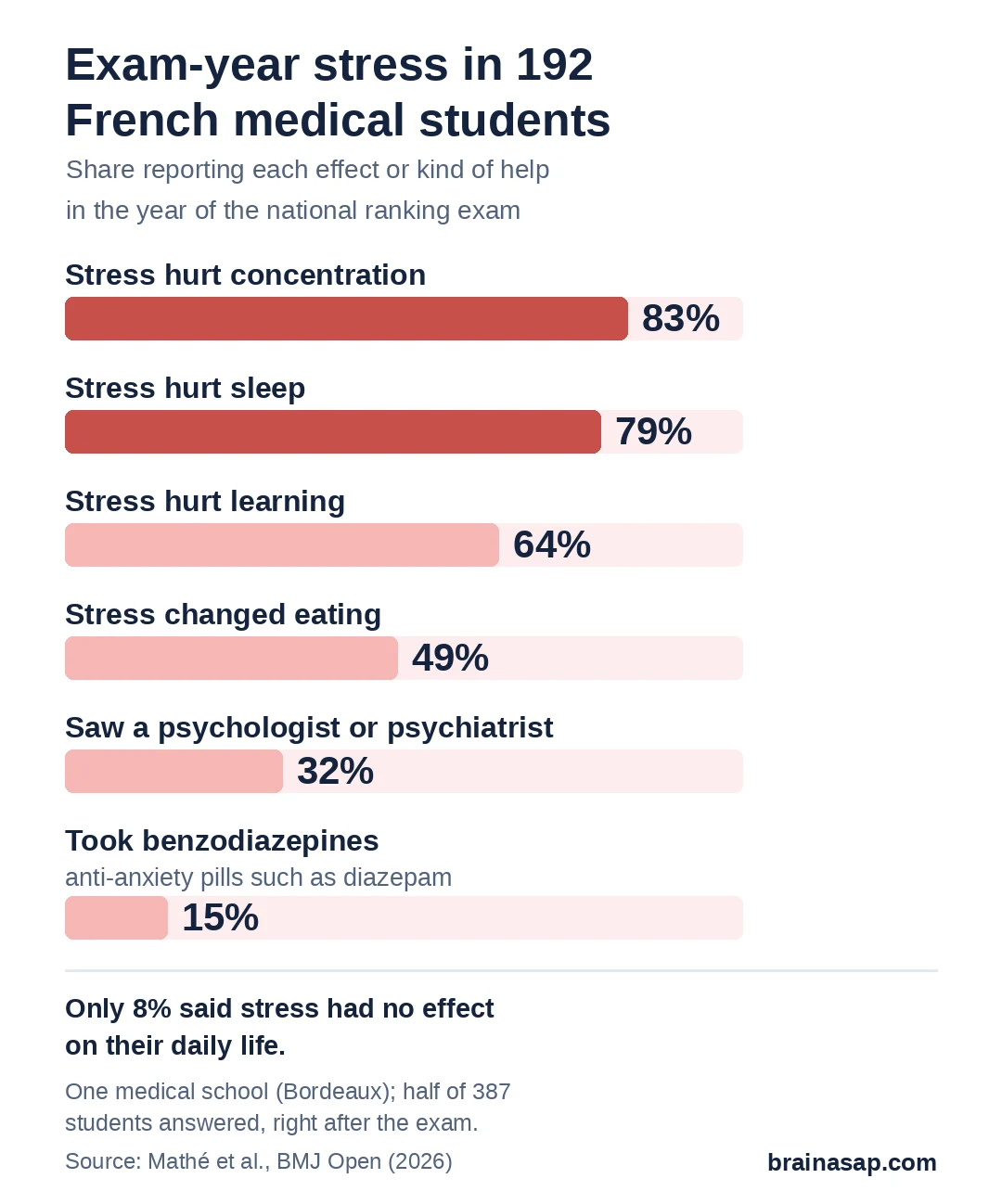
Only 8% said stress hadn't affected their daily life. On a 0-to-10 scale, students rated the clinical exam a bit more stressful (median 8) than the written test (median 7).
Women reported more effects than men in every area asked about:
- Concentration: 92% of women vs 63% of men
- Sleep: 84% vs 68%
- Learning: 72% vs 47%
- Eating: 55% vs 35%
Women also scored higher on the everyday-anxiety questionnaire, and more had seen a psychologist or psychiatrist that year (38% vs 18% of men).
Sport, Breathing Exercises and Pills
Most students tried something to manage stress:
- Regular sport: 86%
- Breathing exercises: 61%, such as slow, paced belly breathing
- A faculty online course on exam stress: 17%
- Yoga or meditation: very few, 3% or less each
Medication was common too. 29 students (15%) said they had taken benzodiazepines, such as diazepam or alprazolam, during the year before the exam. A few more mentioned antidepressants or other drugs, even though the survey didn't ask about them.
Did Calmer Students Rank Higher?
Of the 192 respondents, 176 completed the anxiety questionnaire. Researchers compared 2 groups at opposite ends of the everyday-anxiety scale:
- Rarely anxious students: 24 with very low scores
- Often anxious students: 46 with high or very high scores
The result? Final national rankings didn't differ clearly between the 2 groups. Rank data were available for 20 of the 24 rarely anxious students and 37 of the 46 often anxious students. This small comparison did not prove that anxiety makes no difference. Both groups rated the exams as very stressful.
How they coped did differ. Rarely anxious students more often played sport, and only 1 rarely anxious student had used benzodiazepines, compared with 10 often anxious students. The abstract reports the latter result as 10 of 37, but does not explain why that denominator differs from the 46 students in the group. Only 1 rarely anxious student had seen a psychologist or psychiatrist, compared with 19 of 46 often anxious students.
Using a stress-management strategy, or several, showed no clear link to a better ranking either.
Limits of a One-Day Snapshot
- One medical school: Bordeaux students may not reflect all of France.
- Half answered: Students who filled in the survey ranked better on average (median rank about 3,360 vs 4,880 for those who didn't), so struggling students may be underrepresented.
- Timing: Filling in a survey minutes after a big exam may color how people remember the year.
- Self-made questionnaire: Questions about coping and medication weren't a validated tool, and how often or how well students used each strategy wasn't measured.
- No cause and effect: A single survey can't show whether sport lowers anxiety, or whether calmer students just play more sport.
Should Medical Schools Rethink High-Stakes Rankings?
Mathé, Riviere and colleagues argued that schools should look at how the exam itself is designed, not just offer stress tips, and should track student well-being over time.
What remains unclear is whether changes such as practice clinical exams or earlier support actually reduce stress, sleep problems and medication use, without hurting how well students learn medicine.
Citation: DOI: 10.1136/bmjopen-2026-125171 | Mathé A, Tison F, Sztark F, et al. Stress, coping profiles and anxiety among French final-year medical students in a high-stakes national ranking examination: a cross-sectional study. BMJ Open. 2026;16:e125171.
Study Design: Single-center cross-sectional paper survey (40 items, including STAI-Y state and trait) given immediately after the 2025 national OSCE; responses linked anonymously to final national rank.
Sample Size: 192 of 387 invited sixth-year students at the University of Bordeaux (50%; 132 women, 60 men); 176 completed the STAI-Y.
Key Statistic: Stress affected daily life in 92%; attention 83%, sleep 79%, learning 64%, eating 49%; psychologist/psychiatrist 32%; benzodiazepines 15%. Very low vs high/very high trait anxiety: rank p = 0.1; benzodiazepines 1/24 vs 10/37 (p = 0.003); psychological follow-up 1/24 vs 19/46 (p < 0.0001).
Caveat: One faculty; 50% response with better-ranked responders; non-validated coping and medication items; cross-sectional, no causal inference.