TL;DR: In a 2026 study of about 75,000 American adults with type 2 diabetes on Medicaid, people who had filled a prescription for a newer diabetes drug such as Ozempic or Trulicity were slightly more likely to be newly diagnosed with depression the next year than people who hadn't.
After accounting for other differences between the 2 groups, the gap was less than 1 in 100 people, and the study's design can't show the drugs caused it.
Key Findings
- Small gap in new depression diagnoses: Over 1 year, about 13 in 100 GLP-1 users had a newly recorded depression diagnosis, compared with about 11 in 100 people with diabetes who weren't using these drugs.
- Even smaller after adjustment: Once researchers accounted for differences such as obesity, age and substance use, the estimated gap shrank to 12.1% vs 11.3%, statistically clear but small.
- Not proof of harm: The study used insurance billing records, so it couldn't check diabetes severity, blood sugar levels or how often people saw a doctor, all of which could explain the gap.
Source: Healthcare (2026) | Ndiulor et al.
GLP-1 drugs such as semaglutide (Ozempic) are used to treat type 2 diabetes. They lower blood sugar and help with weight loss.
Because these drugs also act on the brain's appetite and reward systems, people have asked whether they might affect mood, for better or worse.
A 2026 study in Healthcare, by Michelle Ndiulor, Usha Sambamoorthi and colleagues at UNT Health in Fort Worth, Texas, looked at that question in a group often left out of drug trials: working-age adults on Medicaid.
Who Was in the Medicaid Records?
Researchers used billing records from Medicaid programs in several US states. They included 74,760 adults aged 18 to 64 who had type 2 diabetes, stayed on Medicaid through 2022 and 2023, and had no depression diagnosis on record in 2022.
People were sorted into 2 groups based on pharmacy records from 2022:
- GLP-1 users: filled at least 1 prescription for a GLP-1 drug, such as dulaglutide (Trulicity), liraglutide, semaglutide (Ozempic) or tirzepatide (Mounjaro); 14,953 people, or 1 in 5
- Non-users: had diabetes but filled no GLP-1 prescription that year; 59,807 people
The team then checked who had a newly recorded depression diagnosis in 2023. A depression-free baseline year does not establish that this was their first lifetime episode. The drugs were pooled, so the study did not estimate a separate effect for Ozempic or any other individual product.
How Much More Common Was Depression?
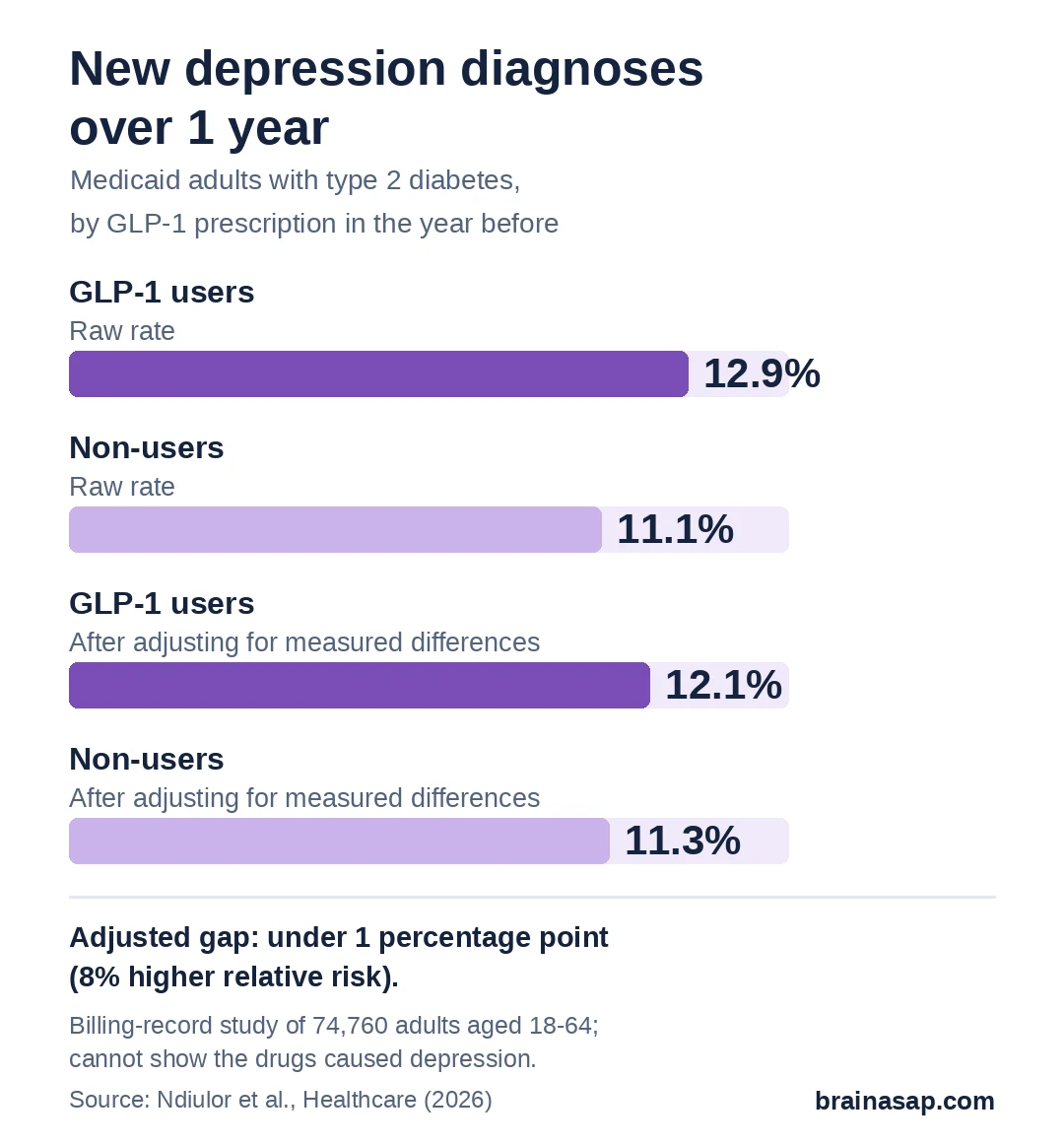
Before any adjustment, 12.9% of GLP-1 users and 11.1% of non-users were newly diagnosed with depression, a gap of about 2 people in 100.
GLP-1 users differed in other ways, though. They were more likely to be women, middle-aged, white and to have a recorded diagnosis of obesity, and women and people with obesity also had higher depression rates in this group.
Researchers ran 3 different statistical methods to even out those measured differences. Each gave nearly the same answer:
- Estimated risk: 12.1% for GLP-1 users vs 11.3% for non-users
- Relative difference: about 9% to 10% higher odds across the logistic models; a separate risk-ratio model estimated 8% higher risk
- Absolute difference: less than 1 percentage point
With nearly 75,000 people, even a small gap can be statistically clear without meaning much for any one patient. Ndiulor and colleagues made the same point, writing that the result should not be read as a large clinical effect.
Why the Drugs May Not Be the Cause
- Billing records only: Records showed who had a depression diagnosis coded, not who actually had depression, and missed people who were never diagnosed.
- More doctor visits, more diagnoses: People prescribed newer drugs may see doctors more often, giving more chances for depression to be noticed.
- Missing health details: No blood sugar levels, years with diabetes or other diabetes medicines such as insulin, any of which could differ between groups.
- A single prescription counted: Filling 1 GLP-1 prescription in 2022 was enough to count as a user, and 12% of non-users started a GLP-1 drug in 2023.
- Not compared with another diabetes drug: Non-users were a mixed group at different stages of treatment, rather than people starting a similar alternative.
- One population: Medicaid adults under 65 only; results may differ for older adults or people with private insurance.
How This Fits With Earlier Research
Results on GLP-1 drugs and mood have been mixed. In its January 13, 2026 safety review, the FDA reported that a pooled analysis of 91 placebo-controlled trials found no increased risk of suicidal thoughts or behavior, or of relevant psychiatric events including depression.
The FDA review led the agency to request removal of the suicidal-thoughts-and-behavior warning from certain GLP-1 weight-loss drug labels. That broader evidence should be considered alongside this observational signal.
Some observational studies and reports to the FDA's side-effect database, however, have flagged more depression among users.
This Medicaid study adds a small signal on the same side, from a design that can't separate the drug from the person taking it.
Comparing GLP-1 Drugs With Other Diabetes Medicines Is Needed
For people with type 2 diabetes on these drugs, this study alone doesn't suggest stopping them, and the gap it found was small.
Ndiulor and colleagues called for studies that compare people starting a GLP-1 drug with people starting a different diabetes drug at the same stage, such as an SGLT2 inhibitor like Jardiance, and that check mood with standard questionnaires rather than billing codes.
Anyone who notices a change in mood after starting any new medicine should mention it to their doctor.
Citation: DOI: 10.3390/healthcare14182971 Ndiulor M, Wang H, Neba R, Rasu R, Zhou B, Sambamoorthi U. Association Between Baseline Glucagon-like Peptide-1 Receptor Agonist Use and Newly Documented Depression Diagnosis in Adults with Type 2 Diabetes: A Multi-State Medicaid Cohort Study. Healthcare. 2026;14(18):2971.
Study Design: Retrospective claims-based cohort (Merative MarketScan Multi-State Medicaid, 2022–2023); GLP-1 RA dispensing in 2022 (landmark exposure) vs newly documented depression in 2023; multivariable logistic regression, inverse probability weighting and doubly robust estimation.
Sample Size: 74,760 adults aged 18–64 with type 2 diabetes and no baseline depression (14,953 GLP-1 RA users; 59,807 non-users).
Key Statistic: New depression diagnosis 12.9% vs 11.1% (unadjusted); adjusted OR 1.10 (95% CI 1.04–1.16); adjusted risk 12.11% vs 11.25% (RR 1.08, 95% CI 1.02–1.13; difference 0.85 percentage points).
Caveat: Observational; claims-coded outcome; no HbA1c, diabetes duration or concurrent diabetes drugs; prevalent-user, non-active-comparator design; possible detection bias and residual confounding.