TL;DR: In a survey of 333 doctors, pediatricians and pharmacists in Azerbaijan, most said they routinely use general painkillers and the antidepressant amitriptyline for headaches. Only about 1 in 7 routinely prescribe triptans, and none reported using beta-blockers to prevent migraine.
Key Findings
- 333 providers: Neurologists, GPs, pediatricians and pharmacists, surveyed in 2024 and 2025.
- Anti-inflammatories led acute care: 67% routinely use them.
- Triptans less common: 15% routinely prescribe these migraine-specific drugs.
- Amitriptyline led prevention: 76%, then magnesium at 51%.
- No beta-blockers reported for prevention, though they're a standard first choice.
Source: Frontiers in Neurology (2026) | Amirguliyev et al.
Migraine is one of the world's leading causes of disability, and how well people are treated depends a lot on where they live. In many lower- and middle-income countries, little is known about what headache care actually looks like day to day.
A team of headache specialists from Azerbaijan, Turkey and the United States ran the first national survey of headache care providers in Azerbaijan.
A Survey of Four Kinds of Providers
Between December 2024 and May 2025, 333 health professionals answered questions on their training, the medicines they use and the patients they see:
- General practitioners: 28%
- Neurologists: 26%
- Pediatricians: 24%
- Pharmacists: 22%
All of them said their training covered migraine diagnosis and treatment, though the survey didn't check how deep that training went. Most worked in city hospitals. Few worked in rural areas, and none in community health centers.
General Painkillers Came First
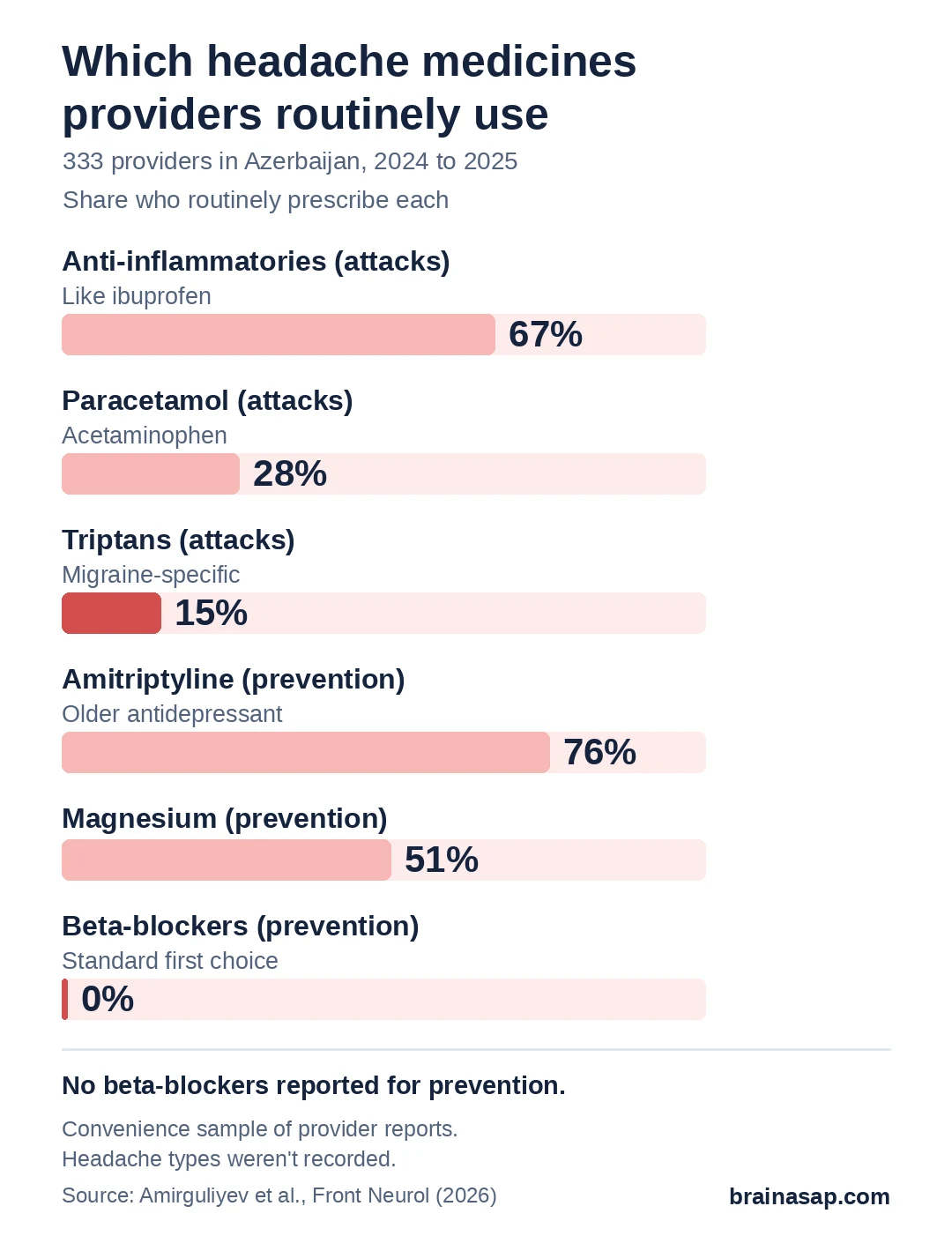
For treating a headache as it happens, providers most often relied on anti-inflammatory painkillers like ibuprofen, followed by paracetamol (acetaminophen). Triptans, drugs designed to stop migraine attacks, were routinely used by about 15%.
The authors caution against reading low triptan use as poor care. Many patients likely had tension-type headaches, where ordinary painkillers are the right first step.
Prevention Leaned on Amitriptyline, Never Beta-Blockers
For preventing frequent headaches, three-quarters of providers used amitriptyline, an older antidepressant often used for migraine and tension-type headache. About half used magnesium, and about a quarter each used gabapentin or valproate.
The researchers found that nobody reported using beta-blockers such as propranolol for migraine prevention. These drugs are cheap and recommended worldwide as a first-line option. The authors call this the most notable gap, since unlike triptans, it doesn't depend on how many patients had migraine.
Newer migraine drugs that block a pain molecule called CGRP, including monthly injections and gepant pills, weren't available in the national health system at the time.
Better-Educated Patients Saw Neurologists
Providers' estimates of their patients hinted at uneven access. Neurologists reported more patients with college or postgraduate education, while general practitioners reported more patients with high school education or less. Across all groups, most headache patients were women.
A Convenience Sample of Opinions
- Not representative: Recruited through professional networks; no response rate.
- Perceptions, not records: Patient details were providers' estimates.
- No diagnoses: Couldn't tell migraine from other headaches.
- City-heavy: Rural providers were underrepresented.
- Snapshot: Can't show trends over time.
Why Beta-Blockers Go Unused Is the Next Question
This survey gives a first rough map of headache care in Azerbaijan: widely trained providers, mostly in cities, relying on familiar general medicines. The striking gap is preventive beta-blockers. Patient-level studies that confirm diagnoses could show whether people with frequent migraine are missing out on cheap, proven prevention.
Citation: DOI: 10.3389/fneur.2026.1886668. Amirguliyev S, Özge A, Uludüz D, Taşdelen S, Şaşmaz T, Burstein R. Healthcare providers' perspectives on headache care in Azerbaijan: results of a national cross-sectional survey. Front Neurol. 2026;17:1886668.
Study Design: National cross-sectional convenience-sample survey (modified HARDSHIP questionnaire).
Sample Size: 333 healthcare professionals (neurologists 25.9%, GPs 27.9%, pharmacists 21.9%, pediatricians 24.3%).
Key Statistic: Routine prescribing: NSAIDs 67.3%, paracetamol 27.6%, triptans 15.0%, amitriptyline 75.7%, magnesium 51.1%, beta-blockers 0%.
Caveat: Convenience sample; provider-reported perceptions; no patient-level diagnoses.