TL;DR: In a reanalysis of a small trial, 15 healthy adults who practiced slow, paced breathing with a heart-rate app for 8 weeks showed shifts in how some brain areas influence each other, compared with 17 who played phone games. The findings are a preprint, and they don't show any health or mood benefit.
Key Findings
- 32 healthy adults: 15 did breathing biofeedback, 17 played phone games, both 5 times a week.
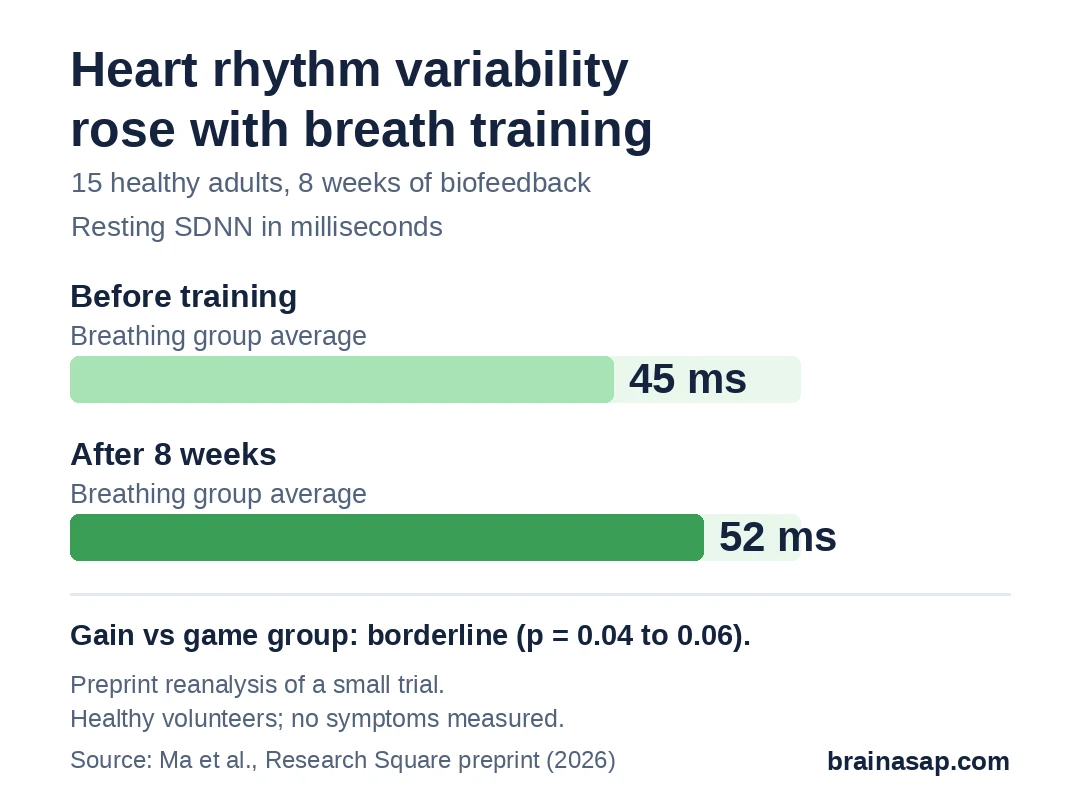
- Heart rhythm variability rose: From about 45 to 52 milliseconds in the breathing group.
- Stronger front-of-brain influence: On the anterior cingulate and both sides of the thalamus.
- One memory-area pathway weakened: Hippocampus to a prefrontal control area, on the right side.
- Preprint reanalysis: Public data, not a new trial.
Source: Research Square preprint (2026) | Ma et al.
Slow breathing at about six breaths a minute makes your heart rate rise and fall in big, smooth waves. Heart rate variability biofeedback trains people to find that rhythm using a live heart-rate display. Earlier studies suggest it can ease stress, anxiety and low mood.
How it might do that inside the brain is less clear. A team led by researchers at Virginia Commonwealth University reanalyzed publicly shared brain scans from an earlier trial to look at which brain areas drive which.
Paced Breathing Versus Phone Games for 8 Weeks
The original trial randomly assigned 32 healthy adults, average age about 29, to one of two programs:
- Breathing biofeedback (15 people): Slow breathing guided by a smoothed heart-rate curve on a phone, aiming to make the waves as big as possible.
- Game group (17 people): Fast-paced jump-and-run phone games on the same schedule.
Both groups trained 5 times a week, four times at home and once in the lab, with two 11-minute runs per session. Everyone had a resting brain scan and heart recording before and after.
Heart Rhythm Variability Went Up
The main heart measure was SDNN, a summary of how much the time between heartbeats varies. Higher values generally mean a more flexible nervous system.
A second heart measure, RMSSD, which reflects quick beat-to-beat changes, didn't change.
The Front of the Brain Gained Influence
The team used a modeling method called dynamic causal modeling. It estimates not just whether two brain areas are active together, but which one seems to drive the other. They focused on 12 regions involved in controlling heart rate and emotion.
Compared with the game group, the breathing group showed new influence from the medial prefrontal cortex, a front-of-brain area tied to self-regulation, on:
- Anterior cingulate cortex: Involved in emotion and attention.
- Thalamus, both sides: A relay hub for body and sensory signals.
These links weren't present in the game group after training. The authors read this as more "top-down" control. But these changes didn't track how much a person's heart variability improved.
A Memory-Area Pathway Moved the Other Way
One pathway from the right hippocampus, a memory and stress area, to a right-side prefrontal control region became negative in the breathing group. In that group, people whose heart variability rose more showed a larger shift. The game group showed no such link. This pathway wasn't part of the original hypotheses.
A Small Reanalysis That Hasn't Been Peer Reviewed
- Preprint: Not yet peer reviewed.
- Secondary analysis: Reused public data from a trial designed for other questions.
- Small groups: 15 and 17 people.
- Modeled, not measured: Brain "influence" is a model estimate from MRI signals.
- Limited map: Only 12 regions included.
- Healthy volunteers: No anxiety, depression or heart patients, and no symptoms measured here.
- Borderline heart effect: Group difference p = 0.04 to 0.06 depending on analysis.
Does This Brain Shift Matter for Stress or Mood?
Paced breathing is cheap and low-risk, and this study adds a possible brain angle to why it might help. But it doesn't show that anyone felt calmer or healthier. The open question is whether the same brain changes appear in people who use biofeedback for anxiety, depression or addiction, and whether they track real symptom relief.
Citation: DOI: 10.21203/rs.3.rs-10895585/v1. Ma L, Steinberg JL, Eddie D, Hardy A, Zuniga EA, Vassileva J, Bjork JM, Snyder AD, Keen LD II, Gonzalez R, Abbate A, Moeller FG. Directional Brain Connectivity Changes Induced by Heart Rate Variability Biofeedback: A Spectral Dynamic Causal Modeling Study. Research Square [preprint]. Posted September 20, 2026.
Study Design: Secondary spectral DCM analysis of a randomized open dataset (OpenNeuro ds003357).
Sample Size: 32 healthy adults (15 HRV biofeedback, 17 video game control).
Key Statistic: mPFC→ACC and mPFC→bilateral thalamus effective connectivity increased vs control (posterior probability 1); SDNN 44.6 → 52.0 ms in biofeedback group.
Caveat: Preprint, not peer reviewed; small healthy sample; 12-region model; between-group SDNN change p = 0.04 (raw) / 0.06 (log).