
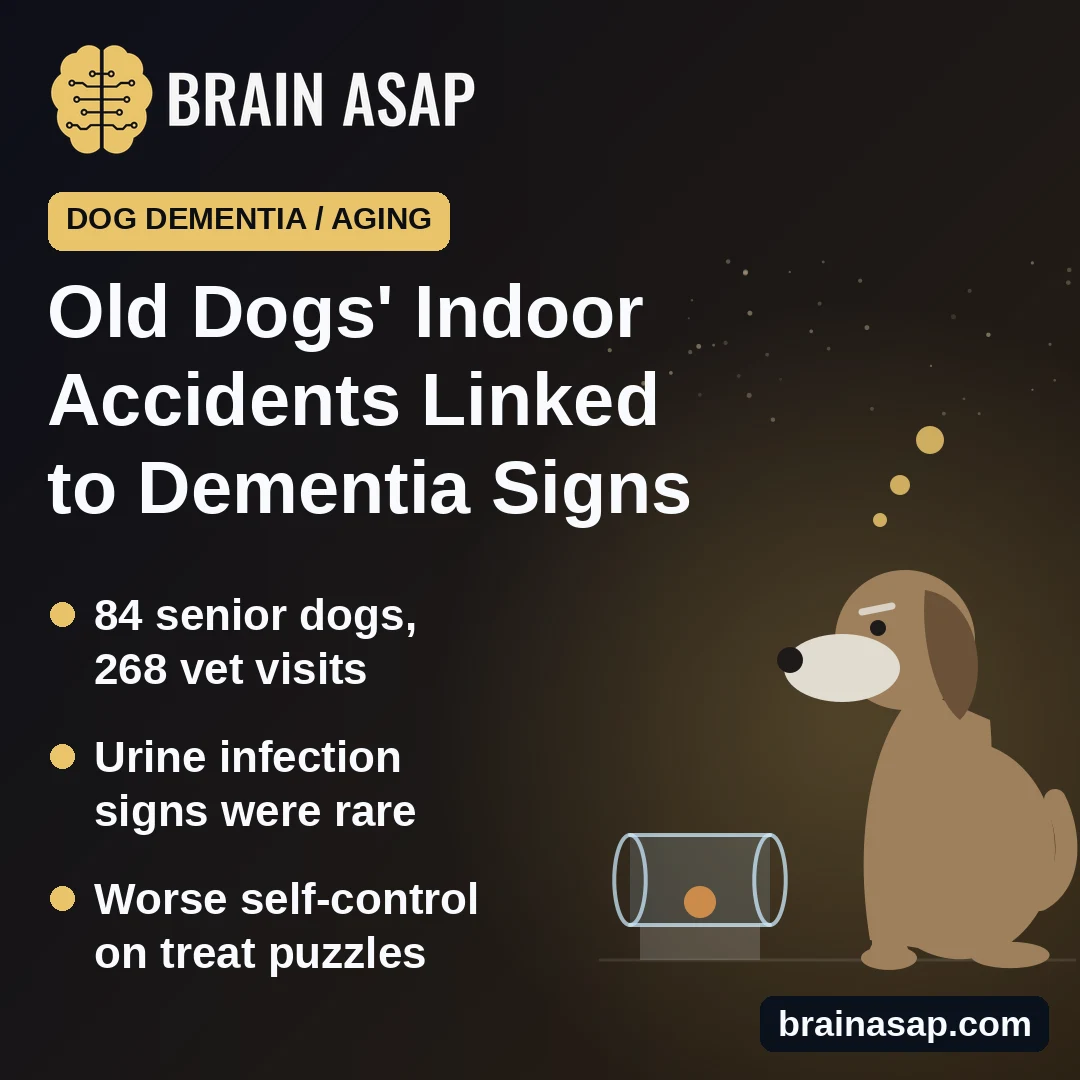
TL;DR: In 84 older pet dogs followed over several years, more indoor accidents went along with worse self-control on treat puzzles, while signs of urine infection were rare and not linked to the accidents. It's a hint that house soiling in old dogs may often reflect a declining mind, not just a bladder problem.
Key Findings
- 84 senior dogs, 268 visits: Average age about 13 at enrollment.
- Infection signs were rare: Bacteria in 11 of 231 urine samples, white blood cells in 19.
- Not linked to accidents: Bacteria and white blood cells showed no clear tie to soiling scores.
- Age and dilute urine were: Older dogs and dogs with more watery urine had more accidents.
- Self-control slipped: Dogs with more accidents did worse on two problem-solving tasks.
Source: Journal of Veterinary Internal Medicine (2026) | Rafatpanah Baigi et al.
When an old, well-trained dog starts having accidents in the house, most owners assume a bladder infection. Vets often check the urine first for the same reason. But dogs, like people, can develop dementia, and losing house training is one of its known signs.
A team at North Carolina State University's vet school asked which explanation fits better in aging pets.
Senior Pet Dogs Tested Twice a Year
The dogs belonged to owners enrolled in a long-running study of brain aging. Between 2019 and 2025, 84 dogs late in their expected lifespan came in about every six months. At each visit the researchers:
- Tested urine: Checked for white blood cells, red blood cells, bacteria, protein and how concentrated it was.
- Asked owners: Owners filled out the Canine Dementia Scale, which includes questions on indoor accidents.
- Ran thinking tests: Attention, short-term memory, following a pointing finger, and two puzzle tasks with a clear tube.
In the first tube task, a treat sits inside a see-through cylinder open at both ends. The dog has to resist bumping its nose into the clear side and go around to an opening. That measures self-control. The second task blocks the dog's favorite side, so it must find another route, which tests flexible problem-solving.
Urine Problems Were Less Common Than Expected
Of 231 urine tests, only about 13% showed anything beyond mild protein:
- White blood cells (a sign of inflammation): 19 samples
- Red blood cells: 14 samples
- Bacteria: 11 samples
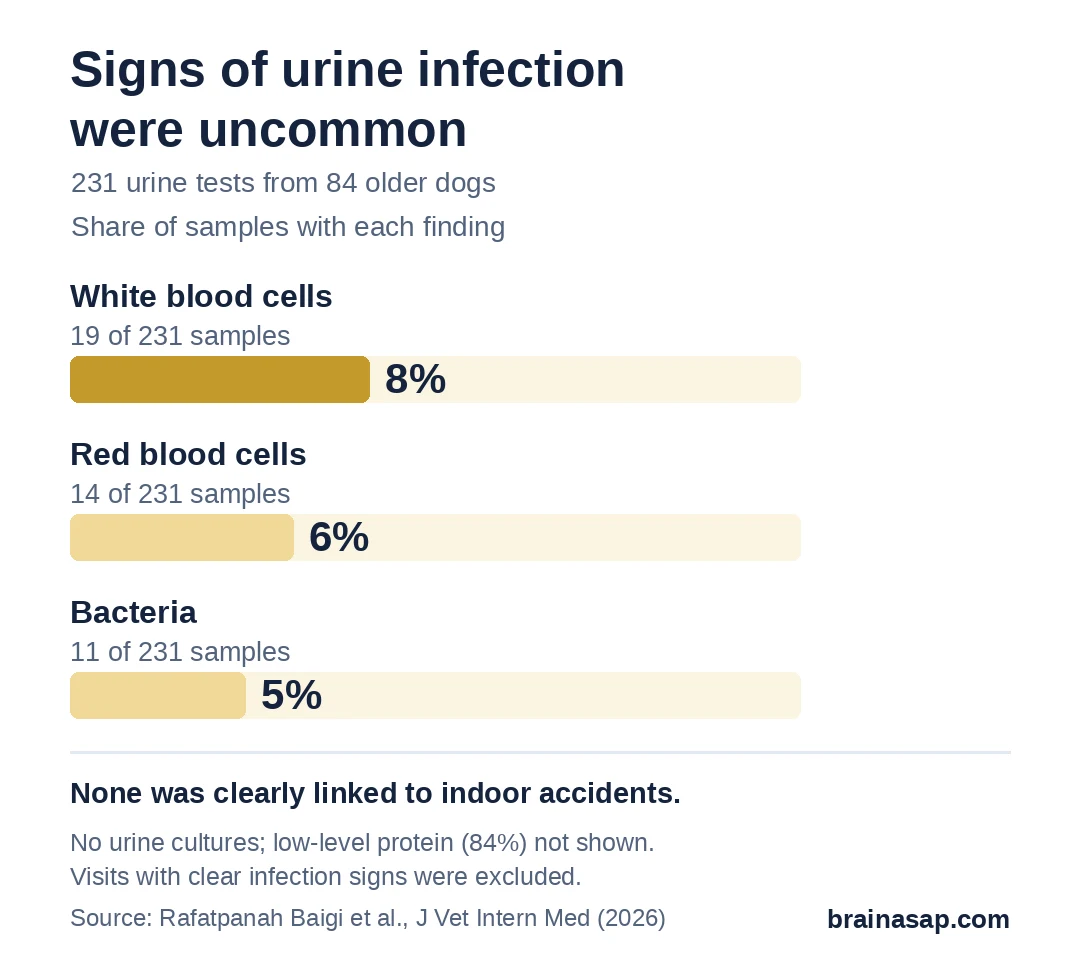
Protein showed up in 84% of samples, mostly at low levels. Female dogs had about 2.5 times the odds of bacteria in their urine.
Accidents Rose With Age and Watery Urine
Older kidneys lose some ability to concentrate urine, and that showed here: urine got more dilute as dogs aged. Soiling scores also climbed with age, by an estimated 71% for each extra year.
After accounting for age, more dilute urine was still linked to more accidents. Each small step up in urine concentration (0.001 on the specific gravity scale) went with about a 2.4% lower soiling score.
Bacteria and white blood cells in the urine were not linked to soiling scores in the adjusted model.
Dogs With More Accidents Struggled With Self-Control
The thinking tests told a clearer story. After adjusting for age, each extra point on the soiling score went with:
- Self-control task: 1.1 percentage points fewer correct tries
- Detour task: 0.8 percentage points fewer correct tries
Attention and short-term memory tracked age instead of accidents. Following a pointing finger wasn't linked to age, urine or soiling at all.
The authors suggest indoor accidents may reflect weaker impulse control and decision-making, not only confusion about where the door is. That fits earlier reports that losing house training tends to appear later in canine dementia.
A Healthy, Small Group With Untested Urine Cultures
- Observational: Links, not proof that thinking decline causes accidents.
- No urine cultures: Hidden infections can't be ruled out, and older dogs may show fewer infection signs.
- Infection visits skipped: Six visits with clear infection signs had no thinking tests.
- Mixed accident score: Owner questions covered both urine and stool accidents.
- Healthier dogs: Dogs with unstable illness weren't enrolled.
- Dilute urine is a second path: Kidney aging could drive some accidents on its own.
Worth a Thinking Check When an Old Dog Starts Having Accidents
For owners, this doesn't mean skipping the urine test. Infections and kidney changes still need ruling out. But a clean urine result shouldn't end the conversation. If an older dog with normal urine starts having accidents, it may be worth asking the vet about cognitive decline. The next step is a study that separates urine from stool accidents and follows whether soiling predicts a later dementia diagnosis.
Citation: DOI: 10.1093/jvimsj/aalag208. Rafatpanah Baigi S, Yang CC, Mondino A, Fefer G, Panek WK, Case BC, Griffith EH, Gruen ME, Olby NJ. The relationship between urinalysis abnormalities, soiling behavior, and cognitive decline in aging dogs. J Vet Intern Med. 2026;40(5):aalag208.
Study Design: Prospective longitudinal observational cohort with mixed-effects models.
Sample Size: 84 client-owned dogs; 268 visits; 231 urinalyses.
Key Statistic: Soiling score linked to inhibitory control (β = -1.13 per point, 95% CI -1.70 to -0.57) and detour task (β = -0.84, 95% CI -1.56 to -0.13); pyuria P = .28, bacteriuria P = .63.
Caveat: Observational; no urine cultures; owner-rated soiling mixes urine and stool accidents; cohort biased toward healthier dogs.