TL;DR: Teenage girls on a national youth soccer team who swapped two practices a week for weight training got stronger and did better on a classic focus test than teammates who kept their usual practice. Blood markers often linked to brain growth did not chang…
Read article ↗
TL;DR: Eleven Indian children whose parents had addiction or serious mental illness all completed 8 sessions of brain-activity feedback training with no side effects. Their brain signals and thinking scores did not change clearly, and there was no comparison g…
Read article ↗
TL;DR: In a crossover trial of 119 adults living near busy highways, a month with a real HEPA air purifier did not clearly speed up a thinking test across the whole group. Among adults 40 and older, though, participants finished the harder test 12% faster afte…
Read article ↗
TL;DR: A 2026 Molecular Psychiatry study found that common genetic influences on sustained attention were partly separable from genetic influences on executive function, using task-based cognition data from the AFFECT study and 23andMe participants. Key Findin…
Read article ↗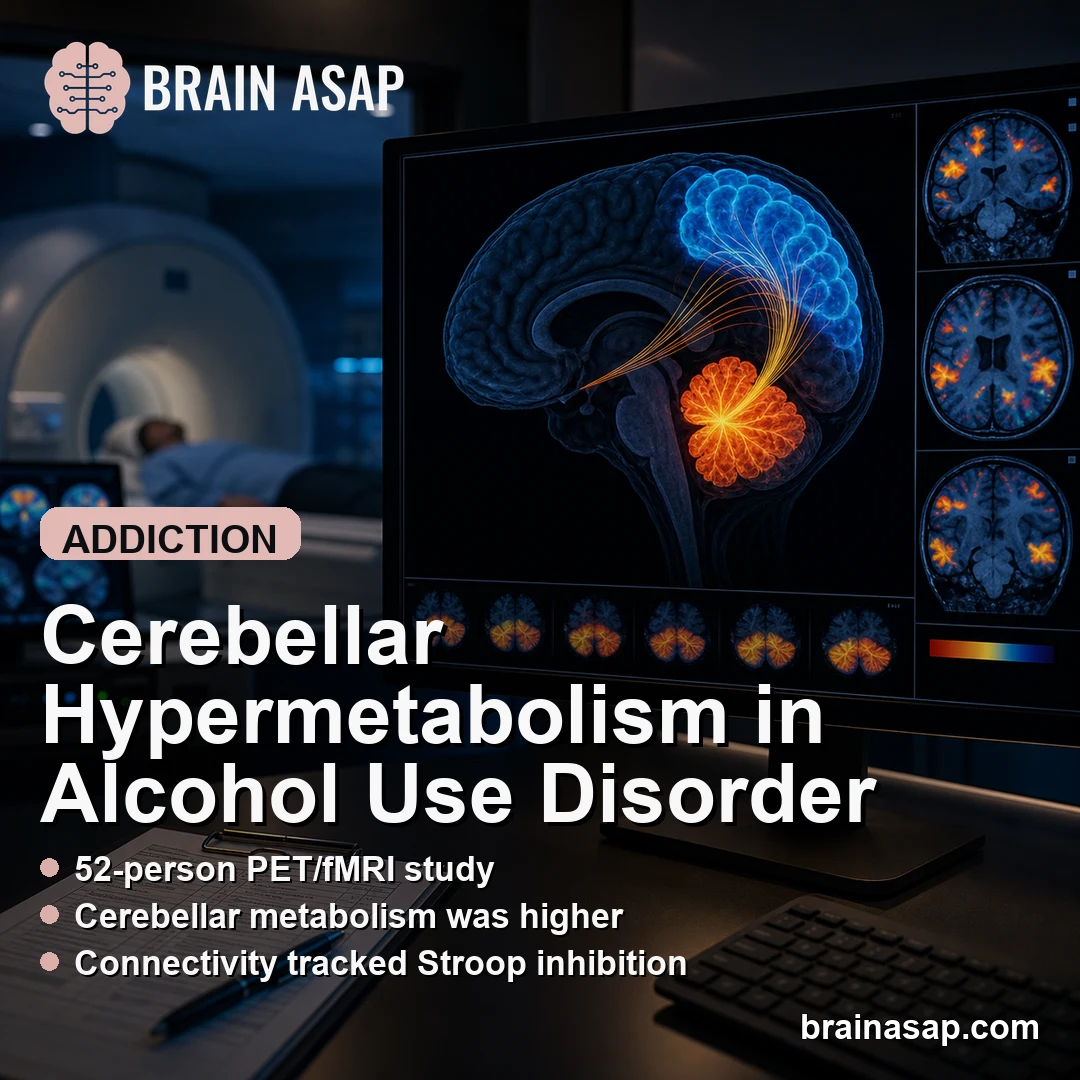
TL;DR: A 2026 study in Translational Psychiatry combined positron emission tomography (PET) and functional MRI (fMRI) in alcohol use disorder and linked cerebellar hypermetabolism to disrupted fronto-cerebellar connectivity and poorer inhibition performance. K…
Read article ↗
TL;DR: A 2026 crossover study in Clinical Physiology and Functional Imaging found that adding electrical muscle stimulation to low-intensity resistance exercise improved inhibitory control in young men, while stimulation alone showed a delayed 15-minute benefi…
Read article ↗
TL;DR: A 2026 randomized trial in JMIR Mental Health found that a 4-week executive-function training app reduced depression and anxiety symptoms at 12-week follow-up, while a self-guided CBT app mainly improved workplace well-being. Key Findings Workplace app…
Read article ↗
TL;DR: A 2026 systematic review and meta-analysis posted as a medRxiv preprint found that mindfulness-based programs were linked to a small improvement in executive function, meaning inhibition, working memory, and flexible thinking, across 13 youth trials. Ke…
Read article ↗
TL;DR: A 2026 study in Journal of Affective Disorders used interpretable machine learning to predict who completed more prompts during a 14-day mindfulness app trial for generalized anxiety disorder. Key Findings Trial size: A two-arm randomized trial included…
Read article ↗
TL;DR: A 2025 study in Computers in Human Behavior linked at-risk problematic gaming to weaker basic working memory, while recreational gaming was linked to better target detection on an attention-control task. Key Findings Three gaming groups: Researchers com…
Read article ↗