TL;DR: In a study published in 2026 in Turkey, 86 women with irritable bowel syndrome, a long-lasting gut condition with belly pain and bowel changes, and 90 healthy women filled in questionnaires on anxiety, depression and searching online about health.
Women with the gut condition had clearly more anxiety and depression symptoms. The study found no clear difference in how much they searched online, but women with IBS felt more upset by what they found.
Key Findings
- More anxiety: 73% of women with IBS had at least low-level anxiety symptoms, vs 10% of healthy women.
- More depression symptoms: 50% of women with IBS had at least mild depression symptoms, vs 7% of healthy women.
- Online searching felt different: Women with IBS searched health topics online about as often, but felt more distress, more often went on to see a doctor and more often let searching crowd out other things.
- Worse gut symptoms, more anxiety: Among women with IBS, those with more severe gut symptoms tended to have somewhat higher anxiety scores, but not higher depression scores.
- A puzzling result: Women with IBS also scored higher on a well-being questionnaire, which the researchers could not fully explain.
Source: Medicina (2026) | Timurkaan, Timurkaan and Yıldız
Irritable bowel syndrome (IBS) brings repeated belly pain along with constipation, diarrhea or both, without a visible cause on standard tests. Many people with it turn to the internet for answers.
That can spill into cyberchondria: searching online about health over and over in a way that feeds worry instead of easing it. A 2026 study in Medicina, by doctors at Fethi Sekin City Hospital in Elazığ, Turkey, looked at how cyberchondria, anxiety and depression show up in women with IBS.
Who Was Compared
The study compared 2 groups of women aged 18 to 65:
- Women with IBS (86): diagnosed at the hospital's internal medicine clinic between March and June 2025
- Healthy women (90): volunteers who came in for a routine yearly check-up and had no known illness or complaints
Anyone with a diagnosed mental health condition was left out of both groups after a psychiatrist's interview. Both groups were similar in age, marriage and education, but more women with IBS had jobs (76% vs 46%).
Each woman filled in questionnaires on:
- Anxiety symptoms, such as nervousness and a racing heart
- Depression symptoms, such as sadness and loss of interest
- Online health searching, in 4 parts: how much people search, how upset searching makes them, whether it sends them to a doctor, and whether it crowds out other activities
- Well-being, such as having purpose and good relationships
- Gut symptom severity, on a 0-to-500 scale
How Big Were the Differences?
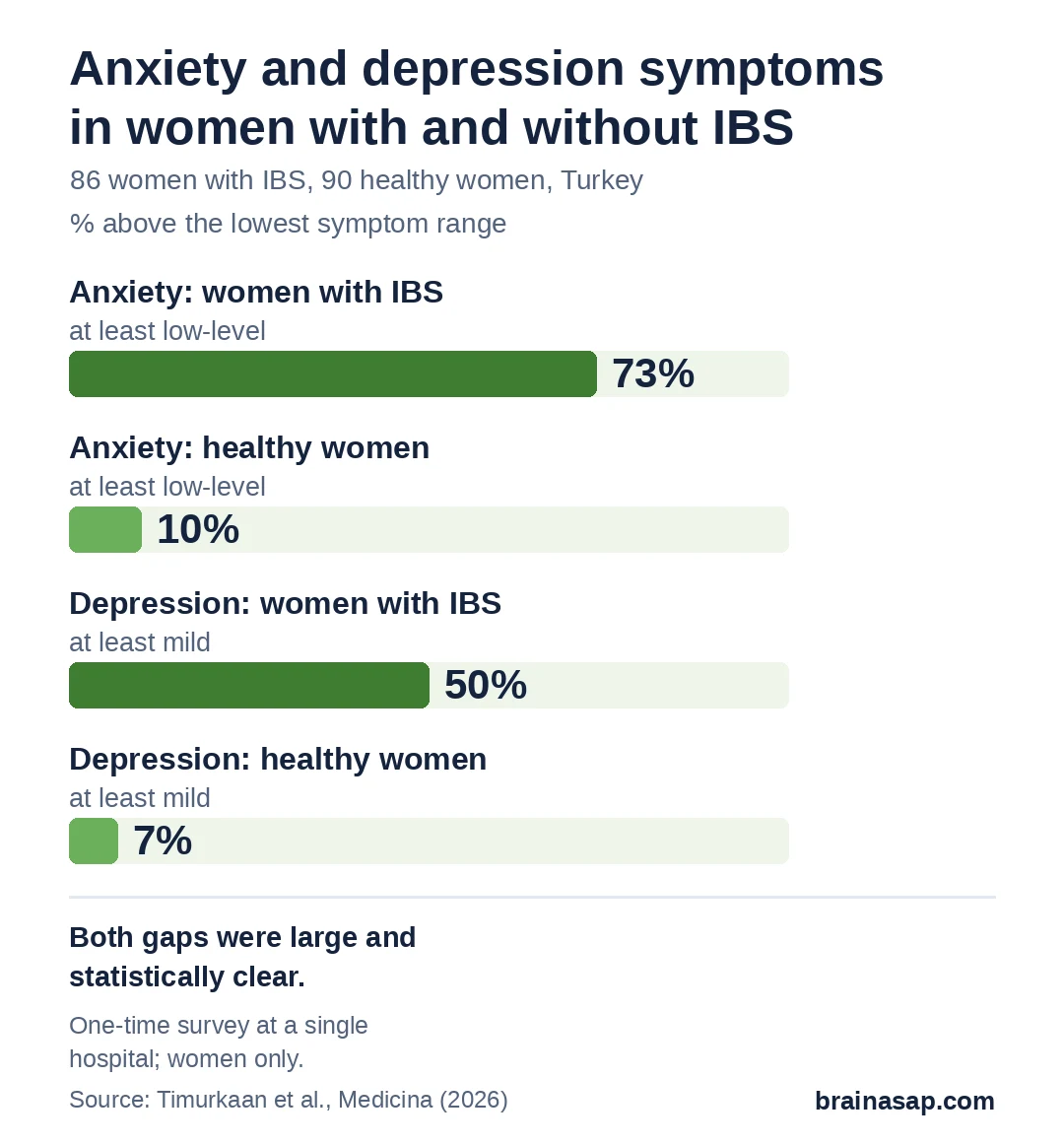
Large. Typical anxiety scores were 14.5 for women with IBS vs 1 for healthy women, and typical depression scores were 9.5 vs 2, both on scales that run to 63.
Most women with IBS were in the low to moderate range rather than the severe range: 9% had severe depression symptoms and 10% had high anxiety.
What About Searching Online?
Here the picture was mixed. Women with IBS did not search more often or more repeatedly than healthy women. They did score higher on the other 3 parts:
- Feeling upset after searching: small difference
- Searching leading to a doctor visit: large difference
- Searching crowding out other things: small difference
In other words, the amount of searching was similar, but how it affected women with IBS was not. Within the IBS group, online searching was not clearly linked to anxiety, depression or gut symptom severity.
A Well-Being Result That Doesn't Fit
Women with IBS scored much higher on well-being than healthy women, an average of 36.7 vs 21.3 on a scale of 8 to 56. That is the opposite of what the researchers expected.
Timurkaan and colleagues suggested that differences between the groups, such as the much higher employment rate among women with IBS, may have played a role. Within the IBS group, women with more depression symptoms did report lower well-being, as expected.
Limits to Keep in Mind
- One-time survey: Can't show whether IBS raises anxiety, anxiety worsens IBS, or both.
- Small, single-hospital sample: 86 women with IBS from one clinic in eastern Turkey.
- Groups differed: Healthy women came from routine check-ups and were less often employed.
- Women only: Hormones and menopause were not measured, and men were not included.
- Gut symptom scale not validated in Turkish: The researchers noted no published Turkish validation was available.
Checking Mood Alongside Gut Symptoms
The team concluded that a psychological check, including how a person uses online health information, could add useful information to IBS care. Whether helping people with IBS search less anxiously would ease their anxiety or gut symptoms is still untested.
Citation: DOI: 10.3390/medicina62091621 Timurkaan ES, Timurkaan M, Yıldız S. Cyberchondria, Psychological Well-Being, Anxiety, and Depression Levels in Female Patients with Irritable Bowel Syndrome. Medicina. 2026;62(9):1621.
Study Design: Cross-sectional case-control study; Rome IV IBS diagnosis; IBS-SSS, CSS-12, Psychological Well-Being Scale, Beck Anxiety Inventory, Beck Depression Inventory; Mann–Whitney U, t-tests, Spearman correlations, ROC analysis.
Sample Size: 176 women: 86 with IBS and 90 healthy controls, Fethi Sekin City Hospital, Elazığ, Turkey (March–June 2025).
Key Statistic: BAI median 14.5 vs 1.0 (Cliff's δ = 0.74); BDI 9.5 vs 2.0 (δ = 0.74); at least mild depression 50.0% vs 6.7%, at least low anxiety 73.3% vs 10.0%. CSS-12 Excessiveness p = 0.211 (δ = −0.09); Distress δ = 0.28; Reassurance δ = 0.53; Compulsion δ = 0.27. PWBS 36.7 ± 10.9 vs 21.3 ± 5.7 (d = 1.79). IBS-SSS–BAI r = 0.255 (p = 0.018); IBS-SSS–BDI r = 0.099 (p = 0.365).
Caveat: Cross-sectional; single center; controls from check-up clinic with lower employment; women only; unexplained higher well-being in IBS group; IBS-SSS not formally validated in Turkish; measurement invariance not tested.