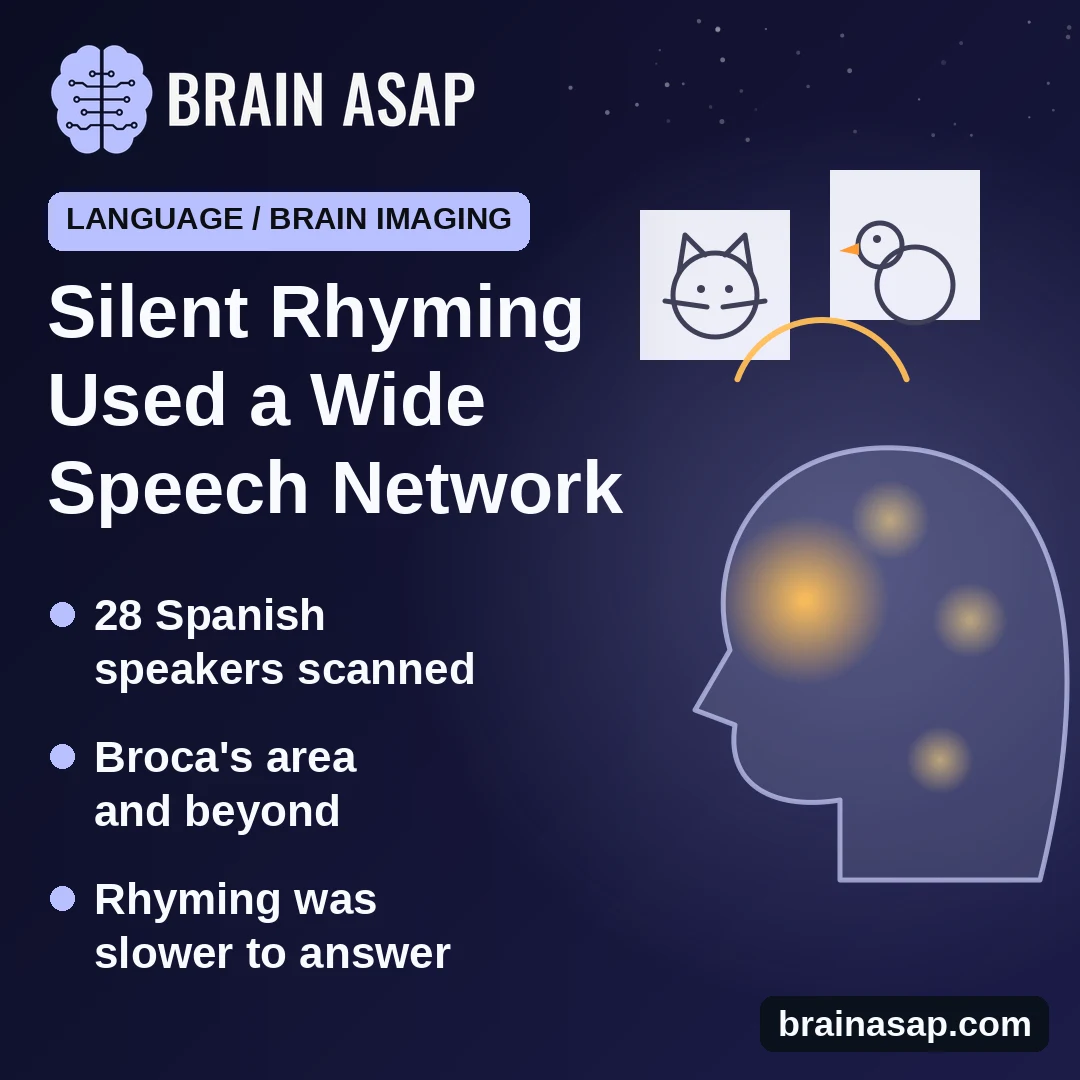
TL;DR: When 28 Spanish-speaking adults silently decided whether the names of two pictures rhymed, brain scans showed a wide left-side speech network at work, including Broca's area and regions for movement planning and sound. The new task avoids written words, which matters in languages spelled the way they sound.
Key Findings
- 28 adults scanned: Out of 32 recruited, all right-handed Spanish speakers.
- Broca's area and beyond: Activity spread across the left lower front of the brain.
- Movement and sound areas joined in: Motor planning regions, a hearing region, deep brain structures and the cerebellum.
- Similar accuracy, slower answers: 88% vs 86% correct, but rhyming took about 0.4 seconds longer.
Source: Frontiers in Psychology (2026) | Barbosa et al.
Most of us hear a voice in our heads when we read, plan or rehearse what to say. Studying that inner speech in a brain scanner is tricky, because people can't talk out loud while lying still and the scanner can't hear their thoughts.
A common workaround is to ask people whether two words rhyme, which forces them to "say" the words silently. A team in Barcelona designed a new version of that task for Spanish speakers.
Why Written Words Don't Work Well in Spanish
Earlier rhyming studies mostly showed written words. In English, spelling often hides pronunciation ("cough" and "though" don't rhyme), so people must sound words out. In Spanish, spelling matches sound so closely that people can judge rhymes just by looking at the letters, without inner speech at all.
The researchers used line drawings of animals and objects instead. To decide whether two names rhyme, like gato (cat) and pato (duck), a person has to retrieve and silently pronounce each word.
Comparing Rhymes With a Same-or-Different Picture Task
Each person did two tasks in the scanner:
- Rhyming task: Do the names of these two pictures rhyme?
- Comparison task: Are these two pictures, shown from different angles, the same object?
The comparison task uses the same kind of pictures and visual processing but needs no words. Subtracting one from the other highlights the brain areas specific to silent naming and rhyming.
A Left-Side Speech Network Lit Up
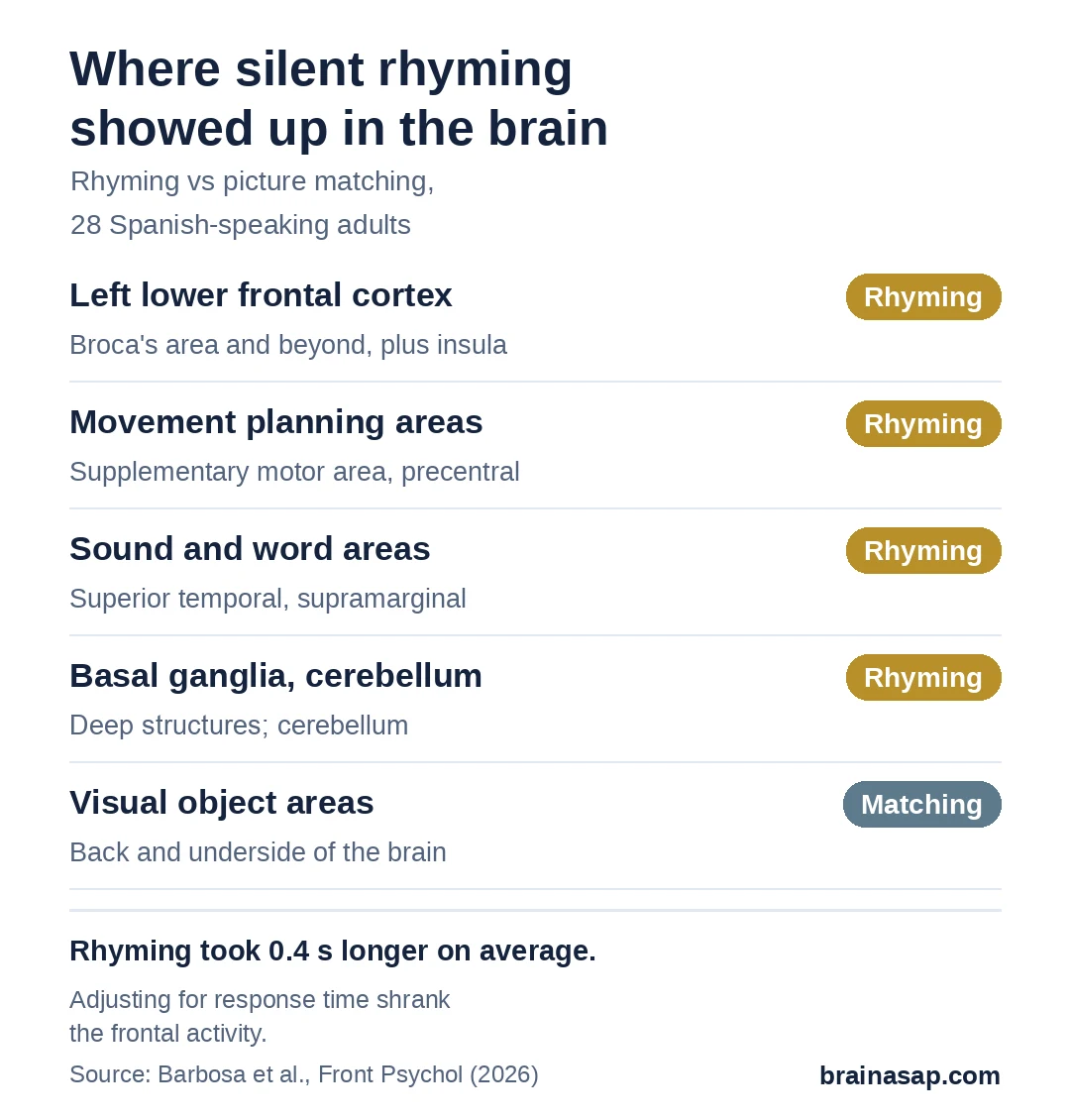
Rhyming drove activity in a large area of the left lower frontal cortex. It included Broca's area, long linked to speech production, but extended beyond it into neighboring frontal regions and the insula. The researchers also found activity in:
- Movement planning areas: The supplementary motor area and the strip that controls the mouth and tongue.
- Sound and word areas: Parts of the temporal and parietal lobes.
- Deep structures: The basal ganglia and the cerebellum.
The picture-matching task, in turn, engaged visual areas at the back and underside of the brain, as expected for recognizing objects.
Harder Task, Not Just More Inner Speech
- Slower answers: Rhyming took 2.5 seconds on average vs 2.1 for picture matching, so effort may explain part of the extra activity.
- Adjusting for speed: When response time was accounted for, the frontal activity was smaller, limited to two parts of the region.
- A task, not natural thought: Rhyme judgments capture one kind of inner speech, not the free-flowing inner voice.
- Modest sample: 28 healthy adults, one language.
A Better Tool for Studying Inner Speech in Spanish
The picture-based task gives researchers working in Spanish, and other languages spelled the way they sound, a cleaner way to probe silent speech. The open question is how much of this network reflects inner speech itself rather than the extra effort of the task, which a version matched for difficulty could answer.
Citation: DOI: 10.3389/fpsyg.2026.1856832. Barbosa L, del Olmo-Encabo P, Aquino-Servín A, et al. Inner speech-related brain areas mapped using a novel rhyming task. Front Psychol. 2026;17:1856832.
Study Design: Within-subject task fMRI (picture rhyming vs picture identity judgment), whole-brain voxel-based analysis.
Sample Size: 28 analyzed of 32 recruited healthy right-handed adults.
Key Statistic: Accuracy 88% vs 86% (n.s.); reaction time 2505 vs 2144 ms (p < 0.001).
Caveat: Task difficulty differs; RT-adjusted analysis narrowed frontal effects.