TL;DR: In 20 healthy young adults, one session of LiuZiJue, a Chinese breathing practice done with six spoken sounds, was followed by faster answers on a color-word test, compared with sitting quietly with eyes closed. Accuracy didn't change, and the speed-up was less than a twentieth of a second.
Key Findings
- 20 college students tried both the breathing practice and eyes-closed rest, in random order.
- Faster after breathing practice: Typical answer time fell from 643 to 606 milliseconds.
- No change after rest: 650 to 657 milliseconds.
- Accuracy stayed near 98% either way.
- Brain measures shifted: Lower frontal activity during practice, longer brain "pause" signal afterward.
Source: Frontiers in Neurology (2026) | Bi et al.
Slow breathing exercises are often sold as a quick reset for a busy mind. Can a few minutes of one actually make you sharper right afterward?
Researchers in Shanghai tested that with LiuZiJue, a traditional Chinese qigong practice, on a classic test of focus. They also looked at the brain in three different ways.
Six Sounds on a Slow Exhale
LiuZiJue means "six healing sounds." You breathe in through the nose, then breathe out slowly through the mouth while voicing one of six syllables: Xu, He, Hu, Si, Chui and Xi. Attention stays on the breath, the airflow and the vibration in the mouth.
In this study, participants sat with eyes closed and did each sound six times, with no body movements. All had been trained in the technique beforehand. Prior qigong experience was limited to a year or less, no more than two sessions a week and no more than 30 minutes per session.
A Color-Word Test Before and After
The 20 participants were healthy college students, 10 men and 10 women, about 22 years old. Each did two conditions on the same day, in random order, at least 2 hours apart:
- Breathing practice: One session of LiuZiJue.
- Eyes-closed rest: Sitting quietly for the same time, breathing normally.
Before and after each condition, they took a Stroop test. Color words like "red" appear in matching or mismatched ink, and you press one key when the word and ink match and another when they do not. It's a standard way to measure how well people block out distractions.
Answers Got Faster, but Not More Accurate
After the breathing practice, the researchers found typical answer times dropped by about 36 milliseconds. After eyes-closed rest, they didn't change. Answers were faster for both easy, matching items and harder, mismatched ones.
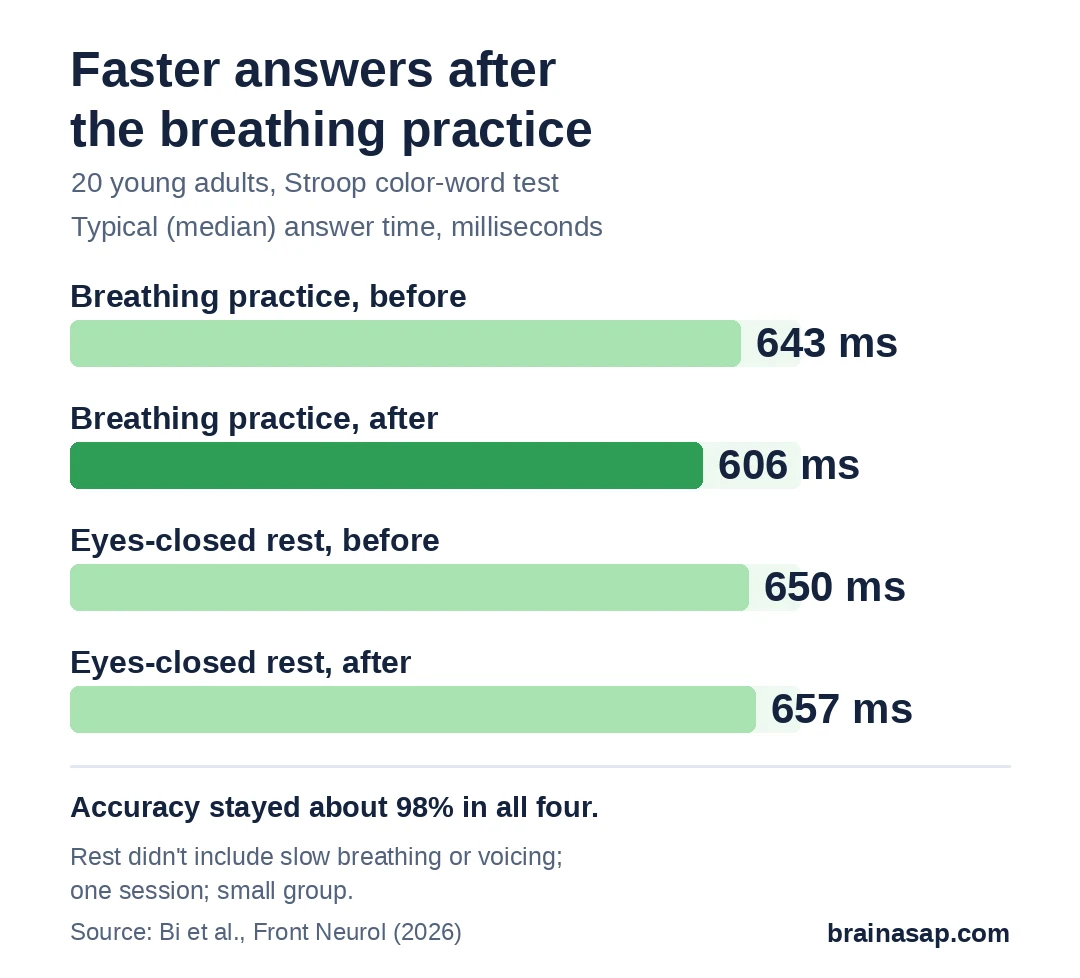
Accuracy sat around 98% before and after both conditions. The test was likely too easy for healthy students to show any gain there, as the authors note.
What the Brain Scans Showed
The team added three kinds of brain measures across two study sessions:
- Light-based sensors (fNIRS) during practice: Oxygen-rich blood was lower in frontal and movement areas while voicing the six sounds than while repeating a plain "Fu" sound.
- MRI at rest, before and after (18 people): Background activity dropped in movement, touch, hearing and vision areas and rose in one small part of the cerebellum.
- Magnetic pulses (14 people): A brain "pause" signal in the movement area, called the cortical silent period, lasted longer after practice, rising from about 110 to 133 milliseconds. A second braking measure didn't change.
During the Stroop test itself, brain oxygen readings didn't differ significantly before and after practice.
A Weak Comparison and a Small Group
- Rest isn't a fair match: It had no slow breathing, no voicing and no focused attention, so any of those could explain the result.
- 20 people: Only 14 finished the magnetic tests, 18 the MRI.
- Healthy students only: Results may not apply to older adults or patients.
- One session: Immediate effects, no follow-up.
- Breathing can skew brain readings: Changes in carbon dioxide and blood flow affect fNIRS and MRI.
- Practice effects possible: Taking the same test four times can speed people up.
Next Test: Breathing Without the Sounds
A short guided-breathing break is low-risk, and this study hints it may speed responses a little. To show the six sounds matter, the next study should compare LiuZiJue with plain slow breathing of the same length, in more people and over weeks of practice.
Citation: DOI: 10.3389/fneur.2026.1865496. Bi Y, Guan H, Wang J, Cheng Y, Ying Z. The multimodal neurophysiological assessment of immediate LiuZiJue: revealing executive control and brain function changes. Front Neurol. 2026;17:1865496.
Study Design: Randomized crossover study (ChiCTR2400087145) with Stroop, TMS, fNIRS and resting-state fMRI.
Sample Size: 20 healthy young adults (14 with complete TMS, 18 in fMRI analyses).
Key Statistic: Total Stroop median reaction time 642.7 to 606.3 ms after LiuZiJue (p < 0.001) vs 649.8 to 656.5 ms after eyes-closed rest; CSP 109.5 to 133.0 ms (p < 0.01).
Caveat: Small sample; control condition did not match breathing, voicing or attention; immediate effects only.