
TL;DR: In brain scans of 149 adults, people whose migraine had turned into near-daily headaches from overusing painkillers had larger fluid-filled spaces around small brain vessels and a smaller hippocampus than people without migraine. The scans were taken once, so it's unclear whether the pills, the frequent headaches or something else drives the changes.
Key Findings
- 149 adults, 4 groups: Painkiller overuse, moderate use, no painkillers, and no migraine.
- Fluid spaces grew step by step: Smallest in people without migraine, largest with overuse, right side only.
- Smaller hippocampus: In all 3 migraine groups, most in the overuse group.
- Waste-flow index unchanged: A popular MRI measure of brain fluid flow didn't differ between groups.
- Moderate test accuracy: Combining two scan measures told overuse from controls with an AUC of 0.75.
Source: Pain and Therapy (2026) | Li et al.
Painkillers are the first thing most people with migraine reach for. But taking them too often can backfire, turning occasional attacks into headaches on most days. This is called medication-overuse headache, and it affects about 1 to 2% of people.
Why that switch happens is still unclear. A team at Ningbo No. 2 Hospital in China looked for clues in the brain's waste-clearing system.
Four Groups Along a Painkiller Scale
Between 2024 and 2025, the researchers scanned 149 right-handed adults aged 18 to 65, split into four groups:
- Painkiller overuse (29 people): Headache on at least 15 days a month and pills on about 24 days a month.
- Moderate users (34): Migraine with pills on 1 to 14 days a month, typically about 5.
- No painkillers (46): Migraine, but no acute medicine at all.
- Controls (40): No migraine.
The pills were ordinary over-the-counter types: anti-inflammatories like ibuprofen, caffeine, or combinations. People using triptans or newer migraine drugs were excluded.
Spaces Around Brain Vessels Were Larger With More Pills
Small blood vessels in the brain are wrapped in thin fluid-filled sleeves called perivascular spaces. They are part of the glymphatic system, which flushes waste from the brain, mostly during sleep. When these spaces widen, it may mean fluid isn't draining well.
In the deep white matter on the right side of the brain, these spaces took up a bit more volume at each step up the scale, from controls to no-painkiller migraine to moderate use to overuse. Compared with controls, the increase was moderate in the overuse group. People with migraine who took no painkillers looked the same as controls. The left side showed no clear difference.
The Hippocampus Was Smaller in Every Migraine Group
The right hippocampus, a memory hub, was smaller in all three migraine groups than in controls. The overuse group showed the biggest gap. But the no-painkiller migraine group had a larger gap than the moderate users, so the pattern wasn't a clean staircase.
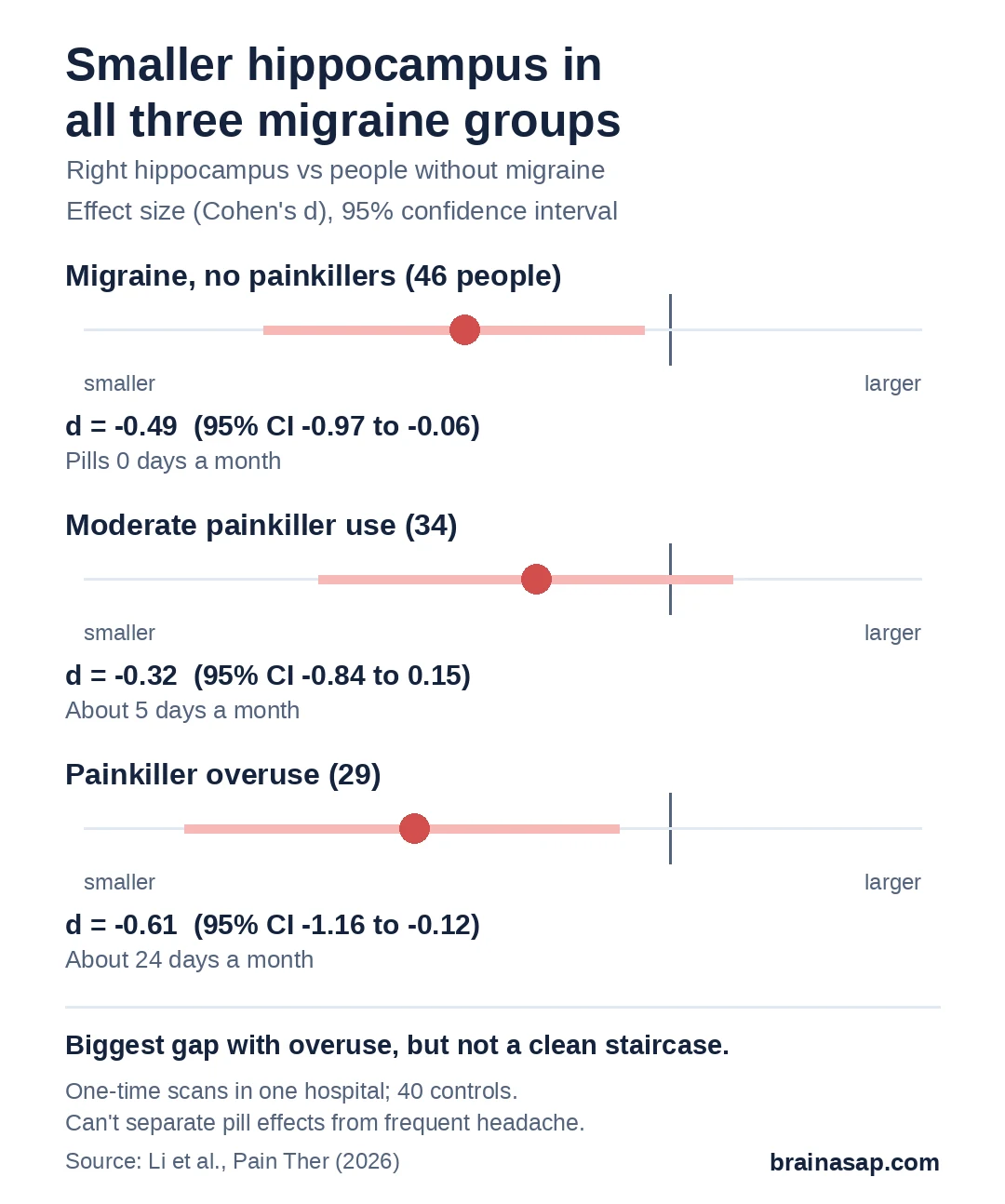
Among people who used painkillers, the hippocampus tended to be smaller the longer they'd had migraine. An exploratory analysis suggested shrinkage sped up after about 11 years, but that came from one-time scans, not from following anyone over time.
A Common Flow Measure Showed Nothing
Not everything lined up. A widely used MRI estimate of glymphatic flow, called the DTI-ALPS index, didn't differ between any of the groups. Neither did a measure of free water in brain tissue. Lower flow scores did go with worse sleep, mood, fatigue and pain across people with migraine, though.
Combining the right-side fluid spaces with right hippocampus size told overuse patients apart from controls with an AUC of 0.75 (1.0 is perfect, 0.5 is a coin flip). That's moderate, and it was only checked within this same group of people.
One Scan Can't Separate Pills From Pain
- Snapshot design: Can't tell if pills, frequent headaches or both drive the changes.
- Missing comparison: No group with chronic migraine who didn't overuse pills.
- Weak main signal: Fluid-space finding didn't survive correction across all brain regions; authors call it hypothesis-generating.
- Coarse scans: Diffusion MRI used only 20 directions, which may have hidden flow differences.
- Uneven ages: Overuse and control groups were older (about 48 and 47) than the other two (about 40).
- Unrecorded factors: Aura, preventive drugs and white matter damage weren't tracked.
Following People Over Time Is the Real Test
The findings fit the idea that the brain's drainage system may be strained in people who overuse painkillers for migraine, but they don't prove it. Nobody should read this as a reason to stop prescribed treatment. Limiting pain pills to fewer than 10 to 15 days a month is already standard advice for avoiding overuse headache. The open question is whether these brain changes appear before overuse headache starts, and whether they ease once people cut back.
Citation: DOI: 10.1007/s40122-026-00883-2. Li A, Guan Q, Fan W, Chen G, Chen B, Li L, Fan Z, Wu Y. Glymphatic–Hippocampal Axis Alterations Across the Migraine–Medication Exposure Continuum: A Multi-modal Neuroimaging Study. Pain Ther. 2026.
Study Design: Single-center cross-sectional multimodal MRI study.
Sample Size: 149 right-handed adults (29 medication-overuse headache, 34 moderate use, 46 medication-naive migraine, 40 controls).
Key Statistic: Right centrum semiovale perivascular space trend p = 0.003 (overuse vs controls d = 0.59); right hippocampal volume overuse vs controls d = -0.61; combined model AUC 0.75.
Caveat: Cross-sectional; regional fluid-space effect did not survive full multiple-comparison correction; internal validation only.