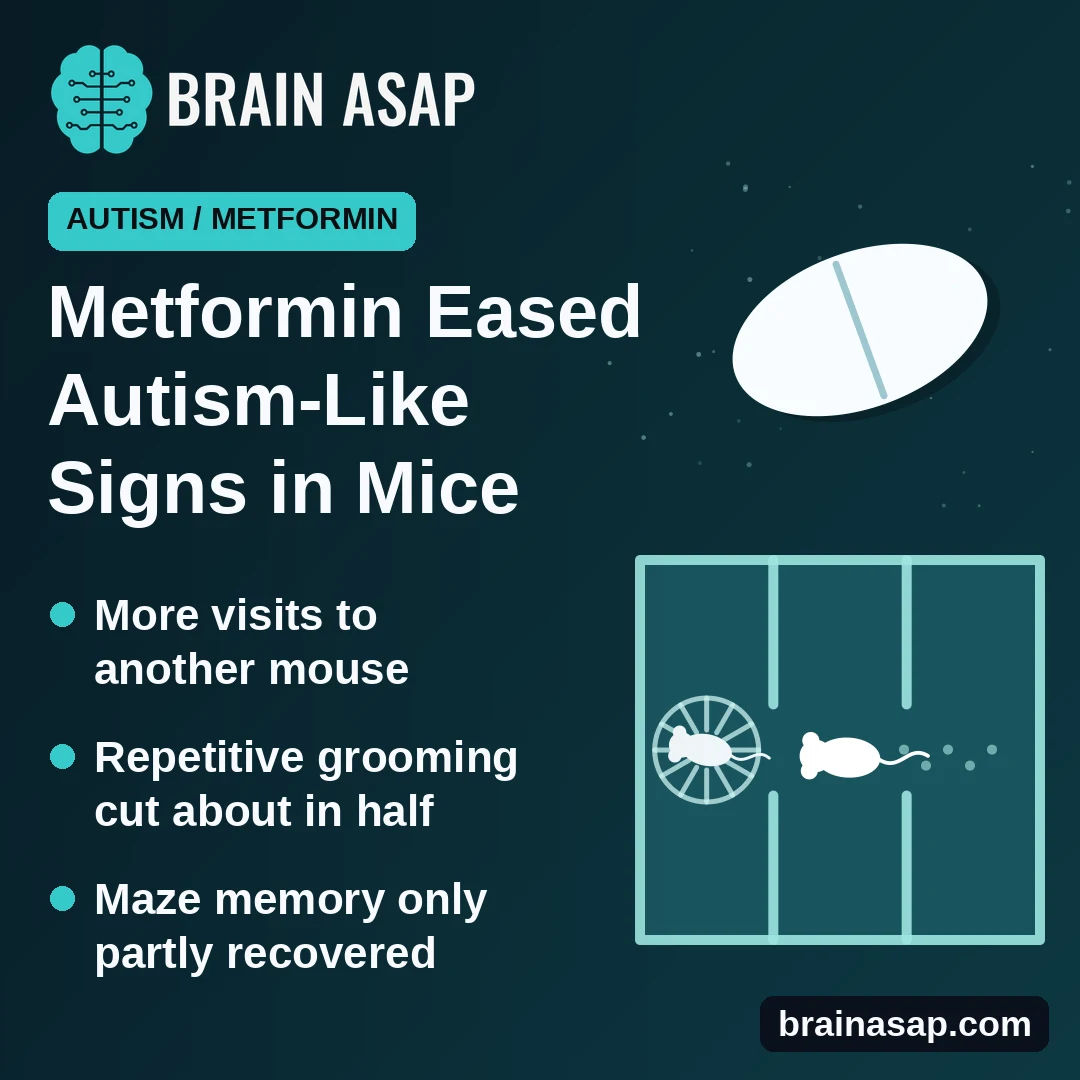
TL;DR: Young mice whose mothers got the epilepsy drug valproate during pregnancy, a standard lab model of autism, were given the diabetes drug metformin for 2 weeks after weaning. They then visited another mouse more often and groomed themselves less, with average results closer to the control group. Their scores on a maze memory test improved and still fell below the control group's scores.
Key Findings
- More visits to another mouse: Valproate-exposed mice given only water entered a chamber holding a strange mouse about half as often as healthy mice; valproate-exposed mice given metformin were back near the healthy level.
- Less repetitive grooming: Water-treated valproate mice groomed about 2.4 times as often as healthy mice; metformin cut that roughly in half.
- Memory only partly back: On a maze test of short-term memory, metformin-treated mice scored better than water-treated valproate mice but still about a quarter below healthy mice.
- Brain chemistry moved too: Metformin changed some markers of chemical stress. Its effects varied by sex and brain region. It also lowered an enzyme's activity in the prefrontal cortex in both sexes.
- 63 mice, one dose: no group of healthy mice got metformin, so its effect without valproate is unknown.
Source: Developmental Neurobiology (2026) | Freitas, Aragão and colleagues
Metformin is one of the oldest, cheapest and most prescribed drugs in the world, taken by millions of people with type 2 diabetes.
Researchers tested whether metformin changed specific behavior measures in mice exposed to valproate before birth.
A Lab Model Built From a Pregnancy Drug
A 2026 study in Developmental Neurobiology, by Madna Costa Freitas, Gislei Frota Aragão and colleagues at the State University of Ceará in Brazil, used one of the most common animal models of autism.
Valproate, also called valproic acid, is an epilepsy drug. Taken during pregnancy, it is linked to a higher chance of autism in children. In this study, offspring exposed before birth showed differences in social exploration, grooming and maze performance.
Young male and female mice fell into 3 groups:
- Healthy mice: mothers received the inactive comparison solution during pregnancy; pups got water
- Valproate mice on water: mothers got valproate; pups got water
- Valproate mice on metformin: mothers got valproate; pups got metformin by mouth for 15 days, starting at weaning
Treatment ran from day 21 to day 35 of life, starting at weaning. After that, the mice went through 5 standard behavior tests, and their brains were checked for signs of chemical stress.
Did Metformin Change Social Behavior?
For the social test, each mouse explored a box with 3 chambers. One side held an unfamiliar mouse in a small cage; the other side was empty. Healthy mice usually spend more time with the stranger.
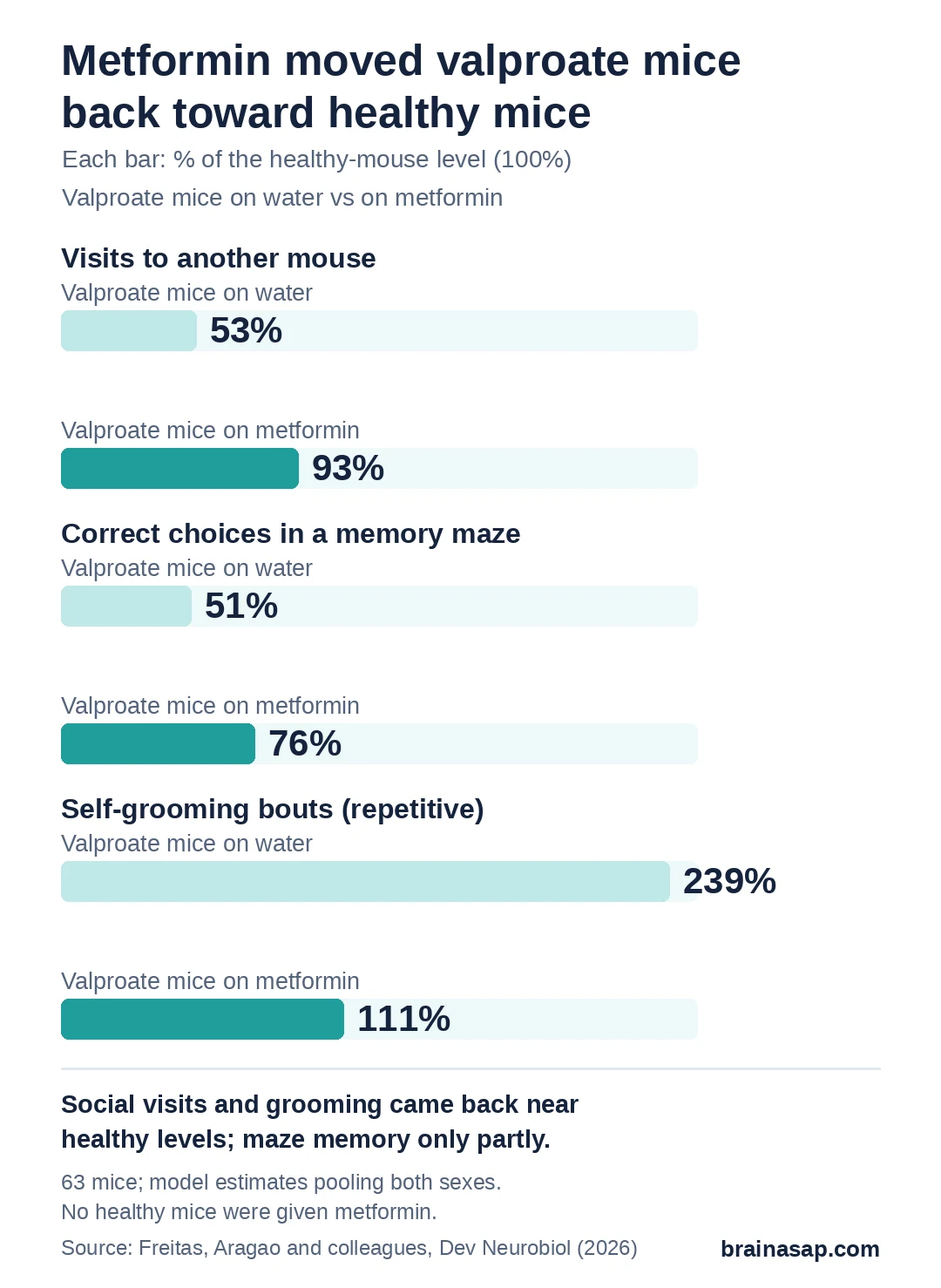
Valproate mice on water entered the stranger's chamber about half as often as healthy mice. Valproate mice on metformin entered it 1.7 times as often as the water group, which put them back near the healthy level.
Time spent with the stranger told a similar story overall. In males, though, metformin did not increase that time: treated males still spent less time near the stranger than healthy males.
Grooming Dropped, Memory Stayed Behind
Repetitive behavior in mice is usually measured by self-grooming: how often a mouse stops to clean itself while exploring an open box.
Valproate mice on water groomed about 2.4 times as often as healthy mice. Metformin cut grooming bouts by about half, to a level close to healthy mice. In males, a small gap with healthy mice remained.
Memory was a different picture. In the Y-maze, a 3-armed maze, mice that remember which arms they just visited tend to try a new one each time. Each mouse got a score: the share of correct 3-arm sequences.
- Valproate mice on water: about half the healthy score
- Valproate mice on metformin: about 3 quarters of the healthy score
Metformin helped, but memory did not fully recover in either sex.
Metformin-treated mice also moved around the open box more, matching healthy mice, and ventured onto the exposed arms of a raised maze more often, a standard sign of lower anxiety in mice. On that last measure, the response differed between males and females.
Signs of Chemical Stress in the Brain
Brain tissue was tested for 2 markers of oxidative stress, a kind of chemical wear on cells, in 2 brain regions: the prefrontal cortex, involved in planning and social behavior, and the hippocampus, important for memory.
- Glutathione, a protective molecule, was lower in valproate mice. Metformin raised it in the female hippocampus and male prefrontal cortex only.
- Malondialdehyde, a marker of damaged cell fats, was higher in valproate mice. Metformin lowered it in 3 of the 4 sex-and-region combinations.
- Acetylcholinesterase, an enzyme that breaks down the memory-related chemical acetylcholine, was higher in the prefrontal cortex of valproate mice. Metformin brought it down in both sexes.
Freitas and colleagues did not test whether these chemical shifts explain the behavior changes, so the link between the two remains open.
Reasons for Caution
- No healthy mice on metformin: without that group, no one can tell whether metformin simply changes behavior in any mouse
- Survivors only: 3 of 15 valproate-treated mothers died and 6 of the remaining 12 lost their whole litter; 4 water-treated and 2 metformin-treated pups also died, leaving 63 mice
- Smaller weight gain: metformin pups gained less weight over 15 days than water-treated pups (about 4.5 vs 6.6 g in females), reported as group averages without statistical testing
- One dose, one time window: the study tested one experimental dose in young mice and ended before adulthood
- Mouse model: valproate exposure mimics some autism-like behaviors, not autism itself
What the Mouse Study Leaves Open
This adds to earlier rat studies with a careful design point: it tested both sexes and accounted for littermates being related.
An obvious next question is whether healthy mice given the same metformin dose also groom less and approach strangers more. If they do, metformin may be changing general activity rather than correcting anything specific to the valproate model. The researchers did not test treatment for autism in people.
Citation: DOI: 10.1002/dneu.70061. Freitas MC, de Freitas RF, Vasconcelos IKM, de Andrade IP, Pitombeira MHS, Fontenele DR, Alves POF, Diógenes VS, Assreuy AMS, Aragão GF. Metformin Attenuates Behavioral Deficits and Oxidative Stress in a Preclinical Model of Autism. Developmental Neurobiology. 2026;86:e70061. PMID: 42755441.
Study Design: Controlled mouse experiment: prenatal valproic acid (450 mg/kg, single injection on gestational day 12.5) or vehicle; offspring given oral metformin (400 mg/kg) or water from postnatal day 21 to 35; open field, self-grooming, elevated plus maze, 3-chamber social test and Y-maze; glutathione, malondialdehyde, total protein and acetylcholinesterase in prefrontal cortex and hippocampus. Generalized linear mixed models with litter as a random effect.
Sample Size: 63 offspring analyzed (24 healthy, 19 valproate on water, 20 valproate on metformin; 31 females, 32 males) from 4 control and 6 valproate litters.
Key Statistic: Social-chamber entries, valproate/healthy ratio 0.53 (95% CI 0.44–0.65); metformin/valproate 1.74 (1.47–2.06); metformin/healthy 0.93 (0.77–1.12). Grooming bouts, valproate/healthy 2.39 (1.72–3.31); metformin/valproate 0.46 (0.35–0.61). Y-maze correct sequences, valproate/healthy 0.51 (0.45–0.57); metformin/valproate 1.48 (1.33–1.66); metformin/healthy 0.76 (0.67–0.85).
Caveat: No healthy-plus-metformin group, high maternal and litter loss in the valproate condition, a single high dose and treatment window, and descriptive-only body-weight data. Full published article reviewed.