TL;DR: Mice given a graft of human stem-cell-derived brain cells a week after a stroke walked better and had more new blood vessels over the next 6 weeks than mice given a sham injection. This is an early animal study in mice bred without a full immune system.
Key Findings
- Grafts survived 5+ weeks and mostly became mature neurons.
- Better movement recovery: Fewer slips on a ladder walk and recovery of wrist and toe height.
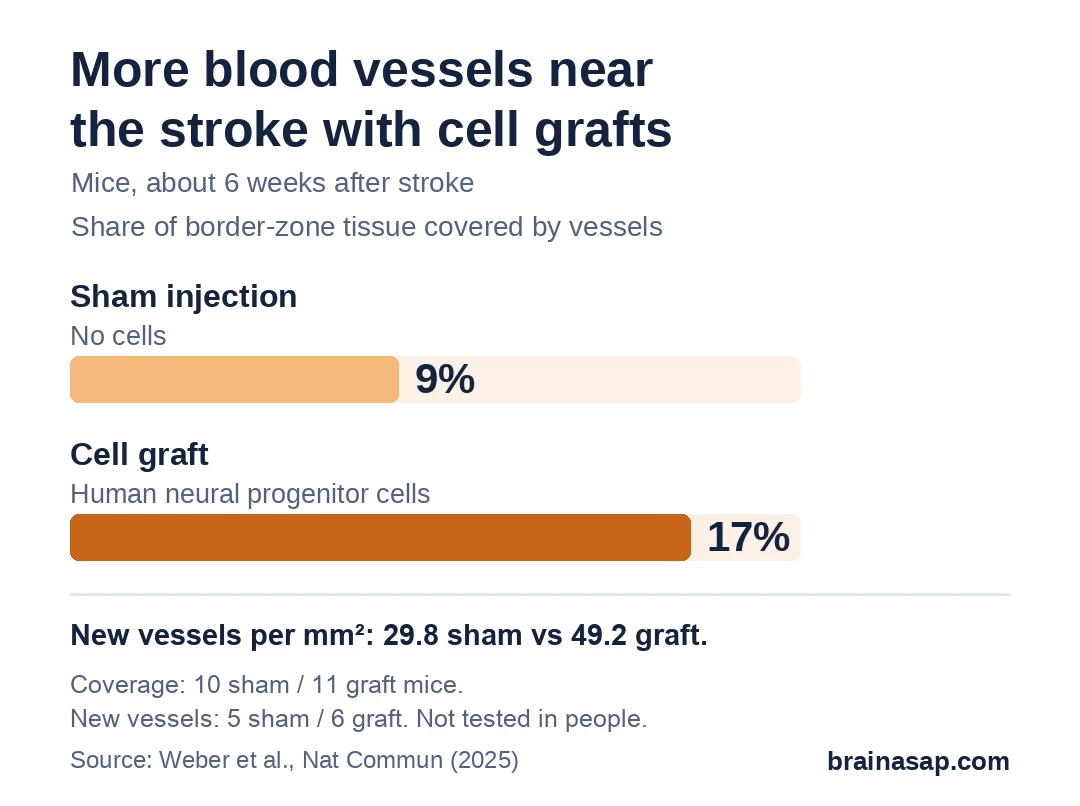
- More blood vessels: 17% vs 9% vessel coverage near the injury.
- Calmer inflammation and less leaky vessels in the stroke area.
Source: Nature Communications (2025) | Weber et al.
After a stroke, the brain has only a limited ability to rebuild damaged circuits, and about half of survivors are left with lasting disability. Stem-cell therapies have long looked promising in animals, but earlier large human trials have not confirmed the benefit.
A team at the University of Zurich and the University of Southern California tested a newer cell source: neural progenitor cells made from human induced pluripotent stem cells, which are adult cells reprogrammed into a stem-like state.
A Cell Graft One Week After Stroke
The researchers used 28 mice of both sexes, bred without key immune cells (Rag2-knockout mice) so they would not reject human cells. Mice had a small stroke in the movement area of the brain. Seven days later:
- Graft group: Received an injection of human neural progenitor cells near the injury.
- Sham group: Received the same injection without cells.
The team then followed movement, brain tissue and gene activity for about six weeks.
Grafted Cells Survived and Became Neurons
Glowing tags showed the grafts survived for more than five weeks. Most grafted cells turned into mature neurons, mainly the calming (GABA) and exciting (glutamate) types, and some sent fibers into nearby brain regions. Only a small share kept dividing, and the authors found no signs of abnormal growth.
Better Walking in Treated Mice
The researchers filmed mice walking and used AI pose-tracking software to measure dozens of movement details:
- Rotating-rod test: Graft mice recovered better by five weeks.
- Gait: Wrist and toe height fully recovered in graft mice, only partly in sham mice.
- Ladder walk: Sham mice made more foot slips with their affected limbs at weeks 5 and 6.
More Blood Vessels and Less Inflammation
In the border zone around the stroke, the graft group had more new blood vessels and less leakage from them. Immune cells called microglia looked less activated, and a marker of inflammation was less elevated on the stroke side than in sham-treated mice (+280% vs +410%, each relative to the unaffected side).
Gene analysis of single cells suggested how grafted neurons might talk to host tissue, through signaling systems called neurexin, neuregulin, NCAM and SLIT. These are predicted links from gene activity, not tested one by one.
Why This Is a Long Way From Patients
- Immune-deficient mice: A normal immune system could attack the graft or change how it behaves.
- Small groups: About 11 mice per group for most measures.
- Short follow-up: About six weeks; long-term safety is unknown.
- Mouse strokes are small and uniform compared with human strokes.
- Proposed signals: Graft-to-host pathways were inferred, not proven.
Next: Tests in Animals With Normal Immune Systems
The study adds to evidence that grafted human neurons can help a stroke-damaged brain repair itself, and offers clues about how. The key question before any human trial is whether the benefit and safety hold up when the recipient's immune system is intact, as it would be in patients.
Citation: DOI: 10.1038/s41467-025-63725-3. Weber RZ, Achón Buil B, Rentsch NH, et al. Neural xenografts contribute to long-term recovery in stroke via molecular graft-host crosstalk. Nat Commun. 2025;16:8224.
Study Design: Mouse experiment: photothrombotic stroke, human iPSC-derived neural progenitor cell graft at 7 days vs vehicle, with behavior, histology and single-nucleus RNA sequencing.
Sample Size: 28 immunodeficient Rag2-/- mice (about 11 per stroke group).
Key Statistic: Vascular area fraction 17% vs 9% in the ischemic border zone (p < 0.001).
Caveat: Immunodeficient mice, small groups, short follow-up; graft-host signaling inferred from gene expression.