TL;DR: In regions where the pork tapeworm is common, about 1 in 4 people with seizures had signs of tapeworm cysts in the brain, based on 35 well-defined studies. That share roughly halved in studies from after 2008, though it is unclear how much of the drop is real.
Key Findings
- 77 studies reviewed, 35 with clear definitions of both the infection and seizures.
- About 1 in 4: 25.2% of people with seizures had brain cysts in those 35 studies.
- Falling over time: 33.7% in 1990 to 2008 studies vs 17.3% in 2008 to 2023 studies.
- Similar drop in Africa, the Americas and Southeast Asia.
- No clear difference between men and women, or children and adults.
Source: Infectious Diseases of Poverty (2026) | Jalal et al.
One of the most common preventable causes of epilepsy in the world is a parasite. The pork tapeworm, Taenia solium, can leave larval cysts in the brain, a condition called neurocysticercosis. It spreads where sanitation is poor and pigs roam freely, mostly in parts of Latin America, Africa and Asia.
Health agencies need to know how big a role it plays in seizures to estimate its burden. The last major estimate relied on studies up to 2008. This new review brings it up to 2023.
How the Review Counted Cases
The researchers searched 20 databases and screened more than 16,000 records. They kept 77 studies that confirmed the infection with brain imaging (CT or MRI), biopsy or autopsy, in groups of people with epileptic seizures.
Their main estimate used only the 35 studies that included both sexes and all ages and gave clear definitions of the infection and of seizures. Those clear definitions mattered. Studies without them reported much lower rates, about 12.8%, which the authors see as a sign of misclassification.
About 1 in 4 With Seizures Had Brain Cysts
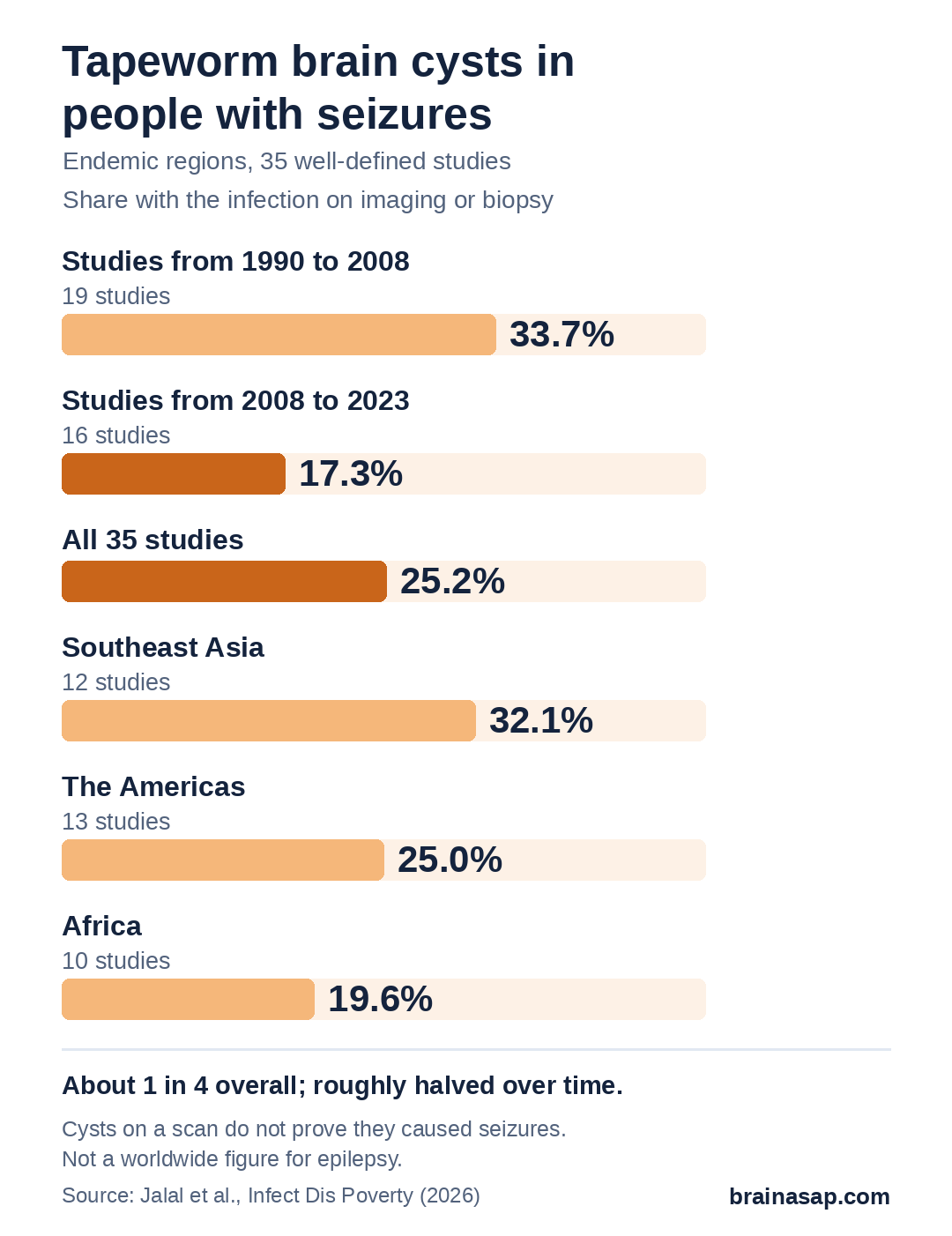
Across the 35 well-defined studies, 25.2% of people with epileptic seizures had the infection (95% credible interval 19.5% to 32.2%). By region:
- Southeast Asia: 32.1% (12 studies)
- The Americas: 25.0% (13 studies)
- Africa: 19.6% (10 studies), with results varying hugely between studies
Rates were higher in community surveys (31.4%) than in clinic and hospital studies (20.0%). They were similar in men and women and in children and adults.
The Share Roughly Halved After 2008
Studies from 1990 to mid-2008 found the infection in 33.7% of people with seizures. Studies from mid-2008 to 2023 found it in 17.3%. In a model that accounted for region, imaging type and setting, the later period had about half the proportion (ratio 0.5, 95% credible interval 0.3 to 0.8).
The drop was similar in all three regions. The authors offer two broad explanations:
- A real decline: Better sanitation, health education, deworming campaigns and pig management.
- An apparent decline: Better scans and updated criteria may cut false positives, or other causes of seizures may have grown.
Because the drop looked the same across regions with different access to scanners, the authors think better equipment alone is an unlikely explanation. They still call for research to settle it.
What 1 in 4 Does Not Mean
- Not a global figure: The studies come from endemic areas, not the whole world.
- Cysts are not always the cause: Finding them on a scan does not prove they caused a person’s seizures.
- Big differences between studies: Heterogeneity was “fairly high,” and extreme in Africa.
- Uneven diagnosis: No universal gold standard exists for diagnosing the infection or epilepsy, and scanner access varies.
Still a Major, Preventable Cause of Seizures
Even with the decline, the numbers suggest that in places where the pork tapeworm circulates, a large share of people with seizures carry brain cysts. That makes sanitation, pig management and access to brain scans part of epilepsy care.
The open question is whether the post-2008 drop reflects fewer infections or just sharper diagnosis. Answering it will shape how the World Health Organization and others estimate the disease’s burden.
Citation: DOI: 10.1186/s40249-026-01501-1. Jalal MS, Figuet O, Di Bacco K, Hubert M, Adame S, Stelzle D, Winkler AS, Budke CM, Carabin H. An updated estimate of the proportion of neurocysticercosis among people with epileptic seizures: a systematic review and Bayesian meta-analysis. Infect Dis Poverty. 2026;15:100.
Study Design: Systematic review and Bayesian meta-analysis with meta-regression (PROSPERO CRD42021266596).
Sample Size: 77 studies included; 35 with formal definitions and all ages and sexes in the main estimate.
Key Statistic: 25.2% (95% BCI 19.5% to 32.2%); period ratio after 2008 0.5 (0.3 to 0.8).
Caveat: Endemic-area populations only; high heterogeneity; imaging findings do not prove cause; the decline may be partly apparent.