TL;DR: A study published in 2026 in Norway followed 304 adults who had just been diagnosed with inflammatory bowel disease, a long-term inflammation of the gut, and asked them about anxiety and low mood at diagnosis and after 3 months of treatment.
Most people's bowel disease calmed down, but anxiety and depression scores dropped only slightly, below a benchmark for meaningful improvement cited by the researchers. People with worse gut symptoms reported more anxiety and low mood.
Key Findings
- Gut improved a lot: Among people with ulcerative colitis, the share in remission rose from 19% to 78% in 3 months.
- Anxiety eased a little: The share with notable anxiety symptoms fell from 30% to 22%; the drop in depression symptoms (14% to 11%) was not statistically clear.
- Below a cited benchmark: Average score drops were under half the 1.7-point benchmark the authors borrowed from cardiovascular research. This study did not measure whether patients noticed a change.
- Gut symptoms showed the stronger links: Worse gut symptoms went with more anxiety and low mood. Lab markers showed little connection; blood CRP had a weak link with depression scores.
- Who struggled more: Women reported more anxiety than men, and younger patients more distress than older ones.
Source: Nursing Reports (2026) | Sagen et al.
Learning you have inflammatory bowel disease (IBD), a lifelong gut condition, often in your 20s or 30s, can be frightening. Diarrhea, pain and fear of flare-ups can upend work and social life.
A 2026 study in Nursing Reports, led by nurse researcher Åse Margrete Sagen at Stavanger University Hospital, asked a practical question: once treatment starts and the gut settles, does anxiety and low mood settle too?
Who Was Followed?
Between 2012 and 2019, the hospital invited every adult newly diagnosed with IBD, before any IBD medicine was started.
- Completed both visits: 304 people, average age 38; 54% men
- Diagnosis: 74% had ulcerative colitis, which affects the large bowel; 26% had Crohn's disease, which can affect any part of the gut
- Treatment: 93% started standard first-line medicines such as anti-inflammatory drugs or steroids; 7% started stronger biologic drugs
At diagnosis and again 3 months later, each person filled in a 14-item hospital questionnaire on anxiety and depression. A score of 8 or more on either part counted as notable symptoms. Doctors also rated gut symptoms with standard scores, and blood and stool tests measured inflammation.
Did Mood Follow the Gut?
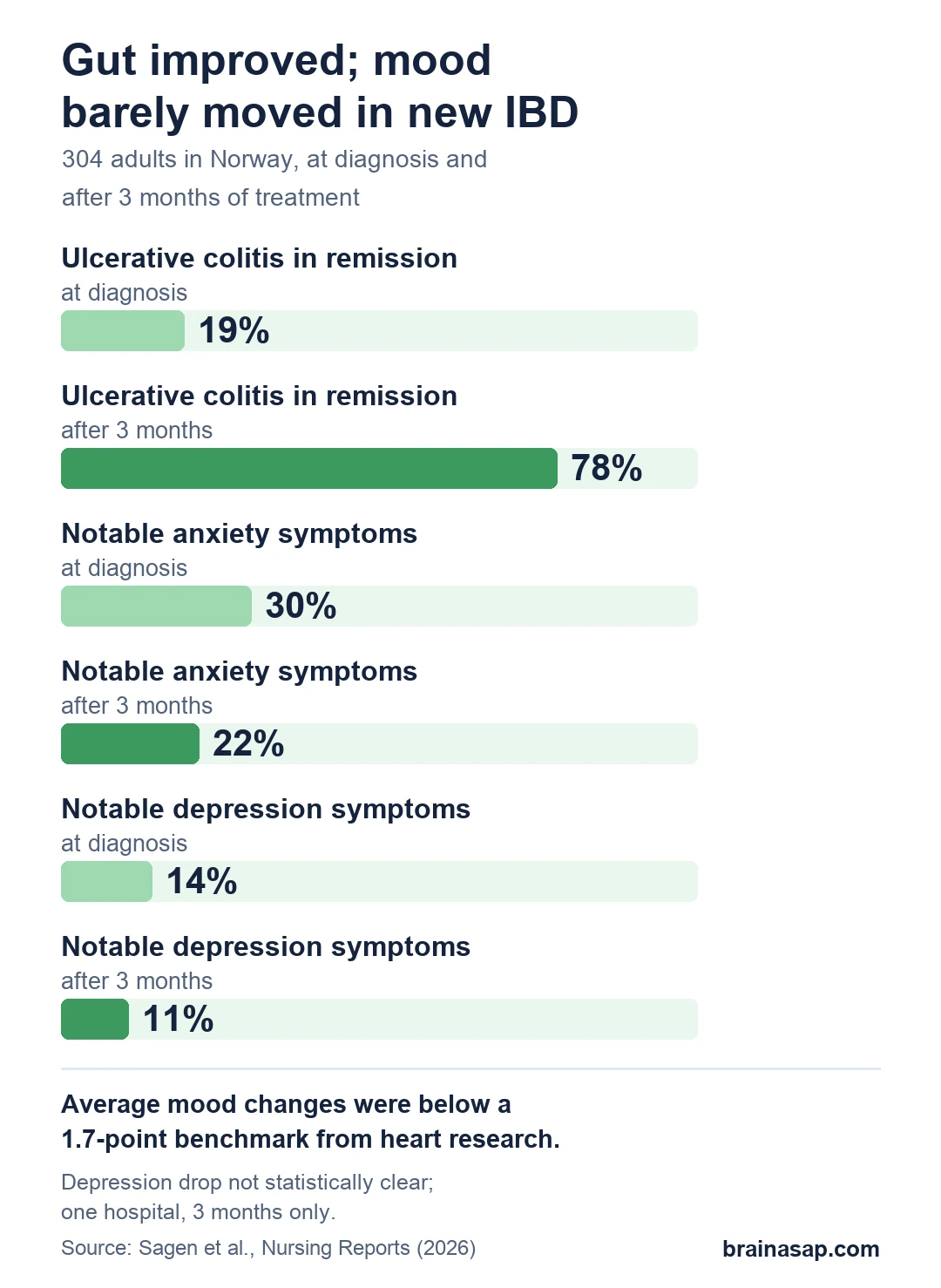
Gut symptoms improved sharply. Remission rose from 19% to 78% in ulcerative colitis and from 54% to 79% in Crohn's disease.
Mood changed far less:
- Anxiety: average score down 0.75 points out of 21
- Depression: average score down 0.57 points out of 21
- Benchmark cited from cardiovascular research: about 1.7 points
After accounting for gut symptoms, age, sex and other factors, the team found no clear change in anxiety or depression over the 3 months.
What Went With More Distress?
- Worse gut symptoms: the strongest link, especially the Crohn's symptom score, which includes pain and general well-being
- Younger age: more distress at diagnosis; this link faded by 3 months
- Being a woman: more anxiety at both visits, though the gap was small; no gap for depression
- Type of IBD: no difference between ulcerative colitis and Crohn's disease
Lab results told a different story. Stool calprotectin, a marker of gut inflammation, plus body weight and vitamin levels showed no link with anxiety or depression. Blood CRP had only a weak link with depression symptoms.
What Limits These Findings?
- Only 3 months: Low mood may take longer to lift than gut symptoms.
- One hospital: Stavanger, Norway, with patients recruited up to 2019; IBD care has changed since.
- Dropouts: 47 of 351 enrolled did not finish, and they may have differed from those who did.
- Not measured: Fatigue, coping, sleep, social support and other life stresses.
- Self-report: Anxiety and depression were questionnaire scores, not diagnoses.
Should IBD Care Check Mood From Day One?
Sagen and colleagues argued that calming the gut alone won't reliably ease distress, so IBD nurses should screen for anxiety and depression from diagnosis onward, with extra attention to younger patients and women. Whether early screening and support would improve how patients feel over the longer term is the next question.
Citation: DOI: 10.3390/nursrep16090301 Sagen ÅM, Eide GE, Grimstad T, Reime MH. Associations Between Anxiety, Depression, and Disease Activity in Newly Diagnosed Patients with Inflammatory Bowel Disease: A Prospective Cohort Study. Nursing Reports. 2026;16:301.
Study Design: Prospective single-center cohort (SUSI study); HADS at diagnosis and 3 months after treatment start; Harvey–Bradshaw Index (CD) and Partial Mayo Score (UC); paired tests, McNemar, multivariable regression and mixed linear models.
Sample Size: 304 newly diagnosed adults with IBD (226 UC, 78 CD) completing follow-up, of 351 enrolled; Stavanger University Hospital, Norway, 2012–2019.
Key Statistic: HADS-A ≥8: 29.8% → 21.6%; HADS-D ≥8: 14.2% → 10.6% (n.s.); HADS-T ≥15: 22.2% → 16.3%. Mean change HADS-A −0.75 (95% CI −1.08 to −0.41), HADS-D −0.57 (−0.92 to −0.23); d = −0.19 to −0.26; MCID 1.7. Adjusted mixed models: no significant time change. HBI adjusted R² 0.073 (HADS-A), 0.128 (HADS-D), 0.141 (HADS-T).
Caveat: Single center; 3-month follow-up; attrition (47 of 351); recruitment 2012–2019; self-report; key psychosocial confounders unmeasured.