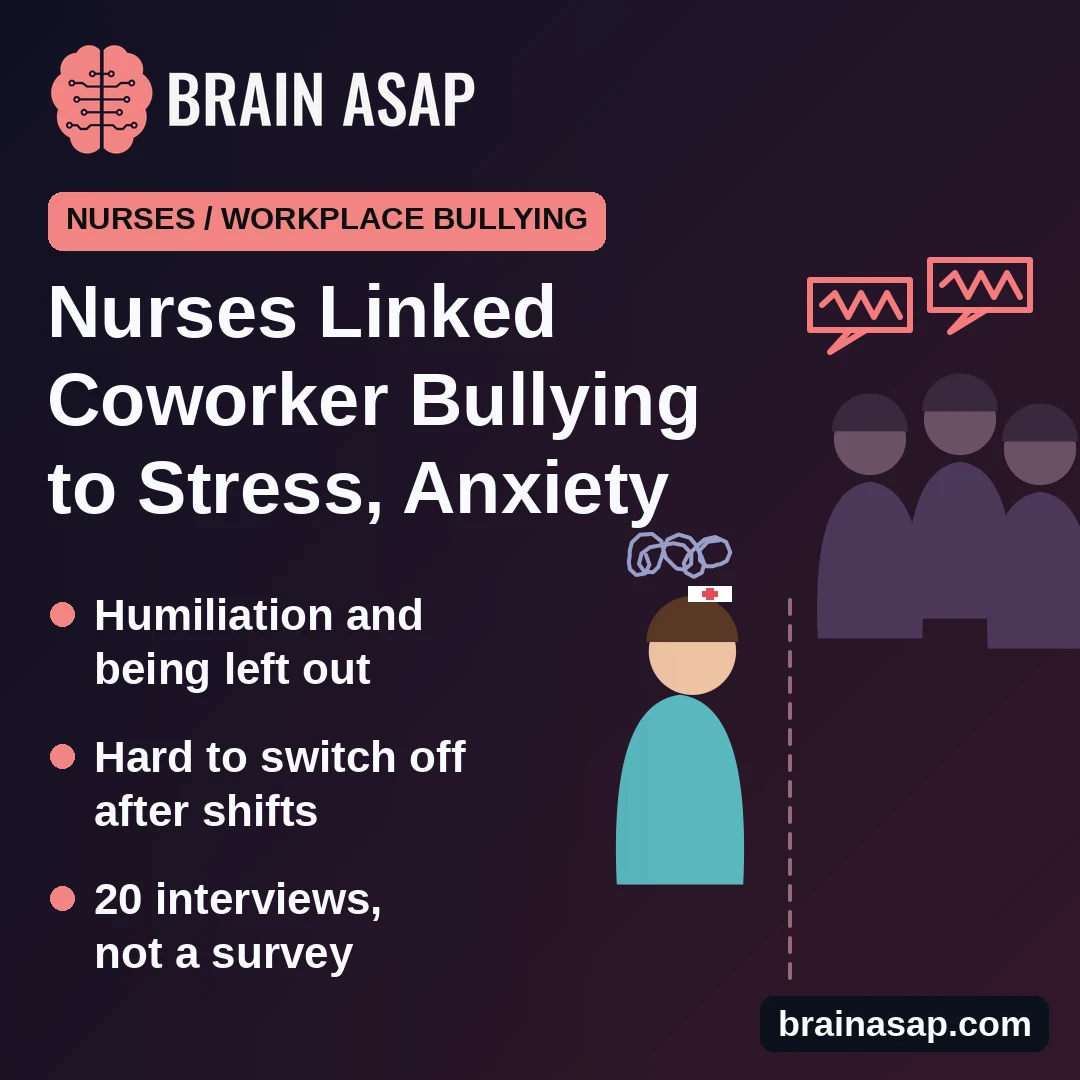
TL;DR: In a 2026 interview study, 20 nurses in Slovenia described being bullied by their own colleagues through insults, humiliation, being left out and hostile talk. They said it left them stressed, anxious, worn out and less confident, and made it hard to stop thinking about work at home.
Key Findings
- Bullying felt common and ongoing: Nurses described verbal abuse, humiliation, social exclusion and hostile communication from fellow staff.
- Mental health toll: They linked the bullying to stress, anxiety, emotional exhaustion and lower self-confidence.
- Work followed them home: Nurses described trouble switching off after a shift.
- Personal accounts, not a count: With 20 interviews, this research can't say how many nurses are bullied or prove what bullying causes.
Source: Journal of Clinical Nursing (2026) | Svetlin and Peršolja
Nursing is stressful enough with sick patients and long shifts. For some nurses, the hardest part of the job is the people they work beside.
Bullying among nurses has been reported in many countries. A new study asked nurses in Slovenia to describe, in their own words, what it's like.
Interviews With 20 Nurses
A 2026 study in the Journal of Clinical Nursing by Anton Grmšek Svetlin and Melita Peršolja of the University of Primorska interviewed 20 nurses. They worked in a range of healthcare settings in Slovenia and were chosen because they could speak to the topic.
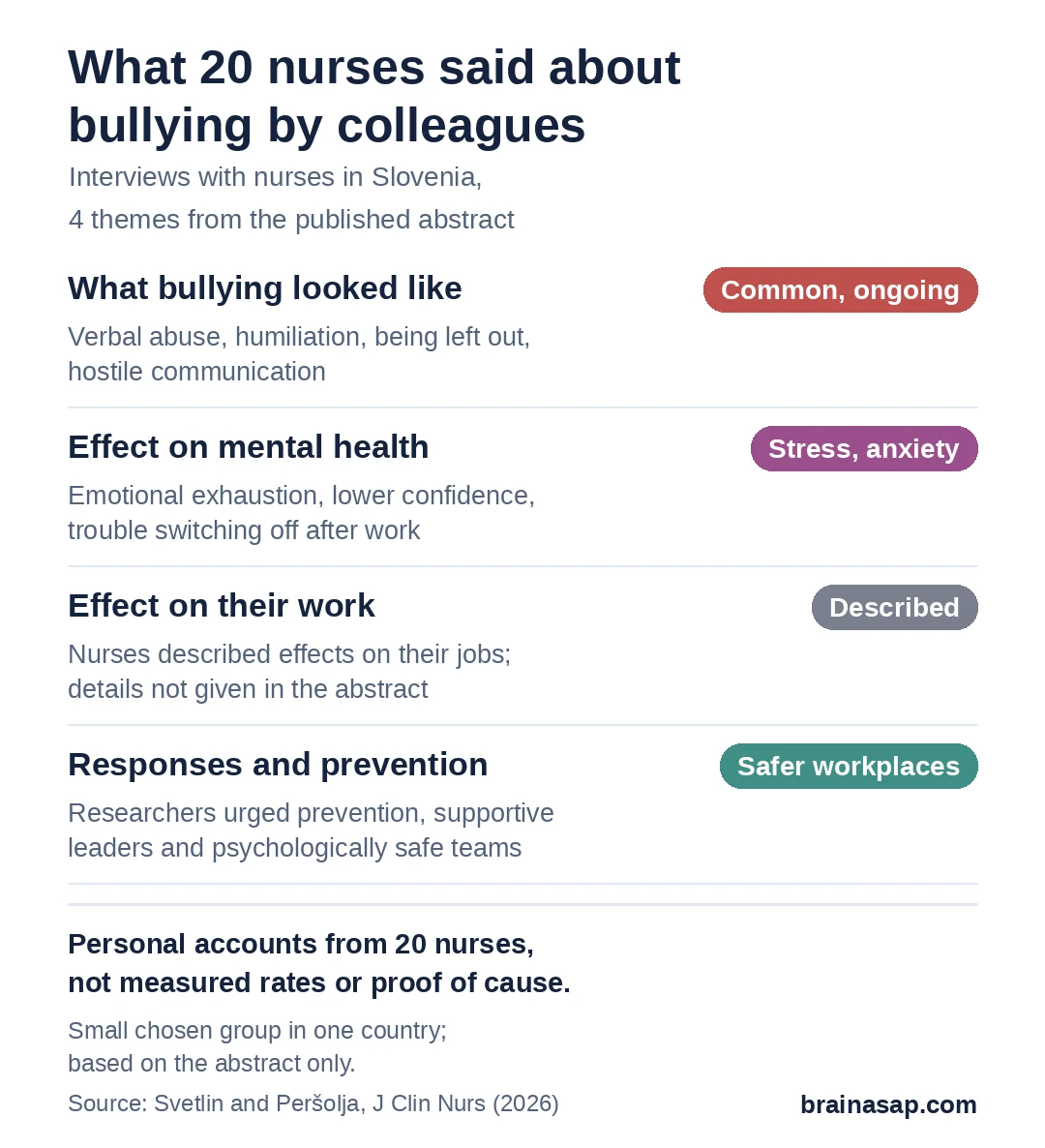
Each nurse took part in a semi-structured interview, with planned topics and room to describe their own experience of bullying by colleagues. Researchers recorded and transcribed the interviews, then grouped what nurses said into recurring themes:
- What bullying looked like
- How it affected their mental health
- How it affected their work
- How nurses responded, and what might prevent it
Insults, Humiliation and Being Left Out
Nurses described bullying by colleagues as common and persistent, not a one-off clash. Behaviors they named included:
- Verbal abuse
- Humiliation
- Social exclusion, such as being shut out by coworkers
- Hostile communication
Stress, Exhaustion and Trouble Switching Off
Nurses said the bullying wore on their mental health. They described:
- More stress and anxiety
- Emotional exhaustion
- Lower self-confidence
- Difficulty detaching from work once they got home
Nurses also described effects on how they did their jobs, and talked about how they responded to bullying. Those parts aren't detailed in the published abstract.
What 20 Interviews Can and Can't Show
- Small, chosen group: nurses were picked to speak about the topic, not drawn at random
- One country: all worked in Slovenia
- Experiences, not measurements: no rates of bullying or mental health scores were reported
- Abstract only: this article is based on the published abstract; the full paper, with nurses' own quotes, was not available to us
Call for Safer Workplaces
Svetlin and Peršolja urged hospitals and clinics to take bullying prevention seriously. They called for supportive leadership and workplaces where nurses feel safe to speak up.
Whether specific anti-bullying programs actually reduce bullying and protect nurses' mental health is the question future studies will need to answer, ideally by measuring both before and after a change.
Citation: DOI: 10.1111/jocn.70640. Svetlin AG, Peršolja M. Colleague-Perpetrated Workplace Bullying Among Nurses: Experiences and Perceived Implications for Mental Health and Professional Functioning: A Qualitative Study. Journal of Clinical Nursing. 2026. PMID: 42998051.
Study Design: Qualitative descriptive study; semi-structured interviews; purposive sampling; Braun and Clarke's six-phase thematic analysis.
Sample Size: 20 nurses from different healthcare settings in Slovenia.
Key Statistic: 4 themes: experiences of bullying; impact on mental health; impact on professional functioning; responses and prevention strategies.
Caveat: Small purposive sample in one country; perceived experiences, not prevalence or proof of cause. This article relies on the PubMed abstract only.