TL;DR: A 2026 review looked for studies comparing memory and thinking test scores of older Latin American immigrants with those of people born in their new country, and found only 3, all on Mexican-born adults in the United States. Those adults scored lower than white Americans, but the gap was mostly linked to less schooling and lower income, and their scores did not fall faster with age.
Key Findings
- Very little research: of 188 papers screened, only 3 compared older Latin American immigrants with people born in the host country. All 3 were from the United States and mainly studied Mexican-born adults.
- Lower scores at first: Mexican-born adults scored lower than white adults born in the United States on memory and thinking tests.
- Gap mostly linked to schooling and income: in 1 study, the gap for Mexican-born men was no longer statistically clear once education and income were accounted for. In another, Mexican-born adults ended up with a lower risk of memory and thinking problems after accounting for education, wealth and neighborhood.
- Women's gap stayed: Mexican-born women still scored lower than US-born white women after education and income were accounted for.
- No faster decline: over up to 24 years, Mexican-born adults' scores fell at a similar or slower pace than those of US-born white adults.
Source: Frontiers in Aging Neuroscience (2026) | Ribeiro, Capitao and Teixeira-Santos
Millions of people who moved from Latin America to wealthier countries are now reaching their 60s, 70s and 80s. Whether their memory holds up as well as that of people born in those countries is a big question for families and health systems.
Surprisingly, almost no one has studied it directly.
A 2026 review in Frontiers in Aging Neuroscience, by researchers at the University of Luxembourg, searched 5 research databases for studies that compared older Latin American immigrants with people born in their new country on memory and thinking.
Why Only 3 Studies Made the Cut
This search turned up 188 unique papers. Most did not clearly say who was an immigrant. Many lumped everyone together as "Hispanic" or "Latino", which mixes people born abroad with their children and grandchildren born in the host country.
To count, a study had to include:
- First-generation immigrants: people born in a Latin American country, aged 50 or older, living in another country.
- A clear comparison group: people of the same age born in that host country.
- A real memory or thinking test, not just people's own sense of being forgetful.
Only 3 studies met all 3 rules. All came from the United States, all used a long-running national survey of older Americans, and all mainly studied people born in Mexico.
Who Was Compared With Whom?
In this article, 2 groups come up again and again:
- Mexican-born adults: people born in Mexico and living in the United States, aged 50 or older.
- US-born white adults: people born in the United States who identified as white and not Hispanic.
Two of the 3 studies also included Mexican Americans born in the United States. One study included 994 Mexican-born adults. Another reported more than 70,000 observations of US-born white adults, but those were repeated survey observations, not that many individual people.
Tests were survey-style, often over the phone: remembering a list of words, counting backward, subtracting 7s and naming the date. None of the 3 studies used a doctor's diagnosis of dementia.
Lower Scores, Mostly Linked to Schooling and Income
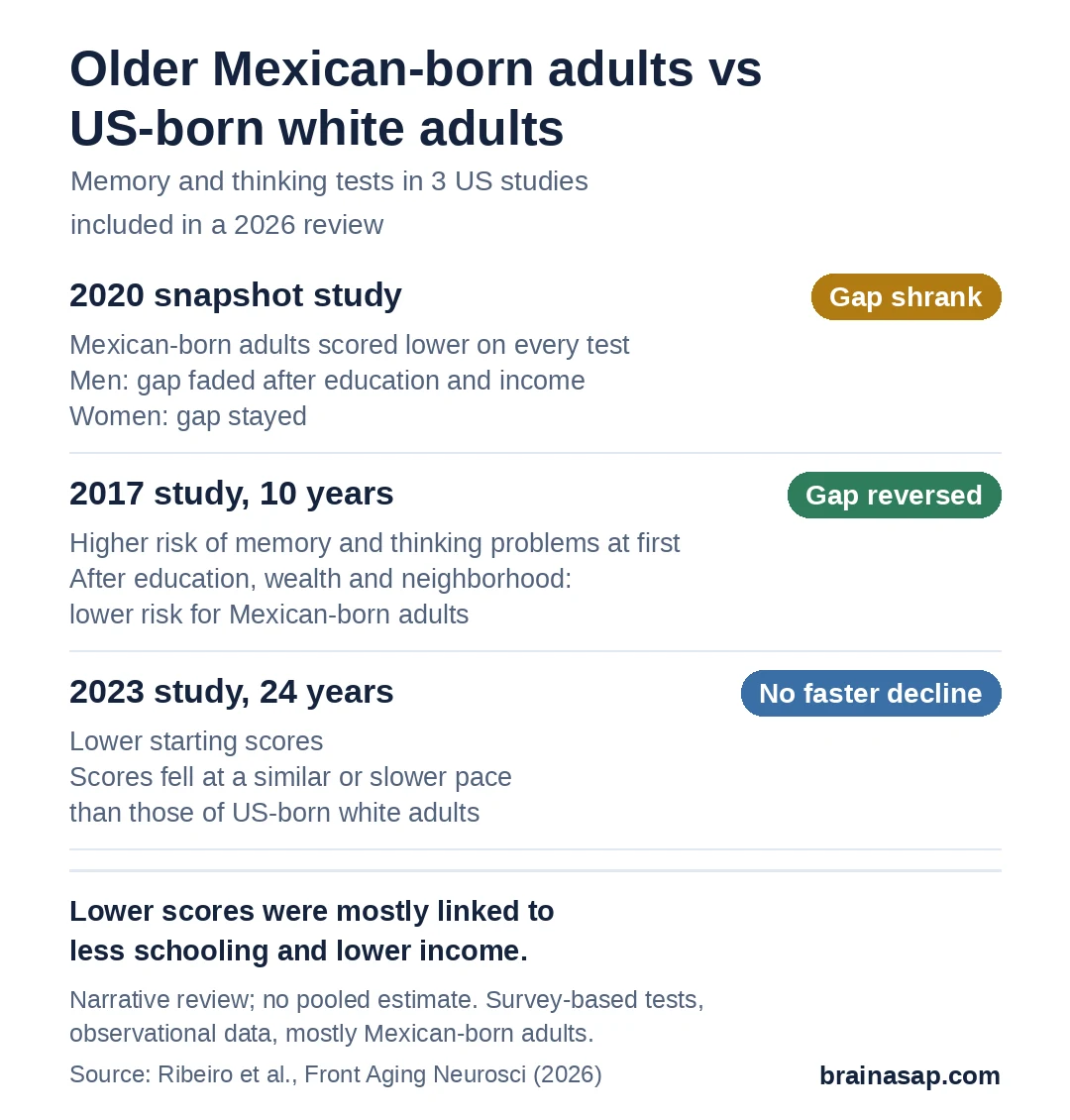
All 3 studies found that Mexican-born adults started out with lower memory and thinking scores than US-born white adults. What changed the picture was accounting for education and money.
- 2020 snapshot study: Mexican-born adults scored lower on every test. For men, the gap was no longer statistically clear after education and household income were accounted for. Health factors such as heart disease, weight, smoking and depression changed the results very little.
- 2017 study over 10 years: Mexican-born adults at first had a higher risk of developing memory and thinking problems. After accounting for education, wealth and the neighborhood's income level, that flipped. Mexican-born adults then had a lower risk than US-born white adults.
- 2023 study over 24 years: Mexican-born adults had lower starting scores, but their scores fell at a similar or slower pace than those of US-born white adults.
Put simply, lower scores were largely linked to fewer chances for schooling and good pay over a lifetime, not to faster brain aging.
Why Women Stood Apart
Only 1 study looked at men and women separately. For Mexican-born women, the gap with US-born white women stayed even after education and income were taken into account.
Ribeiro and colleagues suggested that a lifetime of unequal chances could explain this, including fewer school years, reasons for moving, work outside the home and caregiving duties. No included study tested those ideas directly.
A Possible "Healthy Migrant" Edge
An idea called the healthy migrant effect holds that people who move abroad tend to be healthier or more resilient than those who stay home. It may help explain the "Hispanic paradox", where Hispanic Americans often live longer than their income levels would predict.
Results from the 2017 and 2023 studies fit that idea for memory and thinking, but only after accounting for disadvantages such as less schooling. In the review's words, this points to protective factors and ongoing social disadvantage existing side by side, rather than a clear advantage.
What 3 Studies Can't Show
- Mostly Mexican-born adults in the United States: results may not apply to people from Central America, South America or the Caribbean, or to immigrants in Spain or Canada.
- No combined estimate: each study measured memory differently, so the review could not pool them into 1 number.
- Survey tests only: none used a clinical diagnosis of dementia or mild memory problems.
- Observational data: differences are linked to education and income, but these studies can't prove what caused them.
- Who takes part matters: language barriers, dropout and people moving back home may affect who shows up in surveys.
Research on Other Latin American Immigrants Is Needed
For now, the best available evidence suggests that lower memory test scores among older Mexican-born adults in the United States mostly track lifelong gaps in schooling and income.
An open question is whether the same holds for immigrants from other Latin American countries, and why Mexican-born women's gap did not close. Answering it will take studies that record exactly where people were born, when they moved and how long they have lived in their new country.
Citation: DOI: 10.3389/fnagi.2026.1860593. Ribeiro F, Capitao T, Teixeira-Santos AC. Cognitive ageing among older Latin American immigrants: current evidence and limitations. Front Aging Neurosci. 2026;18:1860593.
Study Design: Systematic mini-review following PRISMA (PROSPERO CRD420261299157); 5 databases searched December 2025; narrative synthesis.
Sample Size: 188 records screened, 9 full texts reviewed, 3 studies included (all US Health and Retirement Study data; 1 also used the Mexican Health and Aging Study).
Key Statistic: 3 of 188 screened studies met criteria; all compared mainly Mexican-born adults with US-born non-Hispanic white adults.
Caveat: Very small, US-only, mostly Mexican-origin evidence base; differing cognitive measures and no pooled effect; observational data.