TL;DR: Many people with Parkinson's still have hours of "off" time each day, when medicine stops working, even on the best regular treatment. Two German neurologists argue that fast-acting "rescue" medicines should be part of everyday care, especially for slow starts in the morning.
Key Points
- Off periods are common and early: About half of people have them within 5 years of diagnosis.
- Mornings are hardest: In one study, about 60% reported early-morning off symptoms.
- Regular treatment leaves gaps: Add-on pills and devices cut 0.5 to 4 hours of daily off time, but hours often remain.
- Fast options skip the gut: Injection, under-the-tongue film and inhaler work in minutes.
- Trade-offs: Side effects, training and cost differ a lot; no head-to-head trials.
Source: Journal of Neural Transmission (2026) | Weise and Gandor
Levodopa is still the best treatment for Parkinson's, but over time its effect starts to wear thin between doses. People slip into "off" periods: stiffness, slowness and shaking come back, sometimes with anxiety, pain or a rush to the bathroom. Off periods often hit hardest first thing in the morning, before the first pill kicks in.
Fast-acting "on-demand" medicines exist for these moments, but they are usually saved for emergencies. In this expert review, two neurologists argue that view is out of date.
Off Periods Start Earlier Than Many Expect
The authors gather evidence that these ups and downs, called fluctuations, are close to universal:
- Movement fluctuations: 54% of people within 5 years of diagnosis and 100% within 10 years in one long-term study.
- Not caused by starting levodopa early: Several studies, including a 2024 meta-analysis, found delaying levodopa did not prevent them.
- Non-movement fluctuations: About 40% by 8 to 10 years, with fatigue most common. These can be as disabling as movement symptoms.
- Morning off: About 60% of 320 patients reported it. A wearable sensor study of 3,288 patients flagged morning slowness in 85%.
Why Pills Don't Always Kick In
Part of the problem is in the gut, not the brain. Levodopa is absorbed in the small intestine, and Parkinson's can slow the stomach, make swallowing harder and change gut bacteria that break down the drug. That can lead to a dose that works late ("delayed on") or not at all ("no on").
Regular add-on pills reduce daily off time by about 0.5 to 2.5 hours. Device treatments, like deep brain stimulation and drug pumps, cut it by 2.5 to 4 hours. But people in those trials started with 3 to 7 hours of off time a day, so many still have hours left.
Four Fast-Acting Options
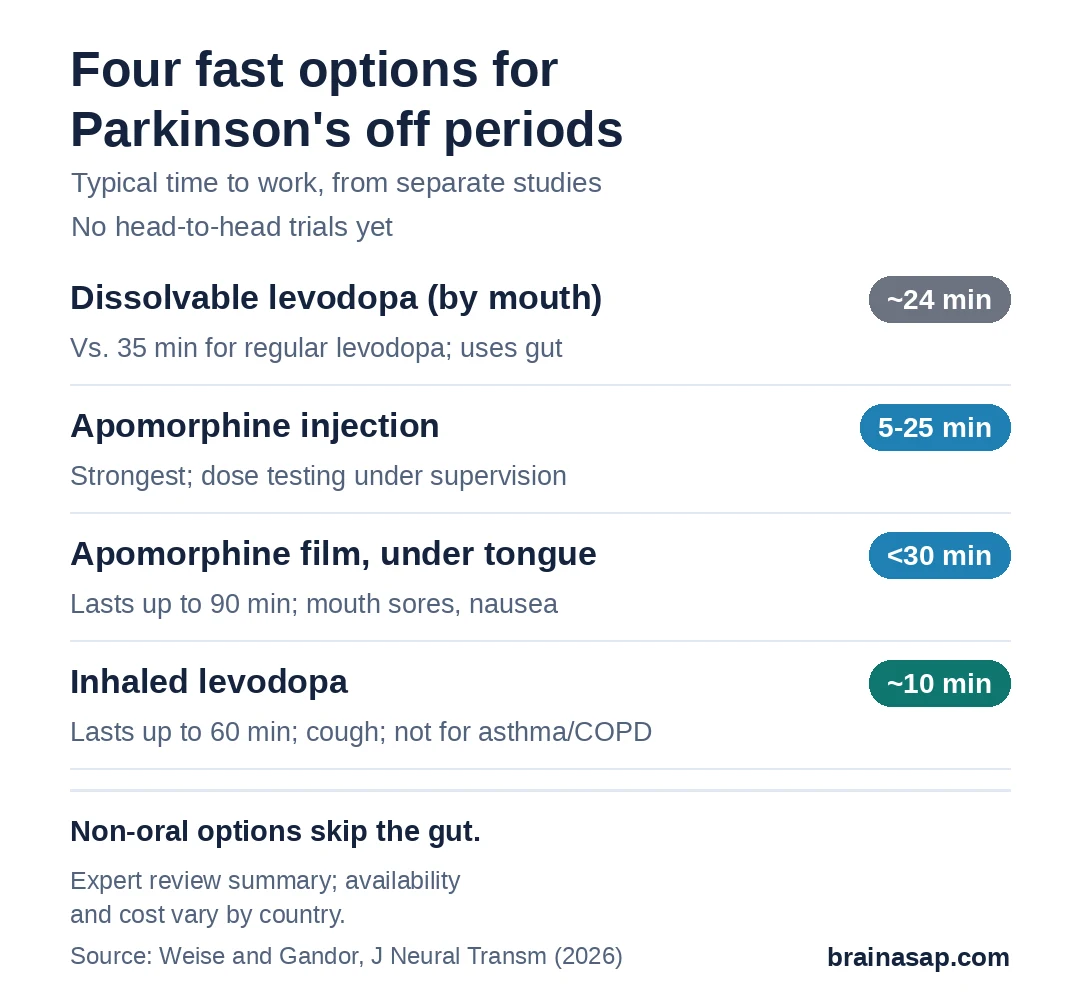
- Dissolvable levodopa: Cheap and widely used in Europe and Asia. Still goes through the gut.
- Apomorphine injection: Fastest and strongest; up to 95% of people respond. Needs dose testing under supervision and can cause nausea, low blood pressure and skin reactions.
- Apomorphine film under the tongue: No needle. Mouth sores and nausea led many people to quit in a long-term study. Not available in the US, Canada or Australia.
- Inhaled levodopa (Inbrija): No injection or dose testing. Cough is common, and it is not recommended for people with asthma or COPD.
The Case for Using Them Daily
The authors suggest treating these medicines as a regular tool alongside standard treatment, not a last resort. They see the clearest use for:
- Early-morning off
- Doses that work late or not at all
- Swallowing problems or a slow stomach
- Planned activities, such as exercise or a social event
Using a rescue medicine as part of a routine is also easier to learn than using it for the first time in a sudden emergency, they note.
What's Still Unproven
- Opinion piece: An expert review, not a new trial or systematic analysis.
- Non-movement symptoms: These medicines are not approved for them, and evidence is limited.
- Total off time: Fast relief for one episode may not shrink total daily off time much, as seen with inhaled levodopa.
- Cost: Newer options cost several times more than dissolvable levodopa.
- Industry ties: Both authors report consulting fees or honoraria from drug companies, including makers of Parkinson's treatments.
For people with Parkinson's who lose the first hours of each day to stiffness and slowness, this review is a reason to ask their neurologist whether a fast-acting option fits. Which one, and how often, depends on side effects, other health conditions, handling and cost.
Citation: DOI: 10.1007/s00702-026-03288-9. Weise D, Gandor F. On-demand therapies–emergency medication or daily routine? J Neural Transm. 2026.
Study Design: Expert perspective / narrative review.
Sample Size: Not applicable; summarizes published trials and cohort studies.
Key Statistic: Motor fluctuations reached 54% within 5 years and 100% within 10 years of diagnosis in one cohort (Kim et al. 2020).
Caveat: Opinion-based review without systematic methods; authors report industry consulting and honoraria.