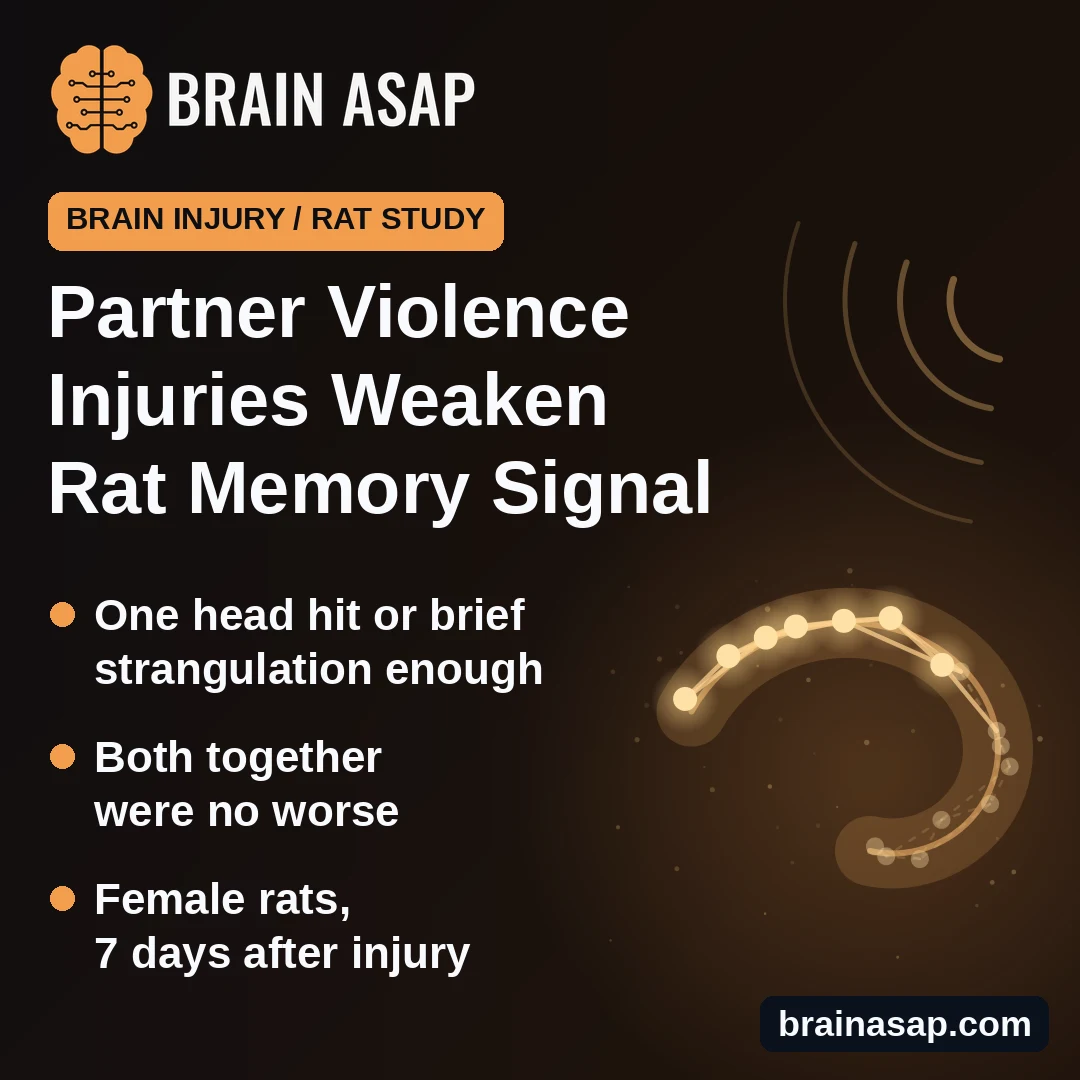
TL;DR: In female rats, a single concussion-type head hit or a brief strangulation weakened a brain-cell signal linked to memory a week later. Getting both injuries together was no worse than getting one.
Key Findings
- 51 female rats, 4 groups: No injury, head hit, strangulation, or both.
- Memory signal weaker after every injury: Lower in one memory region (CA1) in all 3 injured groups, compared with uninjured rats.
- Both injuries no worse than one: No clear difference among the 3 injured groups.
- Second memory region spared: Same signal in the dentate gyrus was unchanged.
- Strangulation hit hardest right away: Lower oxygen, longer breathing pauses, slower recovery of reflexes.
Source: Hippocampus (2026) | Brand et al.
About 1 in 4 women experience intimate partner violence at some point in life, and attacks often target the head and neck. Survivors frequently report memory problems. But a blow to the head and a hand around the throat hurt the brain in different ways, and most brain injury research has studied men and sports concussions.
A team at the University of Victoria in Canada used female rats to ask a narrow question: does either injury, or both together, change how brain cells strengthen their connections, a process thought to underlie memory?
Two Injuries That Often Happen Together
Brain injury from partner violence is unusual because it often combines two things:
- Concussion: Brain shaken or bruised by a blow.
- Nonfatal strangulation: Pressure on the neck cuts air and blood flow to the brain, then flow rushes back.
Earlier work from the same research group found that rats given both injuries did worse on a maze memory test than rats given either one alone. The researchers expected the combination to also do more damage at the level of brain cells.
How the Rats Were Injured
The researchers used 51 young adult female rats, all under anesthesia and pain medicine during the procedures. Rats were randomly assigned to one of four groups:
- No injury (12 rats): Same anesthesia and setup, but no injury.
- Head hit (12): A small weight struck the side of the head, a model of concussion.
- Strangulation (11): A weighted band pressed across the windpipe for 90 seconds.
- Both (16): Head hit and strangulation in the same session.
Each rat had one injury session only. A week later, the researchers took thin slices of each rat's hippocampus, a brain region central to memory, and measured long-term potentiation. That is the lasting boost in a connection between nerve cells after a burst of activity. It is a lab stand-in for learning, not a memory test.
Any Single Injury Weakened the Memory Signal
In the CA1 region of the hippocampus, which helps store memories of places and new objects, all three injured groups had weaker long-term potentiation than the uninjured rats. The overall group difference was strong (p = 0.0006).
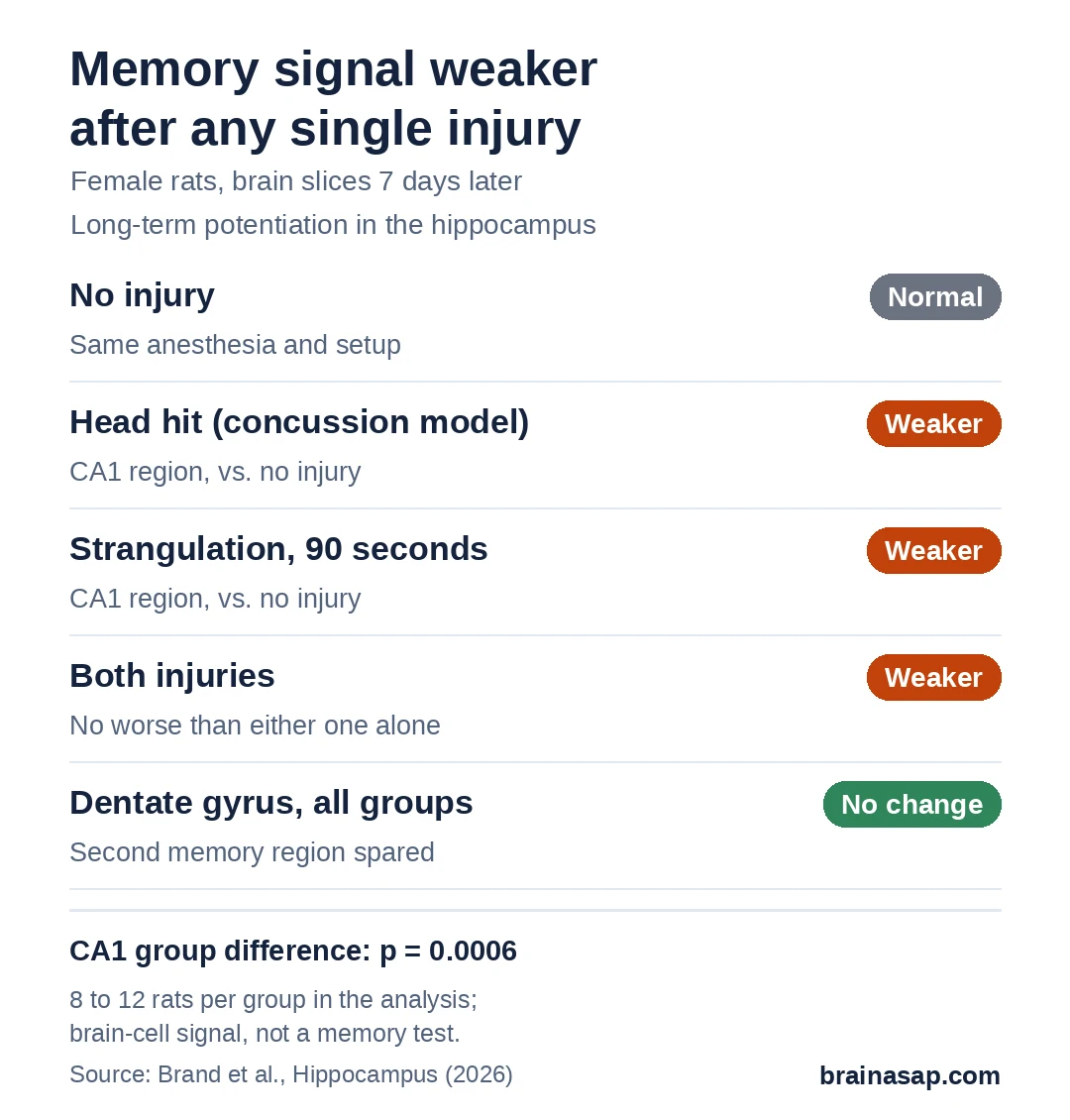
The surprise was the combination. Rats that got both injuries were not worse off than rats with just one. The authors suggest the test may have hit a "floor," meaning one injury already pushed the signal about as low as this method could show.
Some other details:
- Dentate gyrus unchanged: Another memory region showed normal long-term potentiation in every group.
- Short-term boost unchanged: The first minute after stimulation looked normal everywhere.
- Baseline wiring shifted: CA1 cells were more excitable after both injuries, while dentate gyrus responses were lower in all injured groups.
Strangulation Was the Harsher Injury in the Moment
Right after injury, the two strangulation groups stood out. Their blood oxygen and heart rate dropped, they paused breathing longer, and they took longer to react to a pinch and to flip back onto their feet. They also scored lower on a quick 12-point check of reflexes and balance than rats with only a head hit.
Across all rats, longer breathing pauses and slower righting were linked to weaker CA1 signals. Within each group, though, those links were not clear.
Why These Rat Results Can Only Go So Far
- Rats, not people: Injuries were done under anesthesia, without the fear and stress of real abuse.
- One injury, one week: Survivors often face repeated attacks over years.
- Cell signals, not memory: No memory tests were done in this study.
- Small final groups: 8 to 12 rats per group in the main analysis after some recordings were excluded.
- Females only: On purpose, since partner violence mostly affects women, but limits comparison.
Repeated Injuries Are the Next Question
The study suggests that even one concussion-type blow or one brief strangulation can disturb how memory cells strengthen their links, at least in rats. That fits with survivors' reports of memory trouble, without proving the same thing happens in people.
The open question is what happens with repeated injuries over months, which is closer to what many survivors experience. The authors plan to test that next.
Citation: DOI: 10.1002/hipo.70135. Brand J, Eyolfson E, Suesser KRB, et al. Impaired synaptic plasticity in a rodent model of intimate partner violence-related brain injury. Hippocampus. 2026;36:e70135.
Study Design: Randomized animal study; field recordings in hippocampal slices 7 days after a single injury.
Sample Size: 51 female rats (12 no injury, 12 head hit, 11 strangulation, 16 both); 36 in the CA1 analysis.
Key Statistic: CA1 long-term potentiation reduced in all injured groups vs. uninjured (F(3,32) = 7.50, p = 0.0006); no differences among injured groups.
Caveat: Single injury, one time point, no behavioral memory testing; rat model under anesthesia.