TL;DR: In a 2026 online survey of 890 young adults in China, people who played or had learned piano reported feeling slightly more connected to others, and slightly less stressed and anxious, than people who didn't play.
Those gaps were small, and a one-time survey can't show that piano playing caused them.
Key Findings
- Slightly calmer: Piano players scored about 2 points lower on a 40-point stress questionnaire and about 1 point lower on a 21-point anxiety questionnaire than non-players.
- More connected: Piano players also felt a bit closer to the people around them.
- Small differences: Scores in the 2 groups overlapped heavily.
- No clear practice-history link: Among piano players, how many years or how often they played showed no clear association with their stress or anxiety.
Source: Frontiers in Psychology (2026) | Tan
Playing an instrument is often recommended as a way to unwind. But does it go along with better mental health, and if so, why?
A 2026 study in Frontiers in Psychology, by Jie Tan at Sichuan Normal University's Music College, surveyed piano players and non-players to look for clues.
Who Answered the Survey?
From March to June 2026, links to an online questionnaire were shared on social media and online communities in China. After removing incomplete and careless answers, 890 responses remained.
- Age: 18 to 45, average about 25
- Women: 58%
- Piano group: 572 people who said they had piano experience or were currently practicing
- Non-piano group: 318 people who said they had never learned or didn't play at all now
Among the piano group, about a third had played for less than a year, and only about 1 in 6 practiced 5 or more times a week.
What Did the Questionnaires Measure?
Everyone answered 3 standard questionnaires:
- Feeling connected to others: how much a person feels they belong and are understood, scored 7 to 42.
- Stress: how unpredictable and overloaded life felt over the past month, scored 0 to 40.
- Anxiety: how often people felt nervous, worried or restless over the past 2 weeks, scored 0 to 21.
Piano players also rated how absorbed they usually get while playing, a state psychologists call "flow," where time seems to fly and attention locks on the music.
How Did Piano Players Compare?
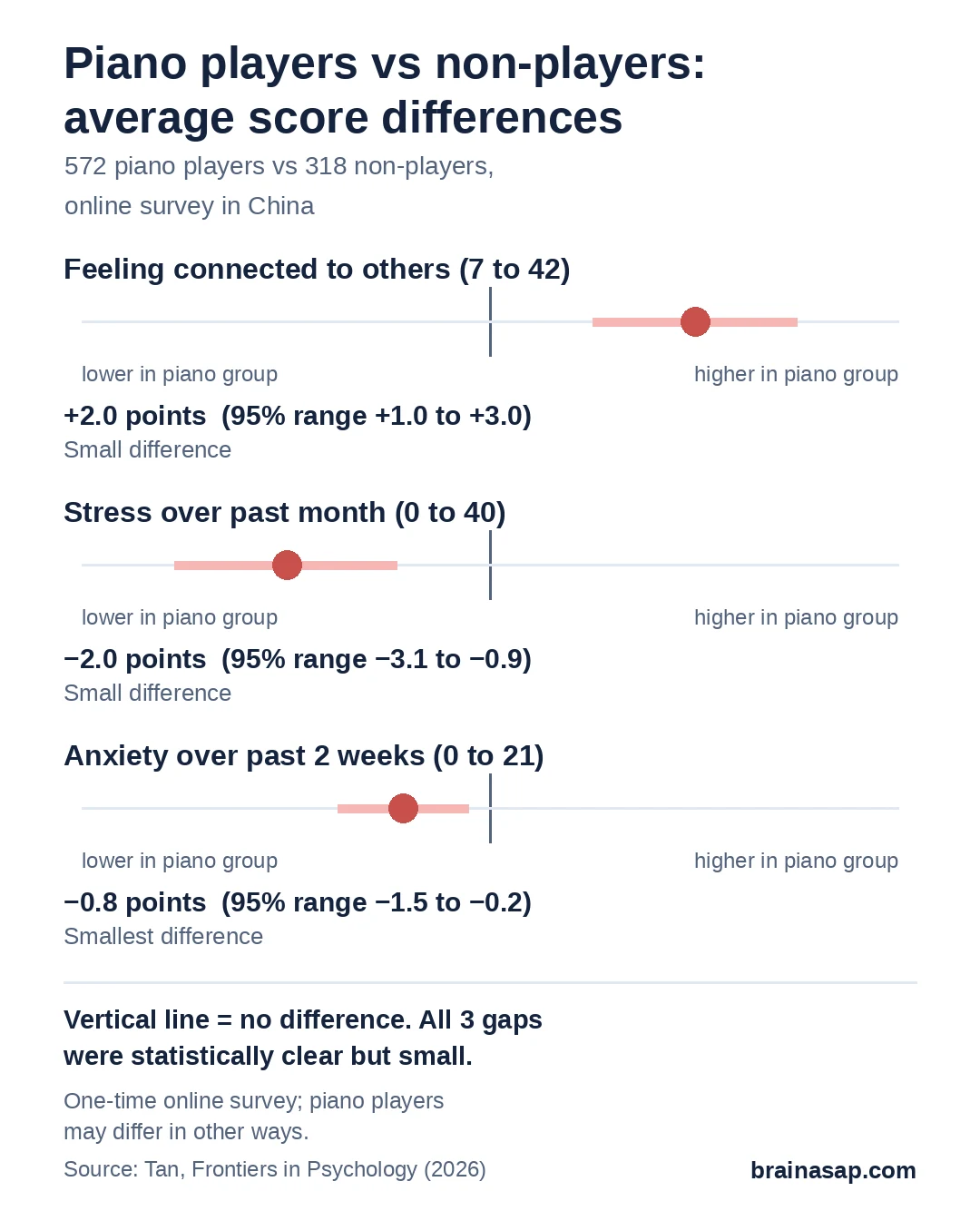
Average scores, piano players vs non-players:
- Feeling connected: 25.3 vs 23.3
- Stress: 19.3 vs 21.3
- Anxiety: 10.2 vs 11.0
All 3 differences were statistically clear but small. Most piano players and non-players had similar scores; the averages just leaned slightly in the piano group's favor.
Is Feeling Connected the Missing Link?
Within the piano group, Tan tested one possible chain: getting absorbed in playing, then feeling more connected to others, then feeling less stressed, then less anxious.
- Absorption and connection: players who got more absorbed felt more connected to others
- Connection and stress: those who felt more connected reported less stress
- Stress and anxiety: less stress went with less anxiety
- No direct link: absorption alone wasn't linked to stress or anxiety
The full chain was statistically detectable but tiny, and the overall indirect link from absorption to anxiety wasn't clear. Years of practice didn't change these links either.
What the Survey Can't Tell Us
- Snapshot only: Calmer, more sociable people may be more likely to take up piano, rather than the reverse.
- Other differences: Piano lessons often go with more family money, time and education, which this comparison of groups didn't account for.
- Fuzzy groups: The answer options mixed past and current playing, so some former players may sit in either group.
- Self-selected sample: People who saw survey links on social media in China, not a representative group.
- Shortened questionnaires: The absorption and connection questionnaires were cut-down versions made for this study.
Would Learning Piano Lower Anxiety?
This survey can't answer that. A trial that gives some adults piano lessons, and compares their stress and anxiety over months with people who don't get lessons, would be the real test.
It would also show whether any benefit comes from the music itself or from the social side of lessons and playing with others.
Citation: DOI: 10.3389/fpsyg.2026.1957899 Tan J. The association pathway between music practice and mental health: a study on social connectedness, perceived stress, and anxiety among individuals with piano experience. Frontiers in Psychology. 2026;17:1957899.
Study Design: Cross-sectional online convenience survey (March–June 2026); independent t-tests between groups; serial indirect-effect model with 5,000 bootstrap resamples and moderation test within the piano group.
Sample Size: 890 adults aged 18–45 in China (572 with piano experience or currently practicing; 318 never learned or not playing now).
Key Statistic: Social connectedness 25.32 vs 23.31 (d = 0.28; difference 2.01, 95% CI 1.01–3.01); PSS-10 19.28 vs 21.27 (d = 0.25; 0.91–3.09); GAD-7 10.18 vs 11.03 (d = 0.18; 0.21–1.49). Serial indirect effect B = −0.039 (95% CI −0.059 to −0.023); total indirect effect not significant.
Caveat: Cross-sectional, self-selected online sample; group options mix past and current practice; abbreviated scales; no causal inference.