TL;DR: In 34 trials of children and teens with cancer, those given supportive programs like play or art did better on anxiety and pain than those who were not. But the trials were small and varied.
Key Findings
- Anxiety: Across 7 trials, program group had a medium-sized drop in anxiety versus comparison group (effect size 0.57).
- Pain: Across 5 trials, program group reported less pain (effect size 1.10). Trials disagreed a lot, so true size is uncertain.
- Working memory: Two small trials of computer-based memory training showed a medium-sized gain (effect size 0.54).
- Not clear: Depression, coping, fatigue, and quality of life showed no clear difference between groups.
- Timing gap: None of the 34 trials began support before cancer treatment started.
Source: Supportive Care in Cancer (2026) | Paterson et al.
Does a visit from a therapy dog, an afternoon of art, or a computer game for memory really help a child with cancer? Hospitals and families have tried all of these, and many more.
The need is real. A cancer diagnosis in childhood means long hospital stays, missed school, frightening procedures, and time away from friends. Earlier research found that nearly half of children in one study met the criteria for an anxiety or depressive disorder at some point in the first year after diagnosis. Some treatments also leave lasting effects on attention and memory. This review pooled the trials to see what holds up.
What the Review Covered
The team searched five research databases for randomized or quasi-randomized trials. In these trials, children and teens aged 0 to 19 with cancer took part in a psychosocial program and were compared with a group that did not. The researchers found 34 trials with 1,988 young people in 17 countries. Individual trials were small, from 13 to 178 children each.
Psychosocial program here means a non-drug approach aimed at emotional, social, or thinking skills. The trials included:
- Play, art, music, and jewelry-making activities
- Visits from a therapy dog
- Supervised exercise programs
- Computer-based memory training
- Virtual reality
- Massage
- Educational programs about managing symptoms and health
Throughout this article, the program group is the children who received one of these programs. The comparison group is the children they were measured against. That was usually regular care, but in some trials it was a waitlist, a different activity, or healthy children.
What an Effect Size of 0.5 Means
The trials measured different things on different scales, so the authors converted each result into a common yardstick called an effect size. It shows how far apart the two groups ended up, in units of how much children normally vary. A value near 0.2 counts as small, 0.5 as medium, and 0.8 or more as large. Here, a positive number means the program group did better.
Each estimate also has a confidence interval, a range that shows how much uncertainty surrounds it. If that range includes zero, the data are also consistent with no difference at all.
Less Anxiety, Less Pain, Better Working Memory
Anxiety and Pain
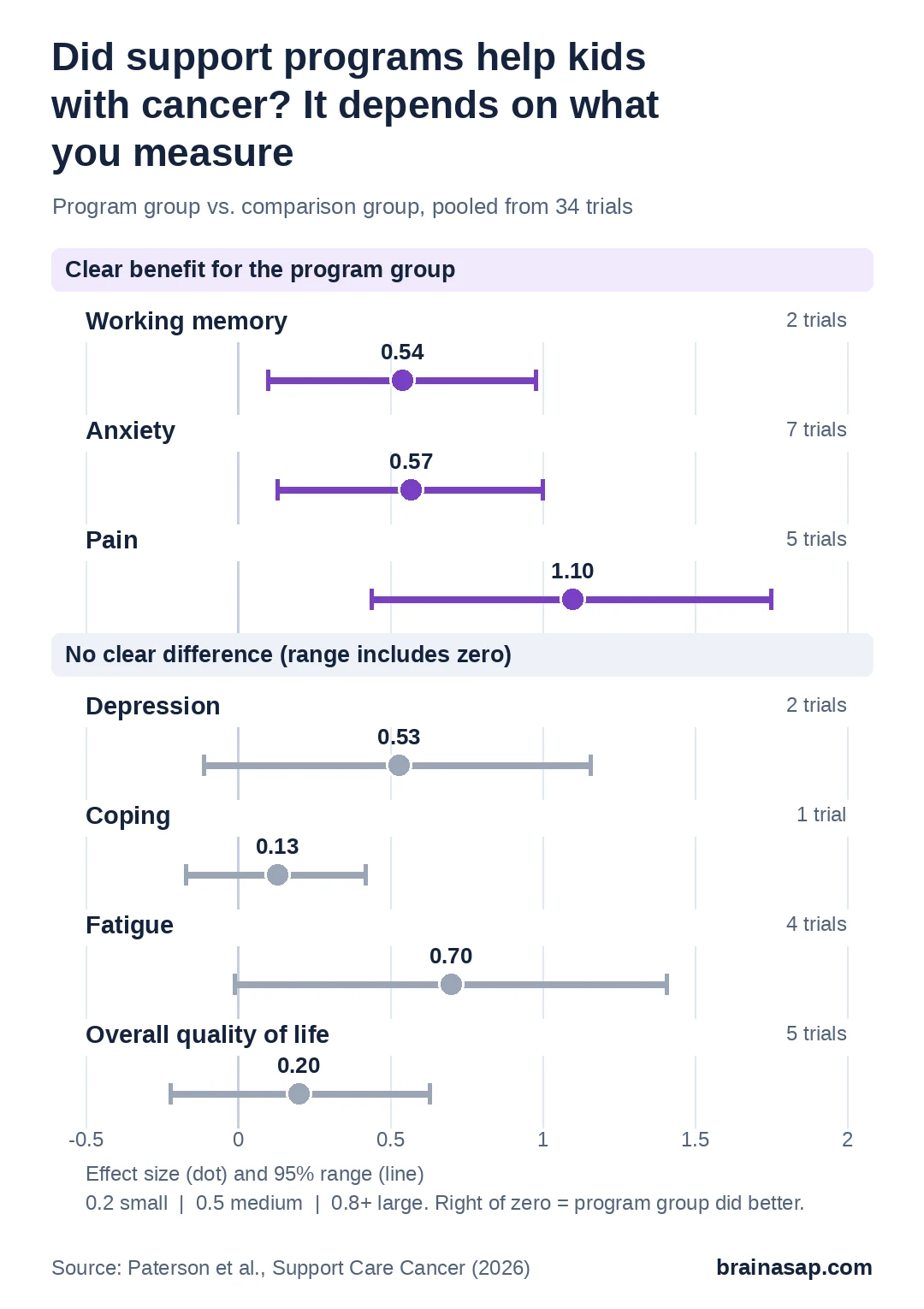
Across seven trials, the program group had lower anxiety than the comparison group, with an effect size of 0.57 (range 0.13 to 1.00). In practice, that is a medium-sized difference. The biggest changes came from hands-on activities in the hospital over a week or few weeks, such as play-based occupational therapy, jewelry-making, and mandala drawing. Some other trials, including a therapy-dog study and one using virtual reality, found little or no difference.
Across five trials, pain scores were also lower in the program group, with an effect size of 1.10 (range 0.44 to 1.75). That is large on paper, but the trials varied widely. Two found small or unclear differences, while three found very large ones. The pooled number is a rough guide that these programs may help with pain, not a promise of how much.
Memory and Thinking
Children treated for cancer, especially those whose treatment involved the brain, can struggle with attention and working memory. In this review, cognitive training had an overall effect size of 0.51 (range 0.32 to 0.69), and 0.54 for working memory specifically (range 0.10 to 0.98).
According to the paper’s chart, the pooled result came from just two trials of a computer-based memory-training program, which enrolled 62 and 20 children. The results across those trials were consistent, but two small trials cannot settle the question. The authors themselves call the estimate “provisional.”
Where the Evidence Was Not Clear
Several outcomes did not show a clear difference:
- Depression: Effect size 0.53, but range (−0.11 to 1.16) included zero. Only two trials measured it.
- Coping and self-worth: Both small and unclear.
- Fatigue: 0.70, range (−0.01 to 1.41) just touches zero.
- Overall quality of life: 0.20 (range −0.22 to 0.63).
“Not clear” is not the same as “no benefit.” With so few trials for each outcome, the review may simply lack the power to detect real effects. The authors suggest that anxiety around procedures may respond to a brief activity, while mood and self-image probably change more slowly and may need longer programs.
Limits of the Pooled Numbers
- Very different programs: Play, exercise, animals, art, and more were pooled by outcome. Programs as a group look promising; which works best, or for whom, is unknown.
- Trials disagreed: Anxiety, depression, pain, and quality of life varied a lot between trials (I² 65% to 87%).
- Small trials, unclear blinding: Blinding is hard when a child either takes part in an activity or does not. Of 34 trials, 15 were low risk of bias, 18 moderate, 1 high.
- Publication bias not checkable: Each analysis had fewer than 10 trials, too few for standard tests. Disappointing studies sometimes go unpublished, which can make a field look better than it is.
- Not pre-registered: Written plan, but not registered publicly in advance.
- Mixed ages and diagnoses: Ages 1 to 19, many cancer types; results could not be split by age or diagnosis.
- Limited search: Only English-language, peer-reviewed trials, so some studies may be missed.
Larger Trials of Program Type and Timing Are Needed
Activities that help a child feel calmer or distracted during treatment, or that train attention and memory afterward, appear to be worth offering. The best evidence points to anxiety, pain, and working memory. Depression and overall quality of life remain open questions.
Few trials used a guiding theory or asked children and families to help design the program. The authors call for larger studies that test timing, dose, and delivery format, and that report results by age, diagnosis, and treatment intensity.
The biggest open question is timing: not one of the 34 trials offered support before cancer treatment began.
Citation: DOI: 10.1007/s00520-026-11176-x. Paterson C, McCarthy MC, Sansom-Daly UM, Wakefield CE, Turner MR, Christina J, Roberts C, Moss C, Thamm C, Carmichael M-A, Johansen S, Atkinson M, Osborn M, Singh B, Ramsey I. Psychosocial interventions for children and adolescents across the cancer care continuum: A systematic review and meta-analysis. Supportive Care in Cancer. 2026;34:995.
Study Design: Systematic review and random-effects meta-analysis of randomized and quasi-randomized trials (five databases searched May 2023, updated November 2025). Risk of bias assessed with Joanna Briggs Institute checklists. Protocol written in advance but not publicly registered.
Sample Size: 34 trials, 1,988 participants aged 0 to 19 with cancer, 17 countries; 2,961 records screened.
Key Statistic: Anxiety effect size 0.57 (95% CI 0.13 to 1.00); pain 1.10 (0.44 to 1.75); working memory 0.54 (0.10 to 0.98); depression 0.53 (−0.11 to 1.16, not significant).
Caveat: Few trials per outcome (working memory from two), high heterogeneity for psychological and quality-of-life outcomes, mixed interventions and ages, publication bias not assessable.