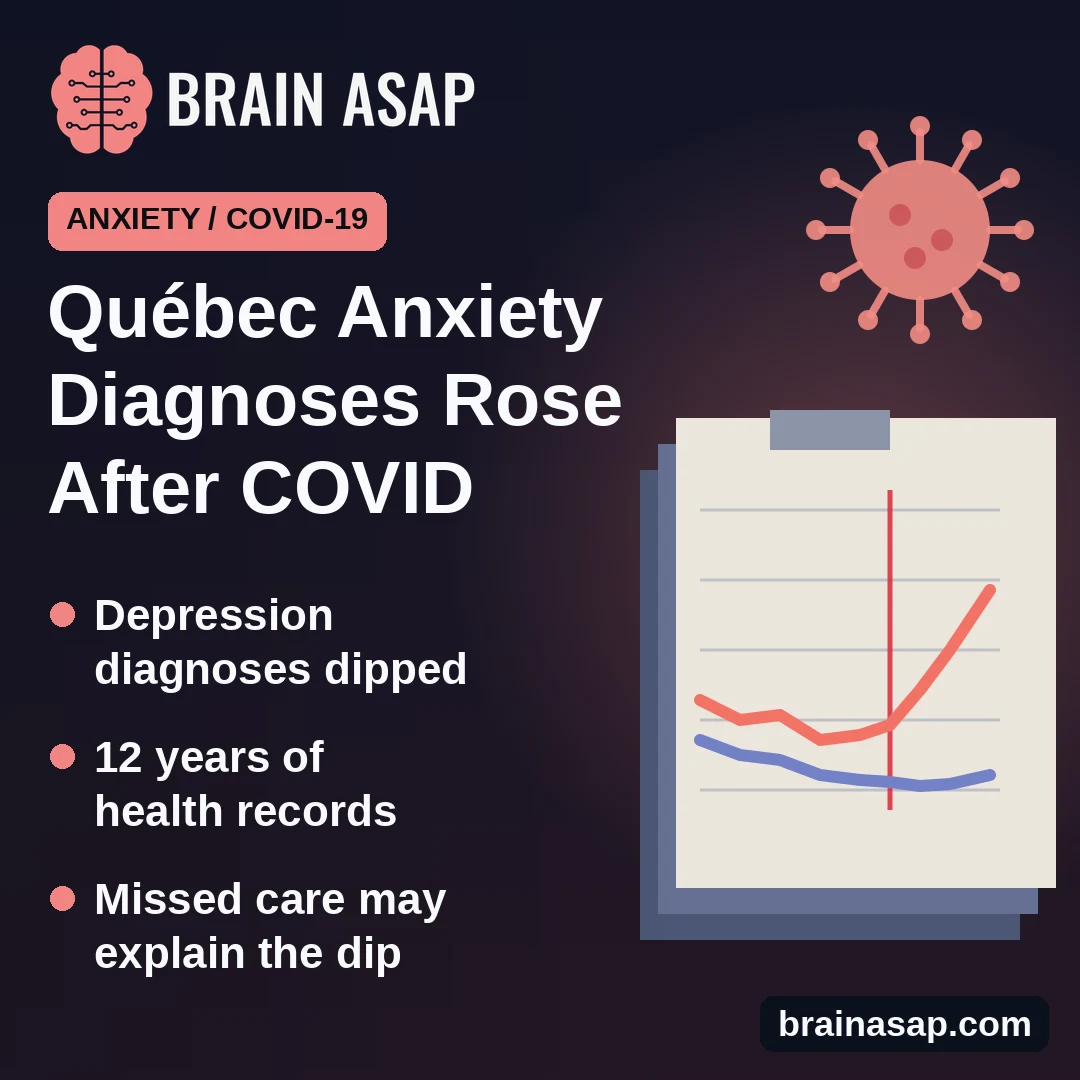
TL;DR: A 2026 study of Québec health records looked at how often doctors gave people aged 15 and older a new diagnosis of anxiety or depression, each month from 2010 to early 2022.
After COVID-19 arrived, new anxiety diagnoses climbed faster than the earlier trend predicted, while new depression diagnoses fell below it. Arpin and colleagues suggested missed or delayed care may explain part of the depression dip.
Key Findings
- More anxiety diagnoses: New anxiety diagnoses averaged 798 per 100,000 people a month in the 2 pandemic years, up from 667 just before.
- Depression held flat: New depression diagnoses stayed near 483 per 100,000 a month, compared with 486 before.
- Against the trend: Compared with a projection of the pre-pandemic trend, anxiety ran about 37 diagnoses per 100,000 higher each month and depression about 18 lower.
- No sudden jump: Neither diagnosis jumped clearly right when the pandemic began; the change showed up as a faster climb over time.
Source: BMJ Open (2026) | Arpin et al.
Surveys early in the pandemic warned of a worldwide surge in anxiety and depression. But surveys capture how people feel, not who actually got diagnosed by a doctor.
A 2026 study in BMJ Open, led by Emmanuelle Arpin at Université de Montréal with Québec's public health institute, checked what happened to new diagnoses in one Canadian province with some of the country's strictest COVID-19 rules.
What Did the Researchers Count?
Researchers used Québec's chronic disease surveillance system, which links records for everyone covered by the province's public health insurance.
- Who: all insured residents aged 15 and older
- When: January 2010 to March 2022, 147 months in all
- What: new diagnoses of anxiety or depression recorded at a doctor's visit or hospital stay
They then projected what the pre-pandemic trend would have looked like through March 2022, and compared the projection with what actually happened.
Their model also accounted for 3 earlier events that shifted diagnosis trends: major health system reforms in 2015, a change in how doctors were paid in 2016 and the legalization of cannabis in October 2018.
How Did Anxiety and Depression Diagnoses Change?
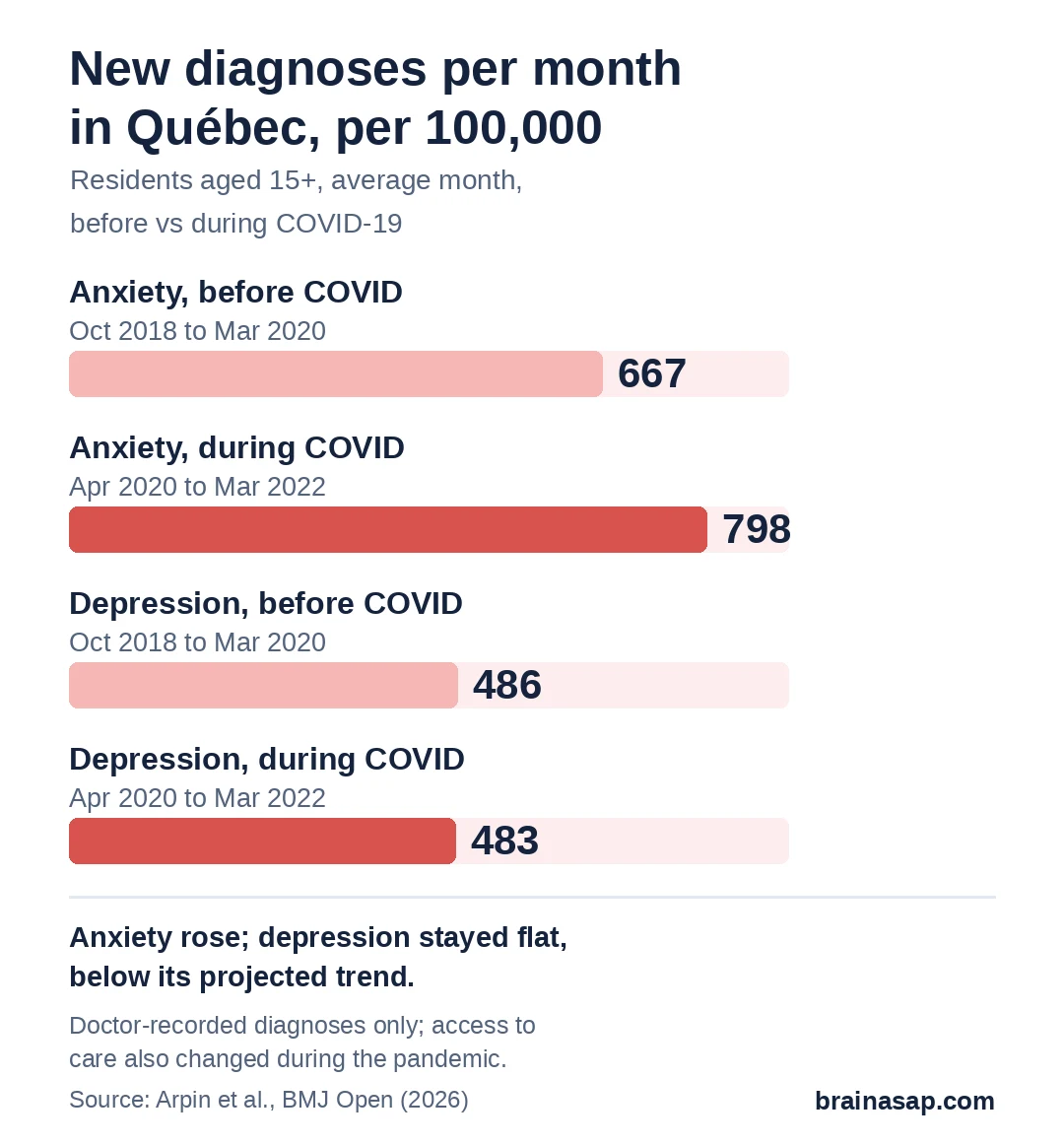
Raw averages already show the split. In the 2 pandemic years, new anxiety diagnoses rose to 798 per 100,000 a month, from 667 in the 18 months before. New depression diagnoses barely moved, at 483 vs 486.
A trend model told a similar story:
- Anxiety: no clear jump at the model’s April 2020 pandemic breakpoint, but the monthly climb sped up by about 1% per month
- Depression: also no clear jump; its monthly trend sped up by about 1.4% per month
- Net result: about 37 more anxiety diagnoses and 18 fewer depression diagnoses per 100,000 each month than the projected trend
So anxiety diagnoses rose above the pre-pandemic trend, while depression diagnoses ran below it and only slowly caught up.
Why Would Depression Diagnoses Dip?
That runs against global estimates of rising depression during the pandemic. Arpin and colleagues suggested 3 possible reasons:
- Harder to see a doctor: Fewer visits early in the pandemic meant fewer chances to be diagnosed.
- Anxiety often comes first: Depression frequently follows untreated anxiety, so a rise in depression diagnoses may lag behind.
- Seen as normal: Doctors may have treated low mood during lockdowns as an expected reaction rather than illness.
None of these explanations was tested directly.
Anxiety Diagnoses Were Rising Before COVID-19
Anxiety diagnoses had started rising before COVID-19. After cannabis became legal in October 2018, new anxiety and depression diagnoses both jumped by about 14% to 16% in the model.
For anxiety, the researchers concluded the pandemic sped up an increase that was already under way. This is a link in timing only; the study didn't look at who used cannabis.
What Records Can and Can't Tell Us
- Diagnoses, not symptoms: People who struggled but never saw a doctor don't appear in these records.
- Access shifts the count: Clinic closures and delays could lower diagnoses without any real change in illness.
- Many things changed at once: Lockdowns, curfews, job loss and fear of the virus overlapped; the study can't say which mattered.
- No comparison province: Without matching data from elsewhere, Québec's rules can't be singled out as a cause.
- Data end in March 2022: Later trends aren't covered.
Watching for Delayed Depression After the Pandemic
If depression diagnoses were held down by missed care, the study's trend suggests they may have kept catching up after 2022.
Data from later years, and comparisons with other provinces, would show whether that happened, and whether Québec's experience was unusual.
Citation: DOI: 10.1136/bmjopen-2025-113006 Arpin E, Massamba V, Rochette L, Dialahy I, Quesnel-Vallée A, Nazif-Muñoz JI. Incidence rates of diagnosed anxiety and depressive disorders in Québec, Canada: changes in trends after the COVID-19 pandemic using interrupted time series methods. BMJ Open. 2026;16:e113006.
Study Design: Interrupted time series of monthly administrative data (Québec Integrated Chronic Disease Surveillance System), Poisson GLM with population offset, adjusted for 2015 reforms, 2016 payment change, 2018 Cannabis Act and share of diagnoses by family doctors.
Sample Size: All insured Québec residents aged 15+; 147 months (January 2010–March 2022).
Key Statistic: COVID-19 level change: anxiety IRR 1.049 (95% CI 0.955–1.153), depression 0.965 (0.904–1.030); slope change: anxiety 1.010 (1.00–1.018), depression 1.014 (1.008–1.020). Monthly average difference vs counterfactual: anxiety +37.3, depression −17.7 per 100,000.
Caveat: Diagnosed cases only; access to care changed during the pandemic; no comparison jurisdiction; concurrent events cannot be separated.