TL;DR: Across 12 small trials, people with Parkinson’s who trained on walking robots scored a bit better on balance and a timed walking test than people who got other therapy. The evidence is low quality, so the true benefit may be smaller.
Key Findings
- 12 randomized trials: Mostly from China and Italy, mostly mild to moderate Parkinson’s.
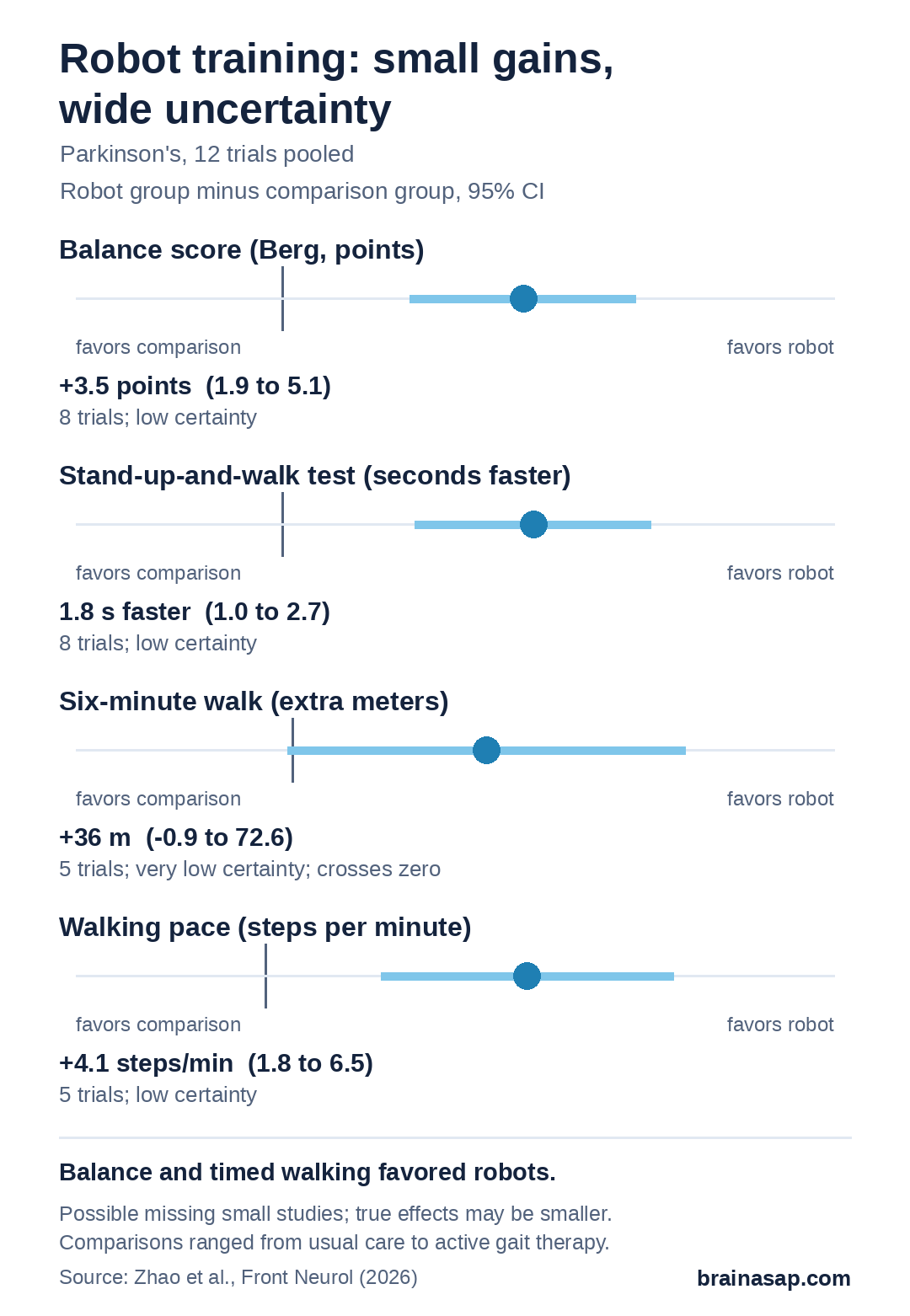
- Balance: About 3.5 points higher on the 56-point Berg Balance Scale with robot training.
- Stand-up-and-walk test: About 1.8 seconds faster.
- Six-minute walk: About 36 meters farther, but the range included no difference.
- Low or very low certainty for every main outcome.
Source: Frontiers in Neurology (2026) | Zhao et al.
Shuffling steps, poor balance and falls are some of the hardest parts of Parkinson’s disease. Walking practice helps, but it takes a lot of therapist time to deliver hundreds of good steps per session. Robots that guide the legs on a treadmill promise to do that heavy lifting.
So do they work better than regular therapy? A new review pooled the randomized trials to find out, and the answer is a cautious “probably a little.”
What Counts as a Walking Robot
The review covered robot-assisted gait training, where a machine moves or supports the legs through a walking pattern. Most trials used treadmill-based systems with a harness that takes some body weight, such as the Lokomat. Others used “end-effector” devices that move the feet on footplates, and some added visual, sound or foot-pressure feedback.
In this article, the robot group means people who had this training, sometimes alongside regular therapy. The comparison group means people who got something else instead: treadmill walking, standard balance or gait therapy, usual care or medication alone.
The researchers searched five databases plus trial registries and found 12 randomized trials. Most enrolled people at Hoehn and Yahr stages 2 to 3, meaning symptoms on both sides of the body, sometimes with some balance trouble, while people can still live independently.
Small Gains in Balance and Walking Tests
The review translated its results back into the units that therapists use:
- Berg Balance Scale (8 trials): +3.5 points for the robot group (95% CI 1.9 to 5.1), on a scale that runs to 56.
- Timed Up and Go (8 trials): 1.8 seconds faster to stand, walk 3 meters, turn and sit (95% CI 1.0 to 2.7).
- Six-minute walk (5 trials): +36 meters, but the range ran from about 1 meter less to 73 meters more.
- Cadence (5 trials): +4.1 steps per minute (1.8 to 6.5), the most consistent result.
- Step length (5 trials): +5.7 cm, with a wide range (0.3 to 11.2).
Leaving out one trial at a time never flipped the direction of any result, so no single study drove the pattern.
Why the Numbers May Be Too Rosy
The authors are unusually frank about the weak spots:
- Small trials: Most had modest samples; the balance analysis had 341 people in total.
- Results varied a lot: Heterogeneity was 81% for balance and 96% for the walk test.
- Signs of missing small studies: Funnel-plot tests flagged balance, walk distance, stand-and-walk time and step length. True effects may be smaller.
- Low or very low certainty: Low for balance, stand-and-walk time and cadence; very low for walk distance and step length.
- Mixed comparisons: Beating usual care is not the same as beating active gait training.
- Registered late: The review protocol was registered during revision, not before the work.
Safety Was Barely Reported
Several trials gave no usable counts of side effects, and most did not say whether they tracked fatigue, pain, near falls or dizziness. The researchers could not pool any safety data, so this review cannot say whether robot training is as safe as regular therapy.
Hints About Dose Are Only Hints
Training five times a week and combining the robot with regular therapy showed larger effects on some tests. But some of these subgroups held only two trials, and the authors treat them as ideas for future studies, not a prescription.
A Possible Add-On, Not a Replacement
For now, the review supports walking robots as a possible add-on to therapist-led rehab for Parkinson’s, with modest and uncertain benefits. Access and cost vary, and a robot session is not proven better than good hands-on gait training.
The open question for the next trials is simple: in larger, well-blinded studies that report side effects, do the balance gains reach a level that patients notice in daily life?
Citation: DOI: 10.3389/fneur.2026.1878057. Zhao Z, Xu C, Li X, Tan Z, Zhang J. Robot-assisted gait training for balance, mobility, and gait in Parkinson’s disease: a systematic review and meta-analysis. Front Neurol. 2026;17:1878057.
Study Design: Systematic review and random-effects meta-analysis of randomized controlled trials, with GRADE certainty ratings.
Sample Size: 12 RCTs; 5 to 8 trials per outcome (e.g., 341 participants for balance, 387 for Timed Up and Go).
Key Statistic: Berg Balance Scale +3.49 points (95% CI 1.85 to 5.12); Timed Up and Go -1.82 s (95% CI -2.67 to -0.96).
Caveat: Low to very low certainty; high heterogeneity, possible small-study bias, underreported safety and retrospective protocol registration.