TL;DR: Among 411 people hospitalized for strokes caused by blocked tiny brain arteries, nearly 4 in 10 needed early rehab. Adding MRI brain-damage scores and blood tests to routine bedside information didn't predict who needed it any better.
Key Findings
- 411 patients, 1 hospital in China: All had small-vessel strokes.
- 155 (38%) needed early rehab assessment within 48 hours.
- Bedside model did best: AUC 0.68, where 0.5 is a coin flip.
- Extras didn't help: MRI and blood tests left it at 0.67 to 0.68.
- Stroke severity score was the top predictor.
Source: Frontiers in Neurology (2026) | Lu et al.
Some strokes come from a blocked tiny artery deep in the brain. These small-vessel, or lacunar, strokes are often seen as mild. But many patients still leave the hospital with weakness, trouble walking or other problems, and starting rehab early can help.
Doctors at Shenzhen Longhua District People's Hospital in China asked whether a prediction model could flag who needs rehab early, and whether adding brain scans and blood tests makes it smarter.
Small Strokes Often Needed Rehab
The team reviewed 411 adults hospitalized in 2022 and 2023 with a small-vessel stroke, average age in the mid-to-late 50s. Within 48 hours of admission, rehab doctors judged each patient's need for a fuller rehab assessment based on movement, walking, daily activities and other deficits.
155 patients, or 38%, were flagged as needing early rehab. That is a lot for a stroke type considered mild. At discharge, about 40% had at least slight disability.
Bedside Information Did Most of the Work
The researchers built models with eight methods, from simple statistics to machine learning. The main model used routine information: stroke severity score, age, blood pressure, walking ability, limb weakness and similar details. Then they tried adding:
- MRI damage score: A rating of white matter wear and tear, a common sign of small-vessel disease.
- Blood markers: White cell counts, inflammation ratios, cholesterol, uric acid and kidney measures.
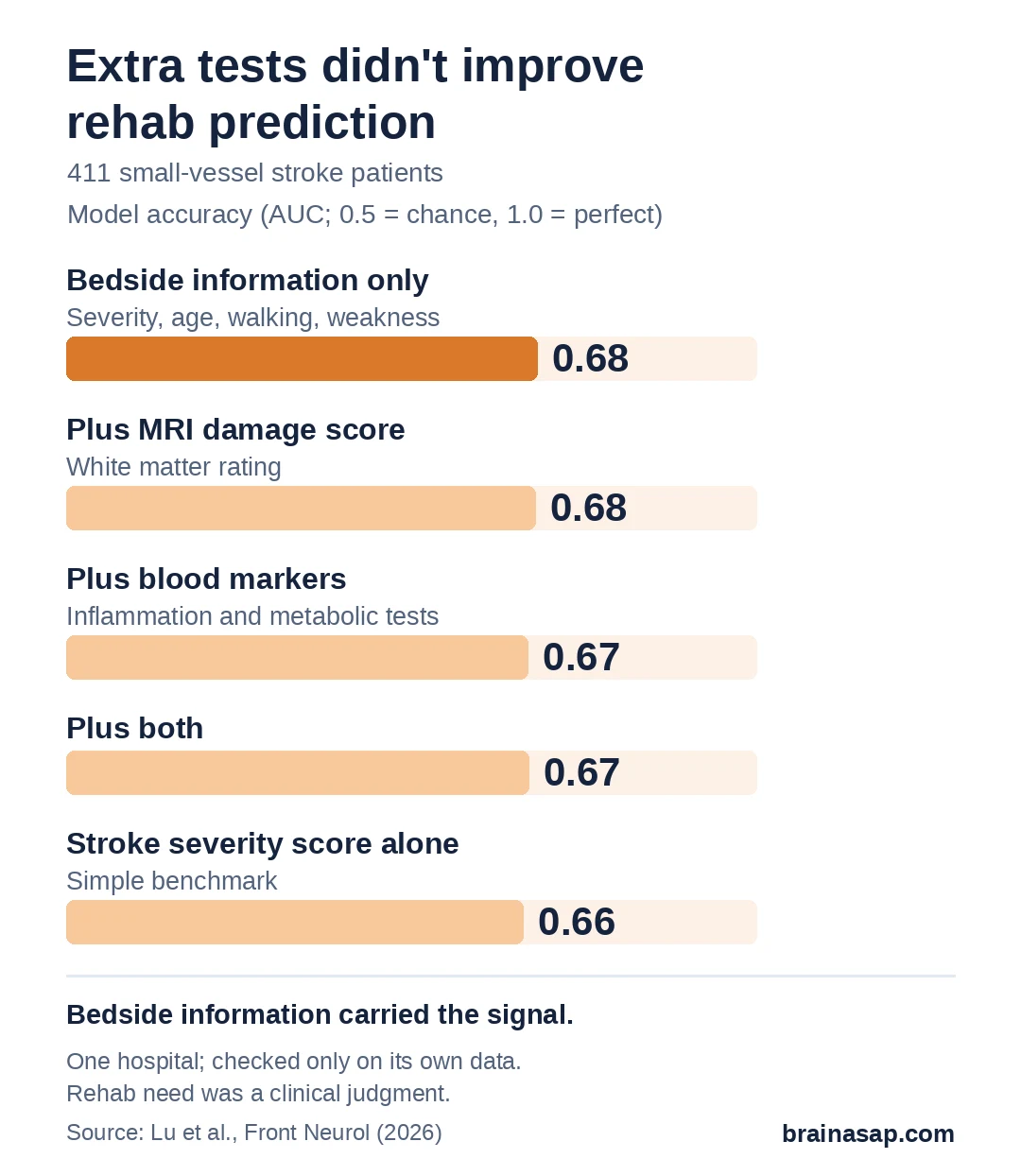
Neither addition helped. Accuracy stayed at about 0.67 to 0.68, and a simple model using only the stroke severity score scored 0.66. Simple statistics did about as well as fancier machine learning.
Stroke Severity Was the Main Signal
The biggest contributors to the model were the NIH Stroke Scale score, a standard bedside check of stroke symptoms, followed by stroke unit admission, age, education and disability level one day after admission.
That raises a catch. When the team rebuilt the model using only information known at the moment of admission, accuracy dropped to 0.62. When they also removed the direct measures of symptoms, it fell to 0.51, no better than a coin flip. In other words, the model mostly predicts that people with worse symptoms need rehab, which doctors would already see.
One Hospital, Moderate Accuracy
- Single center, looking back: Only tested within the same hospital's data.
- Judgment-based outcome: Rehab need was a doctor's overall call, with no fixed score cutoff.
- Limited MRI measure: Other signs of small-vessel disease, like tiny bleeds, weren't counted.
- Missing blood tests: C-reactive protein, D-dimer and homocysteine were dropped for missing data.
- Moderate accuracy: AUC 0.68 would miss many patients if used alone.
A Careful Bedside Exam Still Leads
For patients and families, the practical message is that a "small" stroke can still mean real rehab needs, and a careful bedside exam remains the best early guide. Extra scans and blood work, at least the ones tested here, didn't sharpen that call. Whether any model beats experienced clinicians at other hospitals is still untested.
Citation: DOI: 10.3389/fneur.2026.1910602. Lu Y, Shen M, Chen X, Jiang Y, Wang Y, Qian Q, Zhao Q, Wang W. Clinical variables provide the main predictive signal for early in-hospital rehabilitation triage after small-artery occlusion stroke: development and internal validation of an interpretable model. Front Neurol. 2026;17:1910602.
Study Design: Single-center retrospective registry; prediction model development with stratified tenfold cross-validation.
Sample Size: 411 patients with small-artery occlusion stroke (155 with early rehabilitation need).
Key Statistic: Clinical model AUROC 0.682; +Fazekas 0.679; +biomarkers 0.669; +both 0.670; NIHSS alone 0.662; admission-only model 0.623, falling to 0.507 without deficit variables.
Caveat: Internal validation only; outcome based on clinical judgment; limited imaging and missing biomarkers.