TL;DR: In a 2026 German brain-scan study of 160 adults with and without social anxiety disorder or depression, researchers mapped the white-matter wiring between brain regions and tested whether it could predict how socially anxious each person said they were.
A small set of connections, with the strongest ones in vision-related areas, predicted people's social anxiety scores better than chance, but only weakly.
Key Findings
- A small wiring network: 46 connections between brain regions, with the strongest ones concentrated in vision-related areas, predicted how socially anxious people rated themselves.
- Weak but real: Predicted and actual social anxiety scores matched only weakly, though better than chance.
- Similar result in the clinical subgroup: A related pattern appeared when the researchers analyzed only the 111 participants with social anxiety disorder or depression from the same sample.
- Not a test yet: The team said the network should not be used as a diagnostic marker.
Source: Translational Psychiatry (2026) | Meinert, Leehr and colleagues
Social anxiety isn't all or nothing. Some people feel a little nervous meeting strangers; others dread every phone call, meeting or meal with colleagues.
At the far end is social anxiety disorder, an intense fear of being judged or embarrassed that leads people to avoid social situations. Strong social anxiety also turns up in people with depression.
If social anxiety runs along a spectrum, is there a brain pattern that tracks it, whatever a person's diagnosis?
Who Was Scanned?
A 2026 study in Translational Psychiatry by researchers at the University of Münster, Germany, used brain scans from 160 adults aged 18 to 65, about 28 years old on average. Their social anxiety covered a wide range:
- 64 people with social anxiety disorder, 49 of whom also had current or past depression
- 47 people with current or past depression but no social anxiety disorder
- 49 people with no history of any mental disorder
Everyone filled in the Liebowitz Social Anxiety Scale, which asks how much fear people feel in situations such as talking to strangers or speaking in front of others, and how often they avoid them. Scores run from 0 to 144.
People with social anxiety disorder averaged 68. Those without it averaged 21.
How Did Researchers Map Brain Wiring?
An MRI method called diffusion imaging traces the bundles of nerve fibers, the brain's "white matter," that connect one region to another. With it, the team mapped connections among 114 brain regions in each person.
A computer model then searched for connections that went along with social anxiety scores. The researchers repeatedly split the same group into training and test subsets. Each test subset was held out from its corresponding training run. There was no separate group for external validation.
Did Brain Wiring Predict Social Anxiety?
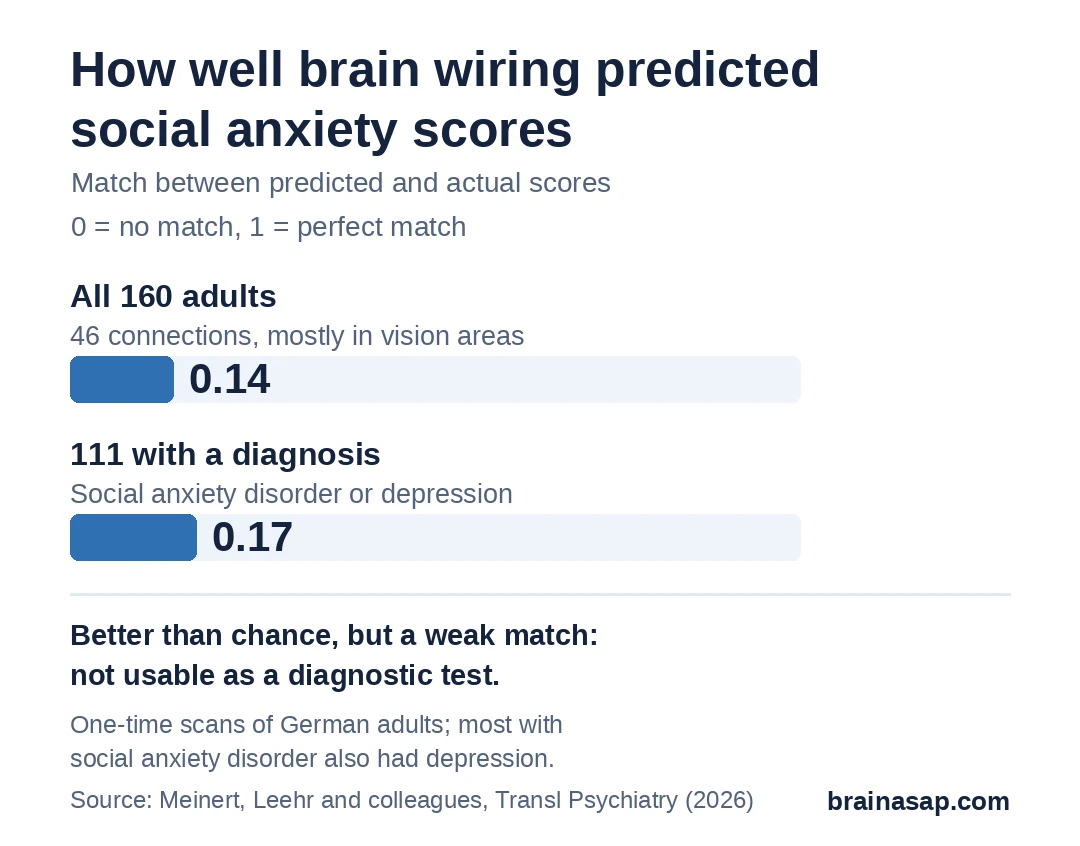
It did, a little. A network of 46 connections emerged, less than 1% of all connections mapped. Predicted scores matched people's actual scores better than chance, but weakly, with a correlation of 0.14 on a scale where 1 is a perfect match.
The strongest connections clustered in regions at the back and sides of the brain involved in vision and visual processing. The network also included weaker connections in frontal and parietal regions.
In a repeat analysis of only the 111 people with a diagnosed mental disorder, a larger network of 59 connections predicted social anxiety slightly better, with a correlation of 0.17.
Did People With the Disorder Have Different Brain Networks?
Mostly not. Across 12 whole-brain measures of how the wiring was organized, people with social anxiety disorder differed from those without it on only 1: their brain networks split into slightly more separate clusters, or "modules."
Higher social anxiety scores across everyone went with several whole-brain wiring measures. Meinert, Leehr and colleagues suggested this may reflect more connections overall but less efficient flow of information, while noting these readings are tentative.
What This Study Can't Tell Us
- Weak prediction: brain wiring explained only a small share of differences in social anxiety; the team said it is not ready for clinical use
- Limited groups: the study included only people with social anxiety disorder, depression or no disorder; other conditions and people of non-European descent were excluded
- Depression overlap: most people with social anxiety disorder also had depression, which may have shaped the pattern
- One snapshot: scans were taken once, so the study cannot say whether the wiring causes anxiety or results from it
- Modest size: with 160 people, the team estimated it could reliably detect only medium-sized effects
The study found a weak link between brain wiring and social anxiety scores across the range of symptoms in this sample. Whether these vision-related connections hold up in larger, more varied groups is the next question.
Citation: DOI: 10.1038/s41398-026-04466-9. Meinert H, Gruber M, Brügge EDE, Brüwer L, Sindermann L, Winter A, Slump TM, Breuer F, Schrammen E, Meinert S, Goltermann J, Grotegerd D, Repple J, Redlich R, Bonnekoh LM, Bauer J, Dannlowski U, Böhnlein J, Leehr EJ. Identifying a structural brain network for social anxiety: connectome-based predictive modeling and network analyses in a transdiagnostic sample. Translational Psychiatry. 2026;16:495. PMID: 42805955. Full text: PMC13619567.
Study Design: Preregistered cross-sectional MRI study (TIP cohort, University of Münster); diffusion and T1-weighted MRI structural connectomes (114 regions); connectome-based predictive modeling (NBSPredict, repeated cross-validation, age and sex as covariates) of Liebowitz Social Anxiety Scale scores; graph-theory comparisons.
Sample Size: 160 adults (64 with social anxiety disorder, 96 without; 49 with no lifetime mental disorder).
Key Statistic: 46-edge network predicted LSAS scores with r = 0.141 (CI 0.12 to 0.20, p = 0.003); clinical subset (n = 111) 59 edges, r = 0.172 (p < 0.001); groups differed only in number of modules (F = 6.03, p = 0.015).
Caveat: Small effect sizes; cross-sectional; limited to social anxiety disorder, depression and healthy controls of European descent; heavy overlap with depression; not a clinical biomarker.