TL;DR: In a study published in 2026, among 501 Syrian refugee teens attending school in Ankara, Türkiye, those who said they bounce back quickly from hard times reported somewhat fewer symptoms of anxiety, stress, depression and trauma-related distress. That link was real but small, and a one-time survey can't show that building resilience would reduce symptoms.
Key Findings
- Bouncing back went with fewer symptoms: teens with higher resilience scores reported fewer symptoms on all 5 measures, including anxiety, depression and unwanted memories of a stressful event.
- A small slice of the picture: resilience explained only 1% to 3% of the differences in symptoms between teens, after accounting for age and gender.
- Strongest for anxiety, weakest for depression: 3.4% of anxiety differences vs 1.1% of depression differences.
- Girls reported fewer symptoms than boys: an unexpected pattern, since refugee girls usually report more.
- Shaky resilience scores: answers on the 6-question resilience survey didn't hang together well in this group, which makes the link harder to interpret.
Source: Children (2026) | Özaslan, Yıldırım et al.
Some young refugees seem to cope with war and displacement better than others. Many researchers point to resilience, the ability to recover from hard times, as part of the reason.
Türkiye hosts more Syrian refugees than any other country, yet few studies have looked at resilience among Syrian teens living there.
A 2026 study in the journal Children, led by researchers at Gazi University in Ankara and Ağrı İbrahim Çeçen University, asked how closely resilience lines up with mental health symptoms in these teens.
Who Took the Survey?
Fifteen secondary and high schools in Ankara with many Syrian students were picked at random, and every student in selected classes was invited. Nearly all, 96%, agreed.
In all, 501 Syrian teens aged 12 to 18 took part, with an average age of almost 16. About 2 in 3 were boys. Surveys were collected between late 2019 and 2022, with a pause during COVID-19 school closures.
Each teen filled out 3 questionnaires:
- Resilience: 6 questions on how quickly they recover from stress, such as "I tend to bounce back quickly after hard times"
- Depression, anxiety and stress: 21 questions about the past week
- Trauma-related distress: 8 questions about a stressful event of their choosing, covering intrusive memories (unwanted thoughts or images of it) and avoidance (trying not to think or talk about it)
Did Teens Who Bounce Back Report Fewer Symptoms?
Yes, on every measure, but not by much.
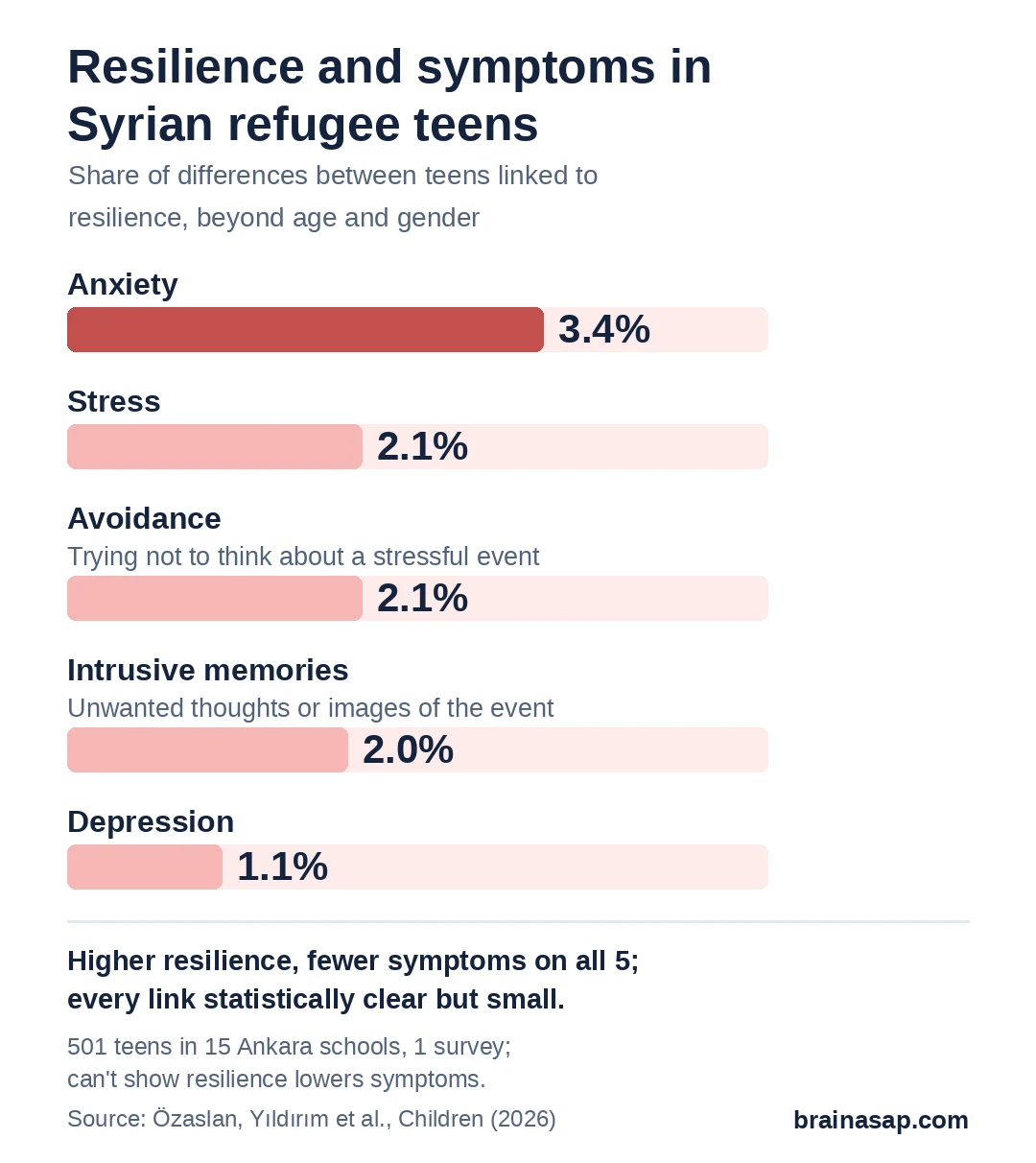
After accounting for age and gender, resilience scores explained these shares of the differences in symptoms between teens:
- Anxiety: 3.4%
- Stress: 2.1%
- Avoidance: 2.1%
- Intrusive memories: 2.0%
- Depression: 1.1%
All 5 links were statistically clear. Most of the differences between teens remained unexplained by these models.
Özaslan and colleagues suggested the resilience survey, which asks about recovering from stress, may sit closer to tense, on-edge feelings like anxiety than to the low mood and loss of interest seen in depression.
Why Did Boys Report More Symptoms?
Girls reported fewer symptoms than boys on all 5 measures. That runs against most research on refugee youth, where girls usually report more anxiety, depression and trauma symptoms.
Possible reasons offered in the paper: boys and girls may have lived through different kinds of trauma, and the group was mostly boys. Neither idea was tested.
Reasons to Read These Results Cautiously
- Snapshot, not a test: one survey at one time can't show which came first. Ongoing symptoms might wear down resilience, rather than resilience easing symptoms.
- Trauma not measured: teens weren't asked what they had lived through, a major factor in refugee mental health.
- Stressful event not specified: the trauma questions let each teen pick any stressful event, which may not have been war or displacement.
- Weak resilience survey: its 6 answers agreed with each other poorly in this group (a reliability score of 0.40, where 0.70 is usually considered acceptable).
- Only teens in school, in 1 city: refugee teens who aren't in school, often among the most vulnerable, were not included.
- Older data: many Syrians have returned home since late 2024, so today's refugee teens in Türkiye may differ.
Could Schools Help Refugee Teens Build Resilience?
Refugee teens rarely reach mental health specialists, so the research team pointed to schools as a practical place to offer support. They also stressed that individual coping skills are only one piece, alongside family, school and community resources.
Whether resilience-building programs in schools would actually lower symptoms is the open question. Answering it will take studies that follow teens over time, measure what they've been through and test the programs directly.
Citation: DOI: 10.3390/children13091183. Özaslan A, Yıldırım M, Öztürk FN, Aktar Songür İ, Aksu MH, Güney E, Tanhan A, Fekih-Romdhane F, Laranjeira C, Gómez-Salgado J. The Role of Resilience in Relation to Depression, Anxiety, Stress, and Post-Traumatic Stress Symptoms Among Syrian Refugee Adolescents in Türkiye. Children. 2026;13:1183.
Study Design: Cross-sectional school-based survey with multistage cluster sampling in 15 Ankara schools (late 2019–2022); Brief Resilience Scale, DASS-21, CRIES-8; 5 hierarchical regressions adjusting for age and gender.
Sample Size: 501 Syrian refugee adolescents aged 12–18 (63.7% boys; mean age 15.7).
Key Statistic: Resilience ΔR²: depression 0.011 (β −0.108, P = 0.016), anxiety 0.034 (β −0.186, P < 0.001), stress 0.021, intrusion 0.020, avoidance 0.021 (all P ≤ 0.001).
Caveat: Cross-sectional; no trauma-exposure measure; CRIES-8 not anchored to a specific event; Brief Resilience Scale α = 0.402; school-attending youth in one city only.