TL;DR: Young female mice bred to develop Alzheimer's-like disease remembered objects normally on a standard test, but lost the resistance to memory interference that healthy females have. Separating the interference by place or strengthening the memory restored their performance.
Key Findings
- Standard memory test looked normal: All four groups recognized a new object.
- Interference exposed a gap: Only healthy females still told new from old after seeing unrelated objects first.
- Alzheimer's-model females lost their edge: They did no better than males of either kind.
- Some fixes worked: A different room or extra training restored memory, except in Alzheimer's-model males.
Source: Brain Communications (2026) | D'Amelio et al.
Alzheimer's changes start in the brain years before standard memory screens pick anything up. Some researchers think a tougher memory test, one that adds distraction, might catch trouble earlier.
A team in Rome tested that idea in young mice and found the answer depended on sex.
A Memory Test With a Distraction Added
The researchers used 2-month-old mice, both healthy ones and a strain called 3xTg-AD that is engineered to develop Alzheimer's-like brain changes. At this age, the transgenic mice do not yet show clear memory problems. Each of the four groups (healthy females, healthy males, Alzheimer's-model females and Alzheimer's-model males) had 8 to 10 mice.
The basic test is simple. A mouse explores two identical objects. A day later, one is swapped for something new. Mice naturally spend more time with a new object, so a clear preference means they remember the old one.
In the harder version, mice explored a pair of unrelated objects one hour before the memory test. This "retroactive interference" can blur the original memory.
Healthy Females Shrugged Off Interference
On the standard test, all four groups did equally well. With interference added, only healthy females still clearly preferred the new object.
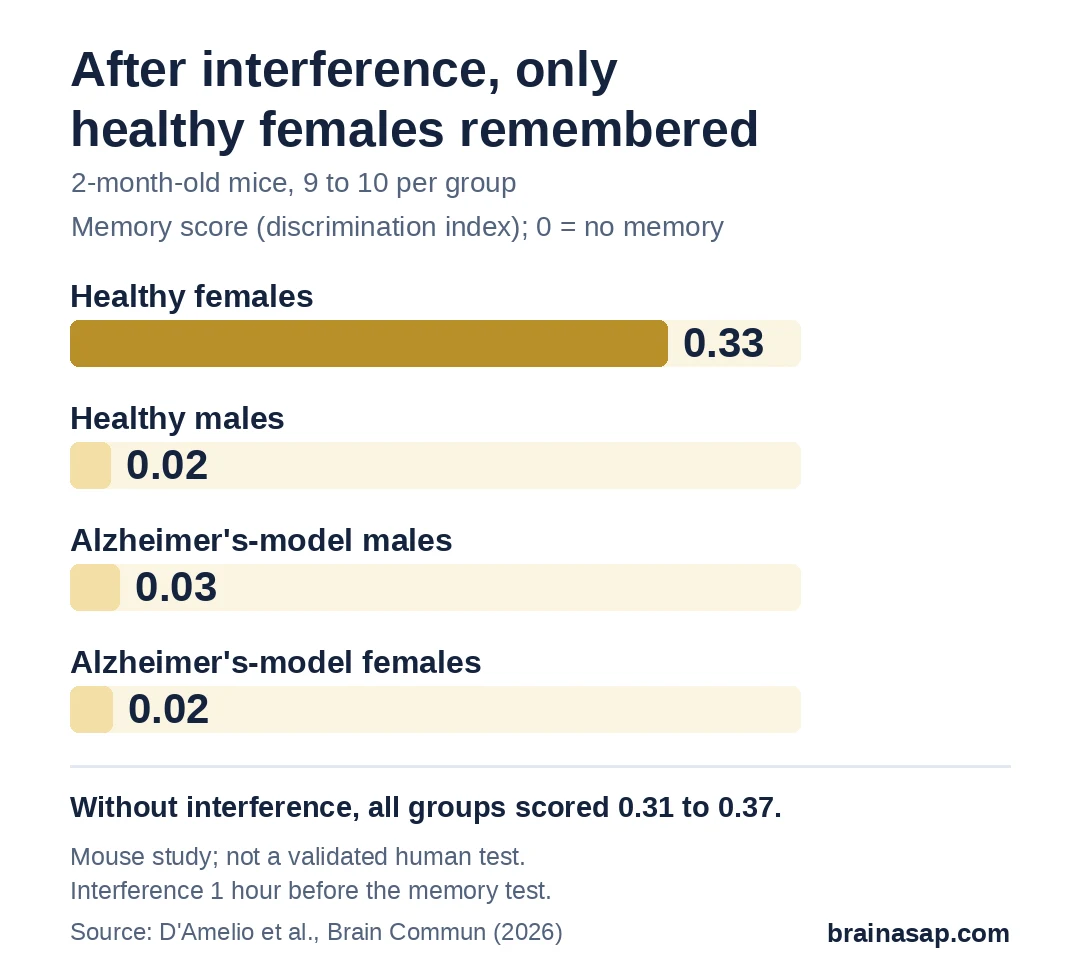
Healthy males were already known to be vulnerable to this kind of interference. The new finding is that Alzheimer's-model females lost the protection healthy females have and fell to the males' level. The authors describe this as losing a resilience, not gaining an extra deficit.
Timing mattered too. When interference came just 1 hour after learning, while the memory was still settling, every group failed, including healthy females. When it came 6 or 23 hours later, healthy females held on, but Alzheimer's-model females did not. Males of both kinds failed at every time point.
A Different Room or Extra Practice Helped Most Mice
The researchers tested two ways to protect the memory:
- Different room: Interference objects shown in a separate arena. Alzheimer's-model females and healthy males recovered; Alzheimer's-model males did not.
- Extra training: Four training sessions over two days instead of one. Alzheimer's-model females and healthy males recovered; Alzheimer's-model males improved only a little.
The authors suggest the females and healthy males struggled because the two memories overlapped. The Alzheimer's-model males may instead have a faster fading memory.
Mice, Objects and Small Groups
- Mouse model: 3xTg-AD mice carry human mutations and do not capture all of human Alzheimer's.
- Behavior only: No brain cell, hormone or protein measurements to explain the sex difference.
- Small groups: 8 to 10 mice per group.
- Low exploration: Alzheimer's-model males explored little in the extra-training test, with no minimum set in advance.
- Not a human test: No evidence yet that this predicts Alzheimer's in people.
The study reported no outside funding, and the authors declared no competing interests.
Could Interference Tests Flag Early Alzheimer's in Women?
In people, tests that add interference already pick up subtle problems in mild cognitive impairment and in some healthy adults with amyloid in the brain. This mouse study hints that such tests might need to be read differently in women and men.
The open question is whether loss of interference resistance shows up early, and differently by sex, in people who later develop Alzheimer's.
Citation: DOI: 10.1093/braincomms/fcag345. D'Amelio C, Autelitano S, Natale F, Rinaudo M, Fusco S, Grassi C. Differences in retroactive interference response reveal sex-specific memory resilience in pre-symptomatic triple transgenic Alzheimer's disease mice. Brain Commun. 2026.
Study Design: Preclinical behavioral study in male and female wild-type and 3xTg-AD mice (2 months old) using novel object recognition with retroactive interference.
Sample Size: 8 to 10 mice per group per experiment.
Key Statistic: Discrimination after interference 0.33 in healthy females vs about 0.02 to 0.03 in the other groups (sex × genotype interaction p = 0.006).
Caveat: Mouse study; behavior only; small groups; not a validated human early test.