TL;DR: A 2026 analysis of a national Chinese school survey looked at 7,328 middle school students and asked whether those who said they keep going when schoolwork gets hard also reported fewer signs of depression, such as feeling down or that life is meaningless.
They did, but only slightly. Anxiety was far more closely linked to depression, and the survey data date from 2014 to 2015.
Key Findings
- Small link with depression: Students who said they push through hard schoolwork reported slightly less depression (correlation of −0.16, a weak link).
- Anxiety mattered most: Anxiety and depression scores were strongly linked (correlation of 0.66).
- Part of the link ran through school strain: In statistical models, about half of the link between persistence and depression ran through students finding their main subjects less hard and feeling less anxious.
- Cause not shown: All answers came from one survey round, so it is unknown which came first.
Source: Frontiers in Public Health (2026) | Wang et al.
Chinese teenagers face some of the heaviest school pressure in the world, with high-stakes exams shaping their futures. Some students seem to bounce back from a bad grade; others sink.
A 2026 study in Frontiers in Public Health, by Guangqiang Wang and colleagues at East China Normal University and Beijing Union University, asked whether that bounce-back quality, which they called academic resilience, goes with less depression, and what might sit in between.
Where Did the Data Come From?
Researchers used the China Education Panel Survey, a national survey that randomly picked 112 schools in 28 counties and surveyed whole classes. This analysis used answers from the 2014–2015 school year.
- Students: 7,328 middle school students; about half boys and half girls
- Family money: 14% described their families as having financial difficulty
Although the data are about a decade old, Wang and colleagues argued that exam pressure in Chinese schools has changed little since.
What Did Students Answer?
Each measure was built from a few survey questions:
- Academic resilience (3 items): statements such as "I would try my best to finish even the homework I dislike"
- Academic pressure (1 question): how hard students found math, Chinese and English
- Anxiety (3 items): feeling nervous, worrying too much and expecting something bad to happen, over the past week
- Depression (6 items): feeling down, unhappy or sad, finding life meaningless, lacking energy and being too low to concentrate
Notably, "academic pressure" here really meant how difficult students found their main subjects, not exam stress or parental expectations.
How Did Each Factor Line Up With Depression?
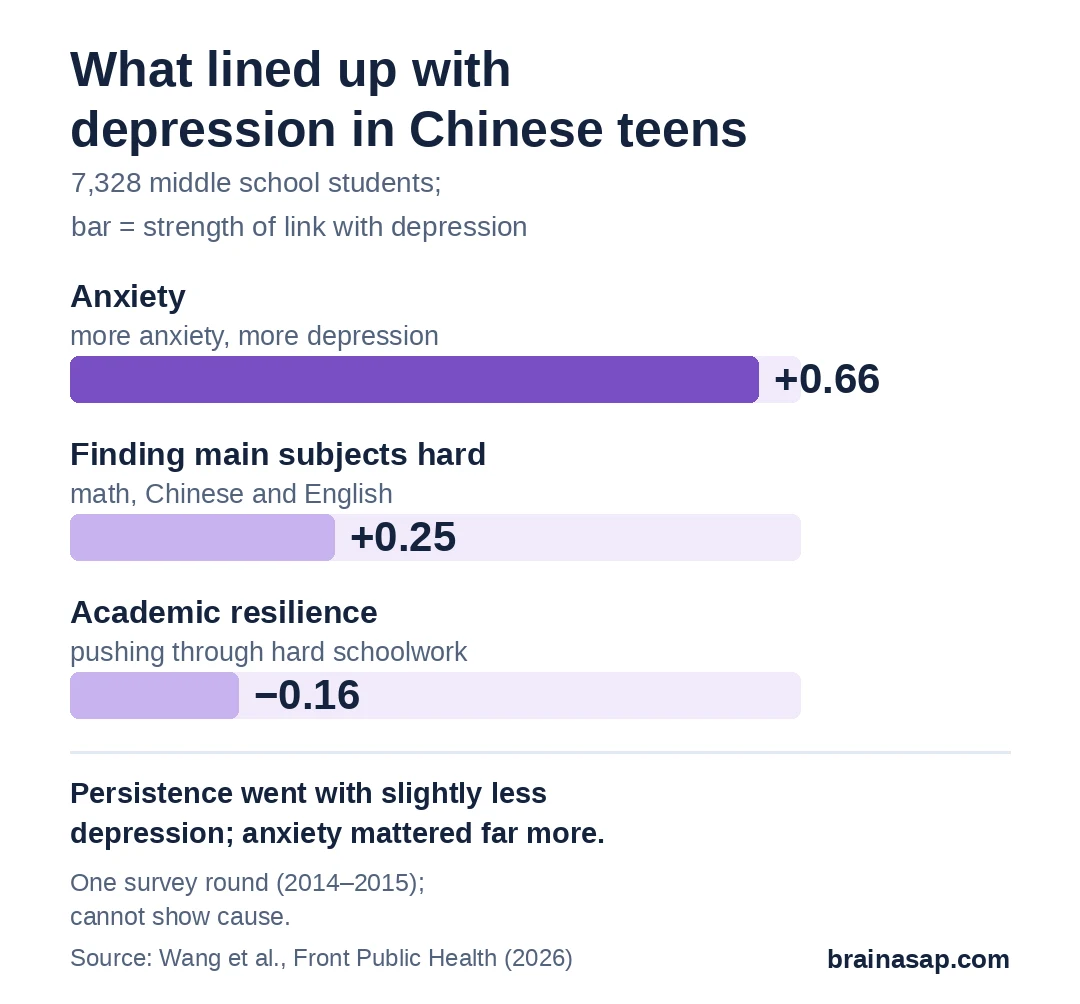
Students who reported more persistence also found their main subjects a little less hard and were slightly less anxious. Each of these was statistically clear in such a large sample, but the persistence links were weak.
Statistical models then split the link between persistence and depression:
- Direct part: about 53%
- Through finding subjects less hard: about 16%
- Through lower anxiety: about 16%
- Through both in sequence: about 16%
Why the Findings Need Caution
- One survey round: Feeling depressed could make schoolwork feel harder and persistence lower, rather than the other way round.
- Thin measures: Academic resilience used 3 items and academic pressure a single question, not full validated scales.
- Missing controls: Age and grade were not accounted for, and schools and classes were not modeled separately.
- Older data: Answers were collected in 2014–2015.
Could Building Persistence Help Teens' Mood?
Wang and colleagues suggested that schools teach students to treat setbacks as part of learning, reduce workload and screen for early signs of burnout. These ideas are reasonable, but this study did not test them.
Given how weak the persistence link was next to anxiety, a trial that tracks students over time, or tests a resilience program directly, would show whether boosting persistence actually lowers depression.
Citation: DOI: 10.3389/fpubh.2026.1813364 Wang G, Zhang H, Hou Y, Wei J. The relationship between academic resilience and depression among Chinese adolescents: a chain mediation model of perceived academic pressure and anxiety. Frontiers in Public Health. 2026;14:1813364.
Study Design: Cross-sectional secondary analysis of the China Education Panel Survey (CEPS) 2014–2015 follow-up wave; PROCESS Model 6 chain mediation with bias-corrected bootstrap (5,000 resamples), controlling for gender, only-child status, parental relationship and family finances.
Sample Size: 7,328 Chinese middle school students from 112 schools in 28 county-level units.
Key Statistic: Correlations with depression: academic resilience r = −0.161; perceived academic pressure r = 0.253; anxiety r = 0.660. Total effect −0.128; direct −0.068 (53.1%); indirect via pressure, anxiety and both in sequence −0.020 each (15.6% each).
Caveat: Cross-sectional; brief non-standard item sets; age and grade not controlled; clustering not modeled; 2014–2015 data.