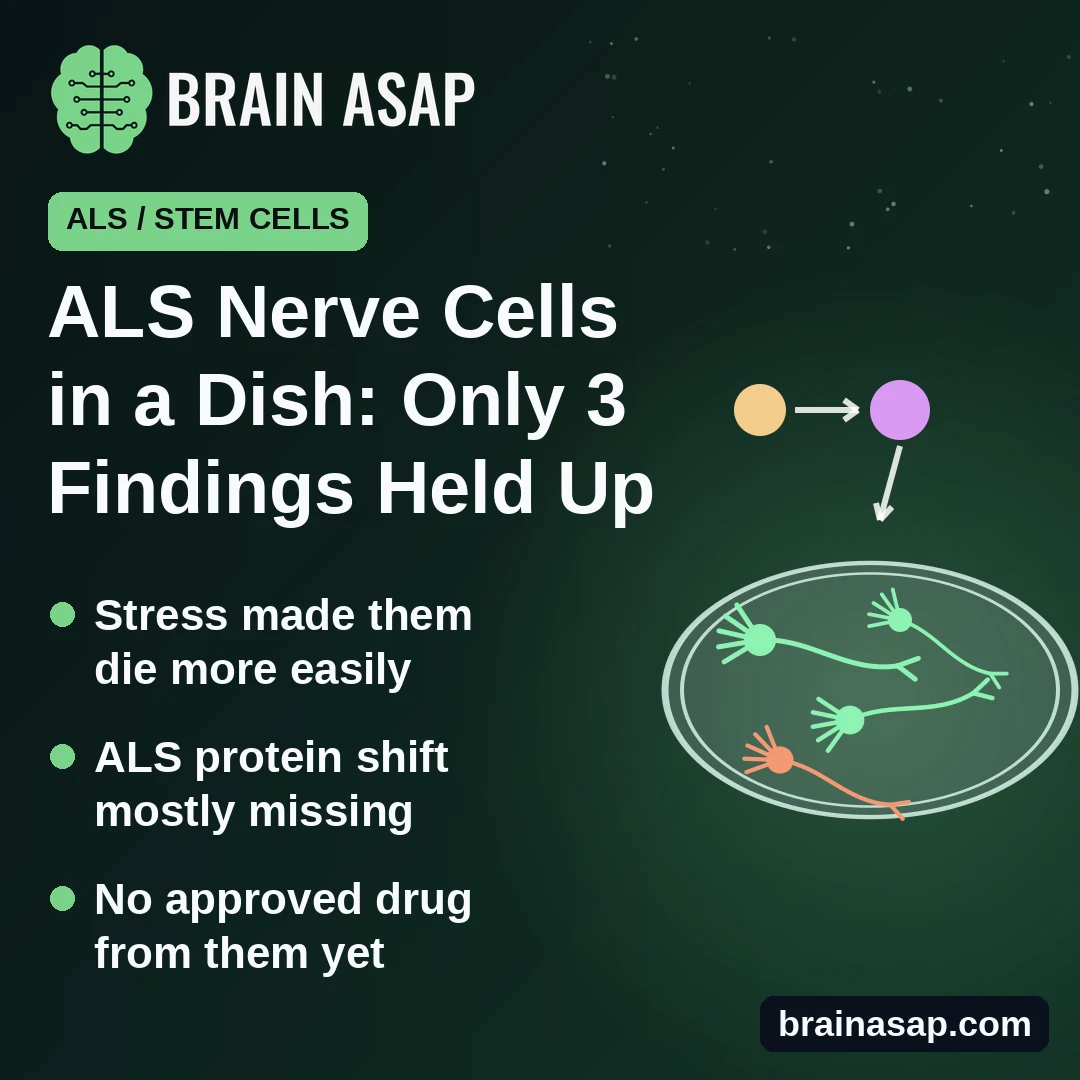
TL;DR: A 2026 review pulled together 36 lab studies that grew motor neurons, the nerve cells destroyed in ALS (Lou Gehrig’s disease), from stem cells of patients whose ALS comes from changes in one particular gene. Only 3 problems showed up reliably, such as dying more easily under stress, while the disease’s hallmark, a key protein drifting out of the cell’s control center, mostly did not appear.
Key Findings
- 3 findings held up: patient-derived motor neurons died more easily under stress, had faulty mitochondria (the cell’s power plants), and handled RNA abnormally.
- ALS hallmark mostly missing: of 16 studies that checked, more than half found TDP-43 stayed in the cell nucleus as in healthy cells.
- Survival without stress unclear: some studies found patient cells died sooner, others found no difference, even with the same patient’s cells.
- Methods differed widely: more than 27 different recipes were used to turn stem cells into motor neurons.
- No approved drug yet: one drug found this way, ropinirole, did not clearly slow decline on the ALSFRS-R functional scale during the blinded part of a 20-person trial.
Source: Translational Neurodegeneration (2026) | Pasho et al.
ALS, also called amyotrophic lateral sclerosis or Lou Gehrig’s disease, kills the motor neurons that control movement. Most people die within 2 to 5 years of symptoms, and no treatment stops it.
Since 2012, scientists have been growing motor neurons from patients’ own cells to study the disease in a dish. But results haven’t always agreed.
A 2026 systematic review in Translational Neurodegeneration, by researchers at the Imagine Institute in Paris and RWTH Aachen University Clinic in Germany, sorted out which findings are reliable.
How Patient Cells Become Motor Neurons
Researchers take skin or blood cells from a person and reprogram them into stem cells, which can become almost any cell type. Then, with a recipe of chemical signals, they coax those stem cells into motor neurons.
This review focused on one gene, TARDBP. It makes TDP-43, a protein that normally works in the cell’s nucleus, handling RNA. Changes in TARDBP cause about 2% to 5% of inherited ALS cases.
In nearly all people with ALS, about 97%, TDP-43 leaves the nucleus and forms clumps in the rest of the cell. That makes TARDBP cells an obvious place to look for how the disease starts.
Pasho and colleagues included 36 studies, chosen from more than 60 published since 2012, that used motor neurons from people with TARDBP changes, or cells edited to carry them.
3 Problems Showed Up Again and Again
Across the studies, 3 findings were the most consistent:
- Stress sensitivity: patient-derived motor neurons died more easily when exposed to toxins or other stresses.
- Mitochondria problems: the cells’ power plants were misshapen or worked poorly.
- RNA handling problems: genes involved in processing RNA were out of balance.
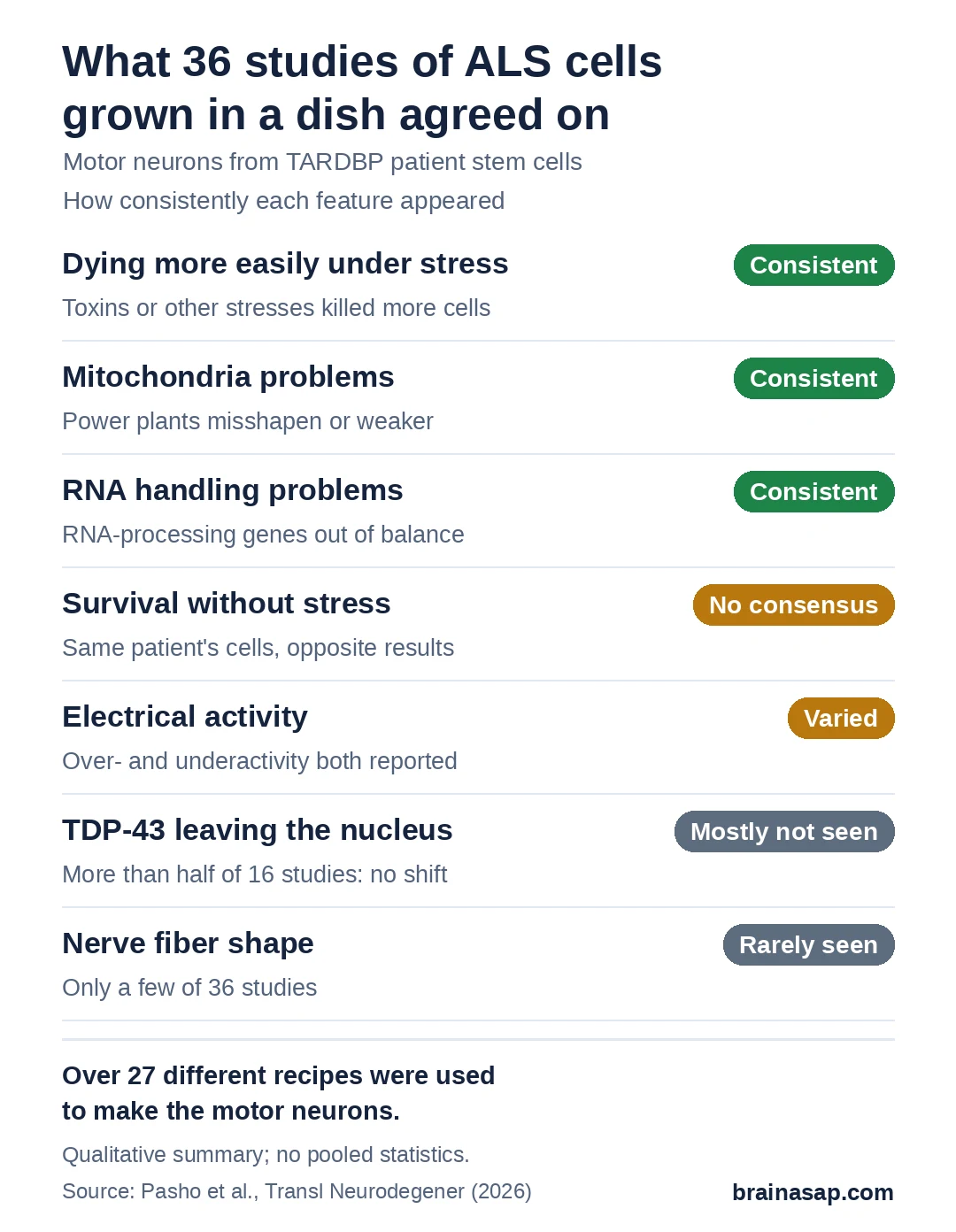
Pasho and colleagues recommended that drug-screening studies use these 3 features as their main measures.
A Key ALS Sign Mostly Didn’t Appear
The result that may surprise people most: TDP-43 mostly stayed where it belongs. Of 16 studies that checked, more than half found no shift of TDP-43 out of the nucleus.
In 2 studies, for example, only 2% to 3% of motor neurons had TDP-43 outside the nucleus, in patient and healthy cells alike.
One possible factor is age. Lab-grown neurons are studied over weeks or months, while ALS usually starts around age 50 to 65. Late disease changes may need time, or extra stress, to show up.
Why Results Disagreed
Other features were all over the map:
- Survival without stress: no consensus. Two studies of cells from the same patient reached opposite conclusions using different methods.
- Electrical activity: some found overactive neurons early and underactive ones later; others found differences that didn’t match.
- Nerve fiber shape: only a few of the 36 studies found changes.
Teams used more than 27 different recipes to make motor neurons, grew them for different lengths of time, and measured them in different ways. Researchers couldn’t tie the disagreements to any one factor, but found that the way images and signals were analyzed often shaped the answer.
What the Review Can’t Settle
- No pooled statistics: findings were summarized study by study, not combined in a meta-analysis.
- One search source: studies came from a PubMed search, and some may have been missed.
- TARDBP only: conclusions don’t necessarily apply to other ALS genes or to the 90% of ALS with no family history.
Can Standard Methods Make These Cells a Better Drug Test?
Stem-cell motor neurons still offer something animals can’t: human cells with a patient’s own genes. The review found that no approved ALS drug had come from them. Ropinirole, a Parkinson’s drug picked through this kind of screening, did not clearly slow decline on the ALSFRS-R functional scale during the blinded phase of a small trial.
Shared, automated methods and open data are the review’s main request, so that the next round of studies can tell real disease signals from lab-to-lab noise.
Citation: DOI: 10.1186/s40035-026-00580-2. Pasho E, Catanese A, Kabashi E, Ciura S. What can we learn on ALS pathophysiology from iPSC-derived motor neurons harbouring TARDBP mutations: a systematic review. Transl Neurodegener. 2026;15:49.
Study Design: Systematic review (PubMed search) of iPSC-derived motor neuron studies with TARDBP mutations, without meta-analysis.
Sample Size: 36 studies published since 2012.
Key Statistic: Of 16 studies examining TDP-43 location, more than half found no cytoplasmic mislocalization.
Caveat: Narrative synthesis; heterogeneous methods; findings specific to TARDBP models.