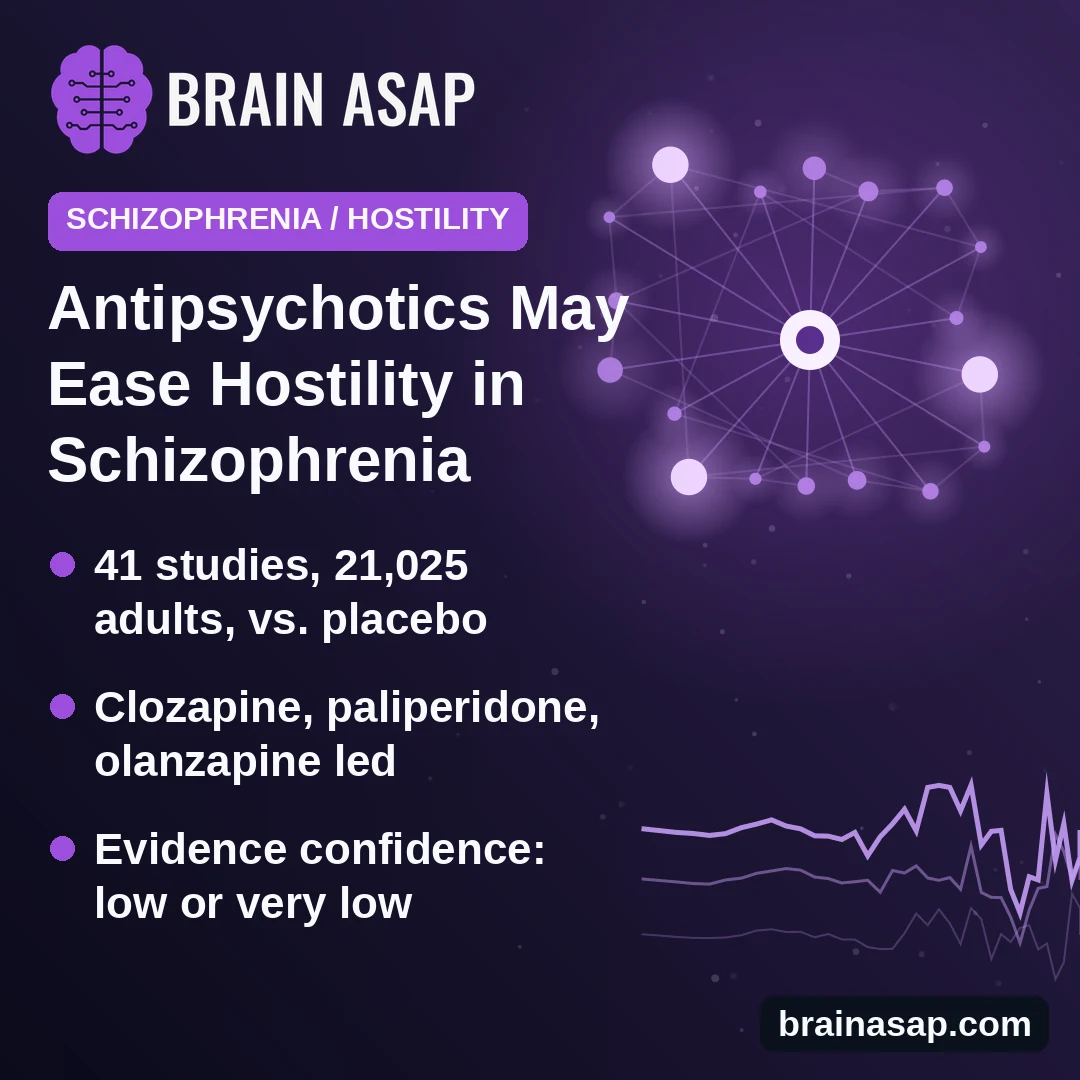
TL;DR: In 41 studies of adults with schizophrenia or a related condition, 7 of 18 antipsychotics lowered hostility more than a dummy pill. Confidence in the evidence was low or very low.
Key Findings
- Antipsychotics beat placebo: 7 of 18 drugs clearly reduced hostility and aggression, over a median of 8 weeks.
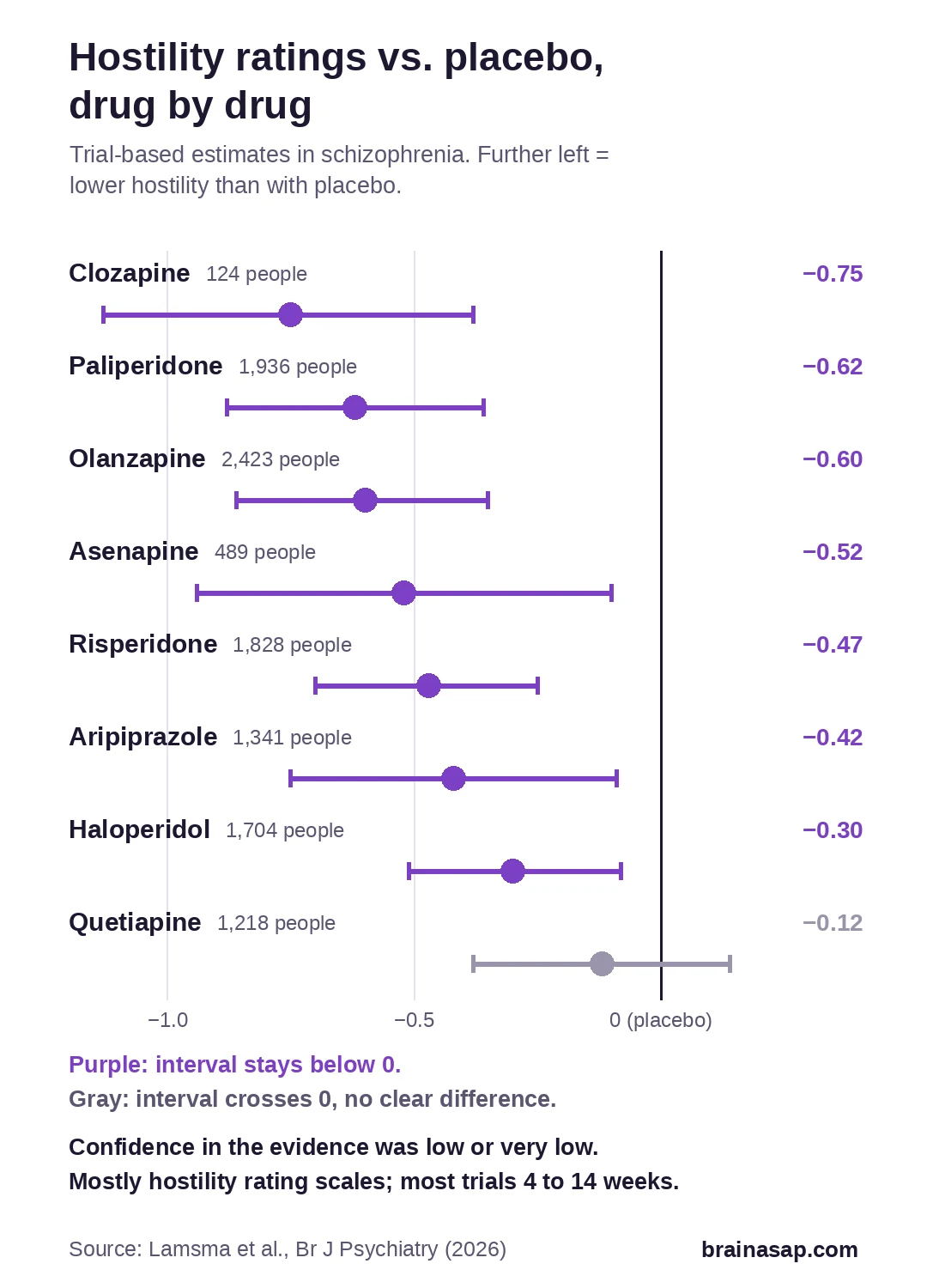
- Largest estimates: Clozapine (−0.75), paliperidone (−0.62), olanzapine (−0.60); more negative means less hostility.
- Smaller but clear: Asenapine, risperidone, aripiprazole, haloperidol (−0.52 to −0.30).
- No clear difference from placebo: Quetiapine (−0.12) and 10 others, several with few participants.
- Low confidence: Authors rated evidence low or very low for every comparison; differences between drugs remain uncertain.
Source: The British Journal of Psychiatry (2026) | Lamsma et al.
Most people with schizophrenia are not hostile or aggressive. But for some, at some points in their illness, anger and aggression become part of the picture, which can harm the person and others and deepen the stigma they already face.
Antipsychotics are central to care, so does the choice of drug matter for this problem? Pooling 41 studies, the answer was a qualified yes for some drugs, with low confidence in the evidence.
How the analysis pooled the trials
The team, based in the Netherlands and at the University of Oxford, ran a network meta-analysis. That is a way of pooling many randomized trials, including trials that never tested two drugs against each other. If Drug A beat placebo in one set of trials and Drug B beat placebo in another, the method can estimate how A and B compare, with the caveat that indirect comparisons like this are less certain than a head-to-head trial.
They searched four databases through April 2025 and included randomized trials of adults with schizophrenia or a related psychotic disorder (such as schizoaffective disorder) that compared a single antipsychotic with placebo or another antipsychotic, and followed people for more than 48 hours. The final set was:
- 41 studies drawn from 60 trials, with 21,025 participants.
- 18 different antipsychotics, plus placebo.
- Average age 38, about 60% men.
- Median follow-up 8 weeks; 34 of 41 studies reported results from weeks 4 to 14.
Mostly hostility ratings, not aggressive acts
The authors combined two overlapping ideas. Hostility covers feelings and behaviors that often come before or alongside aggression, such as irritability, anger, and threats. Aggression means behavior meant to cause psychological or physical harm to someone else.
Here is the catch. In 36 of the 41 studies (88%), the outcome was a hostility item or subscale from a general symptom rating scale, not a count of aggressive acts. Only a handful used a dedicated aggression scale (4 studies) or recorded whether an aggressive act occurred (2 studies). So this is mainly a story about hostility ratings, and the authors say the findings may reflect reductions in hostility more than in aggressive behavior itself.
Seven of 18 drugs beat placebo
Results are reported as a standardized mean difference (SMD). Think of it as a common yardstick that lets researchers combine different rating scales. A value of 0 means no difference from placebo, and more negative means a bigger drop in hostility. As a rough rule of thumb, values near −0.5 are usually considered moderate.
Compared with placebo, 7 of the 18 antipsychotics showed a clear reduction:
- Clozapine: −0.75 (95% CI −1.13 to −0.38)
- Paliperidone: −0.62 (−0.88 to −0.36)
- Olanzapine: −0.60 (−0.86 to −0.35)
- Asenapine, risperidone, aripiprazole, and haloperidol: smaller effects, between −0.52 and −0.30
The other 11 did not show a clear difference from placebo. That includes quetiapine (−0.12; −0.38 to 0.14), which is widely prescribed for behavioral disturbance and had a fairly large body of evidence behind it (1,218 participants). It also includes drugs with very little data. Fluphenazine, for example, had 13 participants, so “no clear difference” there mostly means “too little evidence to say.”
How much to trust the ranking
It is tempting to read the chart as a leaderboard. The authors urge against that, for several reasons:
- Intervals overlap heavily. Plausible range for clozapine overlaps paliperidone, olanzapine, and several others, so the data cannot firmly separate them.
- Clozapine rests on little data. 124 participants, versus more than 1,900 each for paliperidone and olanzapine.
- Drug-to-drug comparisons mostly indirect. Paliperidone's edge over placebo had direct evidence, but its apparent advantage over other drugs was mostly indirect and needs head-to-head trials.
- Evidence rated low or very low. Concerns: study bias (34 studies had “some concerns,” 6 high risk, 1 low risk), imprecision, and inconsistency between direct and indirect results.
The authors ran several checks, such as adjusting for follow-up length and care setting and excluding studies that were not mainly about schizophrenia. The pattern held, and some checks gave slightly larger effects.
Limits of the evidence
- Short-term evidence. Most studies lasted 4 to 14 weeks; unclear how long effects last.
- Mostly hostility ratings. Hostility was usually one item on a broad symptom scale, so part of the effect may reflect people improving overall.
- Uneven populations. First-episode psychosis and forensic settings underrepresented; many trials excluded substance misuse, which is common in real-world care.
- Mostly oral medication. 35 of 41 studies tested pills; only 4 tested long-acting injections, so findings may not carry over.
- No side-effect comparison. Weight gain, sedation, and other adverse effects were not weighed, and they matter a great deal when choosing a medication.
- Few trials targeted aggression. Authors call for trials with aggression as the primary outcome.
Trials focused on aggression are still needed
The clearest takeaway is a broad one: across many trials, antipsychotics were associated with lower hostility ratings, which fits the idea that symptoms like paranoia and hallucinations contribute to hostility and that treating them helps.
Which drug works best for hostility is still open. Choosing a medication also depends on side effects, tolerability, whether someone can take it consistently, and their own preferences, all outside this analysis. The authors point to combining medication with anger management, cognitive behavioral therapy, and social skills training as a direction worth testing. The next step is trials that make aggression the primary outcome and compare drugs head to head.
This article is a summary of research and not medical advice. Anyone taking an antipsychotic should not change or stop it without talking to their prescriber.
Citation: DOI: 10.1192/bjp.2026.10800. Lamsma J, Ostinelli EG, Cipriani A, Fazel S. Comparative efficacy of antipsychotics for reducing aggression in schizophrenia: systematic review and network meta-analysis. The British Journal of Psychiatry. 2026:1–8.
Study Design: Systematic review and frequentist random-effects network meta-analysis of randomized controlled trials (PROSPERO CRD42024572272); searches to 25 April 2025; confidence rated with CINeMA.
Sample Size: 41 studies (60 trials), 21,025 adults with schizophrenia or related psychotic disorders, 18 antipsychotics plus placebo.
Key Statistic: Versus placebo, clozapine SMD −0.75 (95% CI −1.13 to −0.38), paliperidone −0.62 (−0.88 to −0.36), olanzapine −0.60 (−0.86 to −0.35); 7 of 18 drugs showed clear effects.
Caveat: Confidence low or very low for all comparisons; mostly hostility items on symptom scales with 4 to 14 week follow-up; drug-to-drug differences mostly indirect. The article is open access (CC BY 4.0).