TL;DR: In a small trial of 30 nursing-home residents with Parkinson's, adding 15 minutes of Baduanjin, a gentle qigong routine, to regular physical therapy led to better balance and farther walking after 12 weeks. Walking speed on a timed test and motor symptom scores did not clearly improve.
Key Findings
- 30 residents, 27 finished: All did physical therapy; half also did Baduanjin.
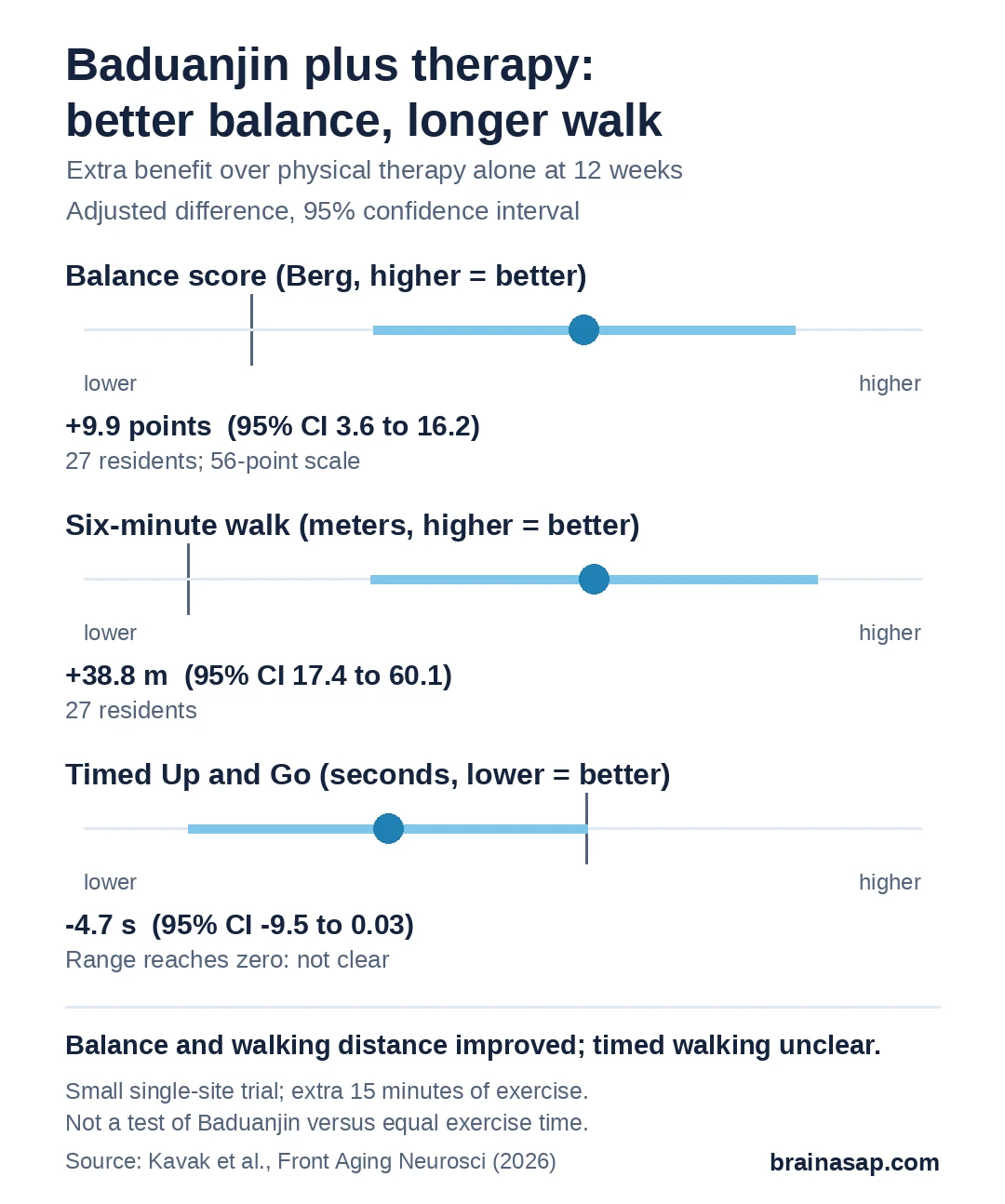
- Balance score up about 10 points: Adjusted difference of 9.93 on the 56-point Berg scale (95% CI 3.64 to 16.23).
- Farther walk: 38.8 meters more in six minutes (95% CI 17.4 to 60.1).
- Timed Up and Go unclear: 4.7 seconds faster, but the range (−9.5 to 0.03) just reaches zero.
- No motor-score gain: Parkinson's movement exam scores were similar.
Source: Frontiers in Aging Neuroscience (2026) | Kavak et al.
Falls are one of the biggest risks for people with Parkinson's, and balance and walking are common targets of rehab. Standard physical therapy helps, but no single exercise has been shown to be best.
Baduanjin, a slow sequence of movements with weight shifting, breathing and focus, is already popular in China for older adults. Could adding it to regular therapy give a further boost?
Regular Therapy With or Without Baduanjin
Researchers in Turkey recruited 30 residents of one nursing home who had Parkinson's and randomly assigned them to one of two groups for 12 weeks:
- Physical therapy only: Supervised 45-minute sessions, three times a week
- Physical therapy plus Baduanjin: The same sessions, plus 15 supervised minutes of Baduanjin each time
A physiotherapist who didn't know which group people were in measured four outcomes at the end: balance (Berg Balance Scale, scored 0 to 56), a timed stand-walk-and-sit test (Timed Up and Go), distance covered in six minutes of walking, and a doctor-rated movement exam for Parkinson's (MDS-UPDRS III). Twenty-seven people finished: 13 in the Baduanjin group and 14 in the therapy-only group.
Balance and Walking Distance Improved
After adjusting for each person's starting level, the Baduanjin group scored 9.93 points higher on the Berg balance scale (95% CI 3.64 to 16.23), a gap the authors note is larger than the scale's 5-point threshold for a real change. They also walked 38.8 meters farther in six minutes (95% CI 17.4 to 60.1). Both held up after the researchers corrected for testing four outcomes at once.
Timed Walking and Motor Scores Showed No Extra Benefit
The Timed Up and Go test favored the Baduanjin group by 4.7 seconds, but after correction the result was not statistically significant (95% CI −9.5 to 0.03). The Parkinson's movement exam score was essentially the same in both groups (difference 1.78 points, 95% CI −5.11 to 8.67).
So the improvements are in balance and walking distance, not in the doctor-rated severity of Parkinson's itself.
Extra Exercise Time Could Explain the Gap
- Small and single-site: 30 people in one nursing home, and wide confidence intervals.
- Extra time, extra attention: The Baduanjin group simply exercised 15 minutes longer each session, so the trial can't separate Baduanjin itself from more exercise.
- No primary outcome chosen ahead of time: All four outcomes were analyzed in parallel.
- Complete-case analysis: Three people were left out, including one who left the nursing home.
- No adherence tracking: Sessions were supervised, but attendance was not recorded in detail.
A Fair Test Needs Equal Exercise Time in Both Groups
The finding is encouraging but early. For nursing-home residents with Parkinson's, a gentle qigong routine looks like a low-risk addition worth testing further.
The next trial needs a comparison group doing an equal amount of other exercise, more people, and a planned main outcome, to show whether Baduanjin adds something special.
Citation: DOI: 10.3389/fnagi.2026.1925159. Kavak MF, Civelek NB, Yalçın G. Integrating Baduanjin exercise into Parkinson's rehabilitation: a randomized controlled trial. Front Aging Neurosci. 2026;18:1925159.
Study Design: Assessor-blinded, two-group randomized controlled trial (NCT07306169); baseline-adjusted ANCOVA with Holm correction.
Sample Size: 30 randomized; 27 analyzed (13 Baduanjin plus therapy, 14 therapy alone).
Key Statistic: Berg Balance Scale adjusted difference 9.93 points (95% CI 3.64 to 16.23); six-minute walk 38.76 m (95% CI 17.39 to 60.13).
Caveat: Small single-site trial; intervention group had 15 extra minutes of exercise; no prespecified primary outcome.