TL;DR: In an Australian study published in 2026, 271 adults gave a mouthwash sample for gene testing and filled in questionnaires on anxiety and depression. A common change in a brain-growth gene went with higher anxiety scores in some women but lower scores in some men, depending on which version of a mood-related gene they carried.
Groups were small, so the pattern needs repeating in a bigger study.
Key Findings
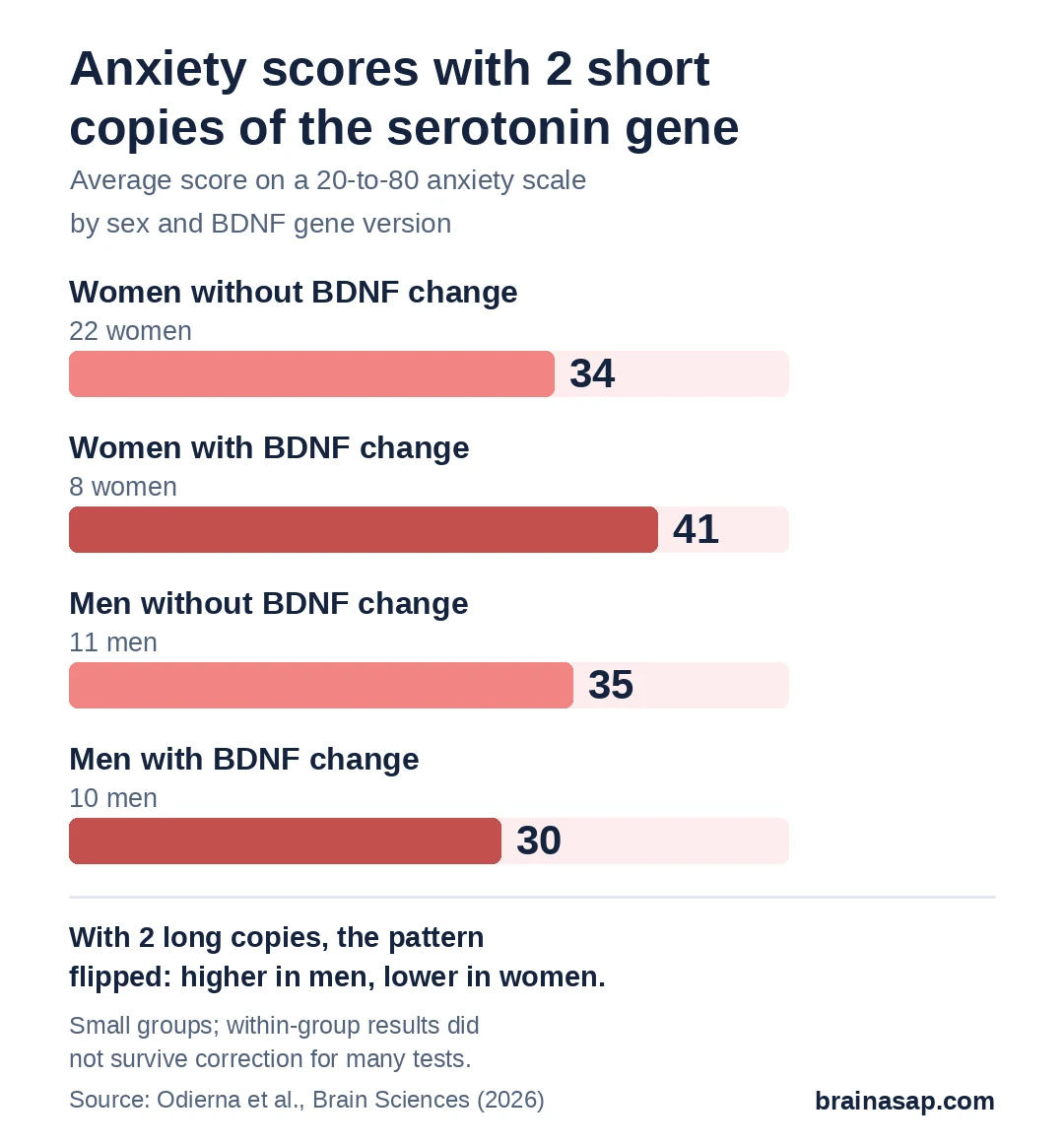
- Opposite directions: Among people with 2 short copies of a serotonin gene, women who also had the brain-growth gene change scored higher on anxiety (41 vs 34), while men with it scored lower (30 vs 35).
- Flipped with the other version: Among people with 2 long copies of the serotonin gene, men with the brain-growth gene change scored higher, and women lower.
- Only some symptoms: The same pattern showed up for loss of pleasure, but not for sad mood, thinking problems or body symptoms such as poor sleep.
- Other measures did not show the pattern: Morning stress hormone levels, body weight, smoking, drinking and a resilience score did not follow the same gene pattern.
- Small groups: Some gene-and-sex groups had fewer than 10 people.
Source: Brain Sciences (2026) | Odierna, Sharpley and Bitsika
For 2 decades, researchers have hunted for single genes that raise the risk of anxiety and depression. Most early leads faded when bigger studies tried to repeat them.
One idea is that genes might matter only in certain combinations, or only in men or only in women. A 2026 study in Brain Sciences, by the Brain-Behavior Research Group at the University of New England in Australia, tested that idea with 2 well-known genes.
Which 2 Genes Were Tested?
- Serotonin transporter gene: controls a protein that clears the mood chemical serotonin from between brain cells. People carry a short or long version from each parent, so they have 2 short, 2 long or 1 of each.
- BDNF gene: makes a protein that helps brain cells grow and form new connections. About 1 in 3 people in this study carried 1 copy of a common change in it (called the A version) that may reduce how much of the protein is released.
Earlier studies linked each of these to anxiety or depression, with mixed results.
Who Was Tested?
Volunteers aged 18 and over were invited by letter from a large rural area of northern New South Wales, whether or not they had ever had mental health problems. Each gave a mouthwash sample for DNA testing and completed:
- A 20-question anxiety questionnaire, scored from 20 to 80
- A 20-question depression questionnaire, split into 4 symptom types: sad mood, loss of pleasure, thinking problems and body symptoms
- A resilience questionnaire about bouncing back from stress
Researchers also measured morning cortisol, a stress hormone, in saliva. After removing the 11 people with 2 copies of the A version, too few to analyze, about 240 people had full anxiety data.
Same Genes, Opposite Results in Men and Women
Neither gene on its own was linked to anxiety. A link appeared only when sex and both genes were looked at together.
Among people with 2 short copies of the serotonin gene, the A version of the brain-growth gene went with more anxiety in women but less in men.
Among people with 2 long copies, the reverse held: men with the A version scored 39 vs 32 without it, and women 33 vs 37.
People with 1 short and 1 long copy showed no clear difference.
Loss of Pleasure, but Not Sad Mood
The same up-in-women, down-in-men pattern showed up for anhedonia, losing interest or pleasure in things you used to enjoy. It did not show up for the other 3 types of depression symptoms.
Odierna and colleagues argued that this narrow pattern makes a quirk of the questionnaires less likely, since a scoring artifact would tend to affect every scale.
They suggested that estrogen, which raises levels of both proteins, might explain why women and men differ. That idea was not tested here: hormone levels, menstrual cycle and menopause were not measured.
Why the Groups Were Too Small to Be Sure
- Tiny subgroups: Splitting 271 people by sex and 2 genes left some groups with 4 to 10 people.
- Effect sizes uncertain: Plausible ranges for the size of the effect ran from almost nothing to very large.
- Follow-up tests didn't survive correction: The overall 3-way pattern held after correcting for many tests, but none of the individual within-group comparisons did.
- Medicines mattered for pleasure scores: Without people taking mood medicines, the loss-of-pleasure pattern was no longer statistically clear; the anxiety pattern held.
- One-time snapshot, one region: Mostly people of European descent in rural Australia.
A Pattern Worth Testing in a Larger Group
This study does not show that anyone's genes set their anxiety level.
It suggests a specific, testable pattern: a brain-growth gene change may tip anxiety and loss of pleasure in opposite directions in men and women, depending on their serotonin gene. A much larger study, ideally with hormone measurements, is needed to see if it holds.
Citation: DOI: 10.3390/brainsci16080883 Odierna GL, Sharpley CF, Bitsika V. Anxiety and Depression Traits Are Moderated by a Sex-Dependent Genetic Interaction Between 5-HTTLPR and BDNF. Brain Sciences. 2026;16(8):883.
Study Design: Cross-sectional community candidate-gene study; 5-HTTLPR (s/l) and BDNF rs6265 G196A (GG vs GA; AA excluded); Zung SAS, SDS clinical-content subscales, CD-RISC; morning salivary cortisol; three-way ANCOVA (sex × BDNF × 5-HTTLPR + age) with Benjamini–Hochberg FDR.
Sample Size: 271 genotyped adults, northern New South Wales, Australia; SAS n = 239 and SDS subscales n = 243 after excluding 11 AA carriers and missing data.
Key Statistic: SAS three-way interaction F(2,222) = 4.5, p = 0.012, FDR p = 0.048; anhedonia F(2,226) = 5.76, p = 0.004, FDR p = 0.029. ss stratum SAS: female GG 33.7 vs GA 40.9; male GG 35.0 vs GA 30.0. ll stratum: male GG 32.1 vs GA 38.8; female GG 36.9 vs GA 32.5. No three-way interaction for depressed mood, cognitive, somatic depression, CD-RISC, cortisol or BMI.
Caveat: Modest, imbalanced subgroups; wide bootstrapped CIs (ss SAS η²p 0.002–0.397); no stratified effect survived FDR across 24 tests; anhedonia effect attenuated without medicated participants; dominant model only; hormones not measured; cross-sectional.