TL;DR: Healthy young adults in China lay still in a brain scanner while researchers tracked how much activity in each brain area changed from moment to moment. Those higher in neuroticism, a personality trait marked by worry, had steadier activity at the front of the brain, as did those reporting more low-mood symptoms.
Key Findings
- Neuroticism and brain activity: among 103 healthy adults, higher neuroticism scores went with less moment-to-moment fluctuation in 5 brain areas, including 2 at the front of the brain.
- Low mood showed the same pattern: in the 39 people who filled out a depression questionnaire, more symptoms went with less fluctuation in those 2 front areas.
- Neuroticism as a statistical bridge: the statistical models linked neuroticism scores to both patterns. A direct link remained clear in one of the two areas.
- Not a depression test: no one had clinical depression, and a single snapshot cannot show what causes what.
Source: Brain Imaging and Behavior (2026) | Lu, Pang, Chen and colleagues
Neuroticism, a tendency to worry and to react strongly to stress and loss, is one of the best-known personality risk factors for depression.
A brain that is "flexible," able to shift quickly between states, is often thought to be a healthy one. Could a less flexible brain sit somewhere between a worried personality and low mood?
Measuring How Much Brain Activity Wobbles
A 2026 study in Brain Imaging and Behavior, led by Fengmei Lu, Yajing Pang and Huafu Chen at the University of Electronic Science and Technology of China, scanned 103 healthy right-handed adults:
- Who: 63 men and 40 women, average age about 25, none with a history of mental illness, serious medical problems or prescription drugs
- Personality test: a 12-item true-or-false neuroticism questionnaire
- Mood test: a 20-item self-rated depression scale, completed by only 39 of the 103
- Brain scan: about 8 minutes of functional MRI with eyes closed, resting and not focusing on anything
Most scan studies average brain activity over time. This one looked at how much activity in each spot jumped around from one moment to the next, roughly every 2 seconds.
Higher variability is thought to reflect a brain that adapts more easily. In earlier research, it has gone with better thinking skills.
Higher Neuroticism Went With Steadier Activity
After accounting for age, sex, education and head movement, people with higher neuroticism scores had less fluctuation in 5 areas:
- 2 front areas: the medial prefrontal cortex, involved in thinking about oneself, and the dorsolateral prefrontal cortex, involved in focus and control
- 3 others: areas toward the side and top of the brain that earlier studies have linked to worry and emotion regulation
All of them were on the right side of the brain.
Low Mood Followed the Same Pattern at the Front
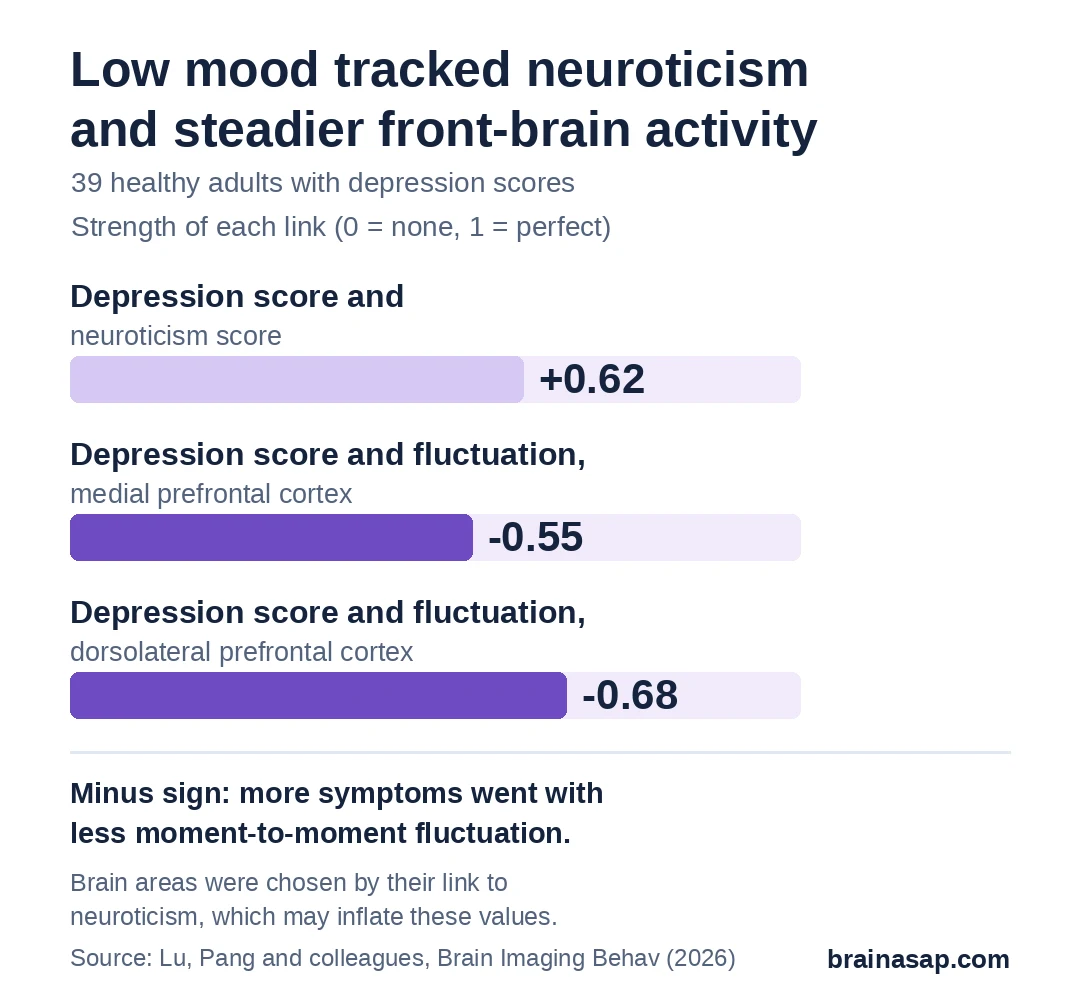
The team then checked those 5 areas against depression scores. Only the 2 front areas showed a link, and both were fairly strong for this kind of study.
Depression scores averaged 37 on a scale that runs from 25 to 100, on average well below the range usually used to flag depression, so these were mostly mild, everyday symptoms.
Neuroticism and depression scores were also closely linked (correlation 0.62), as many studies have found before.
Is Neuroticism the Link Between Brain and Mood?
To test that, the researchers ran a mediation analysis, a statistical check of whether one measure helps explain the link between 2 others.
After the model accounted for neuroticism, the direct link between low mood and steadier activity was still statistically clear in the dorsolateral prefrontal cortex. In the medial prefrontal cortex, the remaining direct link was less certain.
Lu and colleagues suggested this fits a picture where less flexible activity at the front of the brain goes with a worry-prone personality, which in turn goes with low mood. They also said that, if this held up over time, it might point to neuroticism as a target for preventing depression.
Why the Numbers May Look Stronger Than They Are
- Only 39 mood scores: all the depression results rest on fewer than 4 in 10 of the people scanned
- Areas picked by neuroticism: the brain areas tested against mood were chosen because they matched neuroticism, which itself tracked mood, so the paper notes the links may be inflated
- One snapshot: a single scan and questionnaire cannot show whether brain activity, personality or mood came first
- Healthy volunteers only: results may not apply to people with clinical depression
- No repeat sample: findings have not been checked in a separate group
A Lead Worth Testing Over Time
In this group of healthy young adults, a worry-prone personality and mild low mood both went with less changeable activity at the front of the brain.
Whether that steadier activity comes before rising neuroticism and depression, or follows them, is the question a study tracking people over several years would need to answer.
Citation: DOI: 10.1007/s11682-026-01194-y. Lu F, Pang Y, Li T, Liu M, Jia C, Gao J, Luo W, Yu Y, Wang L, Tang Q, Cui Q, Gao Q, He Z, Chen H. The mediating effect of neuroticism on the association between brain signal variability in the prefrontal cortex and depression among healthy individuals. Brain Imaging and Behavior. 2026;20:132.
Study Design: Cross-sectional resting-state fMRI study; voxel-wise mean-squared successive difference (MSSD) of the BOLD signal regressed on neuroticism (EPQ-RSC), then partial correlation with Zung Self-Rating Depression Scale and bootstrapped mediation analysis, adjusting for age, sex, education and head motion.
Sample Size: The imaging analysis included 103 healthy right-handed adults (63 men, 40 women; mean age 24.7). The depression scale analysis included 39.
Key Statistic: Depression score vs neuroticism r = 0.62; depression score vs MSSD, medial prefrontal cortex r = -0.55, dorsolateral prefrontal cortex r = -0.68; mediation ACME -73.11 (p = 0.006) with non-significant direct effect in the medial prefrontal cortex, ACME -50.36 (p = 0.001) with significant direct effect in the dorsolateral prefrontal cortex.
Caveat: Cross-sectional; depression analyses limited to 39 people; regions chosen by their link with neuroticism, risking inflated estimates; non-clinical volunteers; no replication sample. Full published article reviewed.