TL;DR: In a study published in 2026 in China, 231 women near the end of radiation treatment after breast cancer surgery filled in questionnaires about their personality, their feelings and symptoms of anxiety and depression.
About half had signs of possible depression and about 1 in 3 had signs of possible anxiety. Women who found it hard to recognize and put words to their feelings tended to have more of both.
Key Findings
- Common distress: 52% of women scored in the range for possible depression and 35% for possible anxiety.
- Trouble naming feelings: Women who had a harder time identifying and describing their emotions reported more anxiety and more depression symptoms.
- Personality mattered: Women prone to worry and mood swings, and those with more detached, tough-minded traits, had more anxiety and depression symptoms. Outgoing women had somewhat fewer depression symptoms.
- A small go-between role: Trouble naming feelings explained only a small part of the link between personality and distress.
- One snapshot: The survey was taken once, so it can't show what causes what.
Source: Frontiers in Psychiatry (2026) | Li, Luo et al.
After breast cancer surgery, many women go on to several weeks of daily radiation treatment. It is a stretch of time when worry and low mood can build up quietly.
Some people also struggle to tell what they are feeling, or to describe it to others. Psychologists call this alexithymia. A 2026 study in Frontiers in Psychiatry, by researchers at West China Hospital of Sichuan University, asked whether it helps explain why some women feel more anxious or depressed during radiotherapy.
Who Was Surveyed?
Between January and May 2024, the team recruited women having radiation after breast cancer surgery. Each filled in questionnaires during her last 2 weeks of treatment.
- Final group: 231 women, after removing 14 whose answers suggested they were trying to look good and 3 with incomplete forms
- Most common age: 50 to 59 (47%)
- Surgery: 78% had the whole breast removed; 22% had breast-conserving surgery
The questionnaires covered 3 things:
- Anxiety and depression symptoms over recent days, with a score of 8 or more counted as "possible" anxiety or depression
- Personality on 3 traits: proneness to worry and mood swings, outgoingness, and a detached, tough-minded streak
- Trouble identifying and describing feelings
How Many Women Had Signs of Anxiety or Depression?
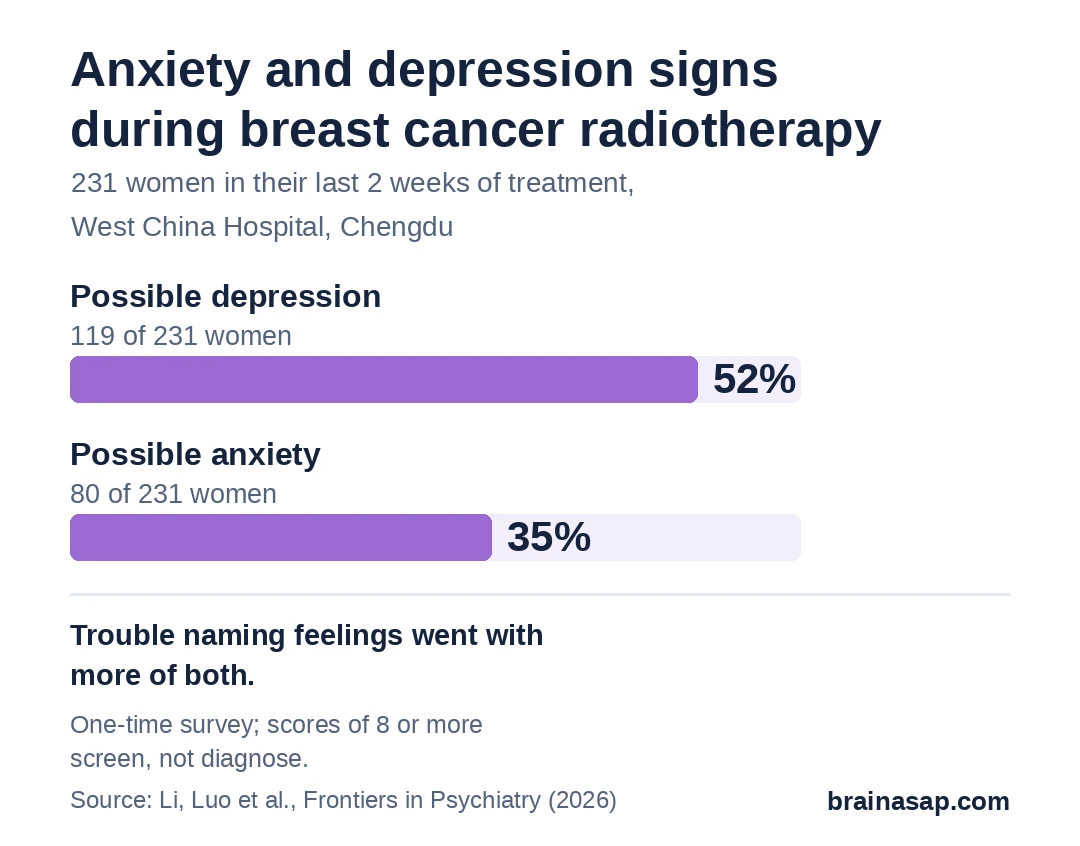
Possible depression was more common than possible anxiety: 119 women vs 80. Education level was linked to both, and women with the slower-growing luminal A type of breast cancer had less depression than women with other types.
These are screening scores, not diagnoses from a doctor.
Which Traits Went With More Distress?
- Prone to worry and mood swings: clearly more anxiety; slightly more depression
- Detached, tough-minded traits: clearly more anxiety and depression, the strongest link for depression
- Outgoing: somewhat fewer depression symptoms; no clear link with anxiety
- Trouble naming feelings: more anxiety and, more strongly, more depression
Women with detached, tough-minded traits also had the most trouble naming their feelings.
Does Trouble Naming Feelings Connect the Two?
Li, Luo and colleagues tested whether trouble naming feelings sits between personality and distress. In statistical terms, it did, but the share it explained was small.
Most of the link between personality and anxiety or depression ran directly, not through trouble naming feelings. Researchers were careful to call these indirect links, not proof of a chain of causes.
Limits of a Single Survey
- One time point: Can't show whether personality or trouble naming feelings came before the distress.
- Self-report only: No interviews by doctors or psychologists.
- Some weak scales: The depression and one feelings subscale were less consistent than ideal, which can blur links.
- Other treatments not recorded: Chemotherapy and hormone therapy can affect mood and were not tracked.
- One hospital: West China Hospital, using a convenience sample.
Could Learning to Name Feelings Ease Distress During Radiotherapy?
Based on this, the authors suggested that radiotherapy units could screen for trouble naming feelings and offer short training in recognizing and expressing emotions. Whether that would actually lower anxiety or depression in women with breast cancer is still untested and would need a trial.
Citation: DOI: 10.3389/fpsyt.2026.1891800 Li Y, Luo Y, Li Z, Wang D, Yang L, He Y, Wen Q. Personality characteristics, alexithymia and anxiety/depression in breast cancer patients undergoing radiotherapy: a cross-sectional mediation analysis. Frontiers in Psychiatry. 2026;17:1891800.
Study Design: Cross-sectional survey, convenience sample; Eysenck Personality Questionnaire (neuroticism, extraversion, psychoticism, Lie scale), Toronto Alexithymia Scale (TAS-26), HADS (≥8 = probable); Pearson correlations and PROCESS mediation adjusting for education (and molecular subtype for depression).
Sample Size: 231 women in the last 2 weeks of postoperative radiotherapy, West China Hospital, Sichuan University (January–May 2024); 248 enrolled, 14 excluded for EPQ Lie score >70 and 3 for incomplete data.
Key Statistic: Probable anxiety 34.6% (80/231), probable depression 51.5% (119/231). Correlations with anxiety: neuroticism r = 0.471, psychoticism r = 0.486, alexithymia r = 0.294; with depression: neuroticism r = 0.246, psychoticism r = 0.571, extraversion r = −0.208, alexithymia r = 0.407. Indirect effects via alexithymia −0.028 to 0.020 (Table 5) (all 95% CIs excluded 0).
Caveat: Cross-sectional; single center; self-report; HADS-Depression and TAS-DFAN α < 0.70; sample size not powered for mediation; systemic treatments not recorded.