TL;DR: In a hospital survey published in 2026 in China, 364 people with colorectal (bowel) cancer answered standard questions about 16 common symptoms of anxiety and depression.
Most had mild symptoms. Among people with symptoms, feeling down or hopeless was the one most strongly linked to the others, while for people with a stoma, a surgical opening that lets stool leave the body into a bag, changes in appetite took that spot.
Key Findings
- 3 groups of patients: 28% had no anxiety or depression, 57% had mild symptoms and 15% had moderate symptoms.
- Feeling down sat at the center: In patients with symptoms, low mood had the strongest overall links to the other anxiety and depression symptoms.
- A bridge between anxiety and depression: Moving or speaking unusually slowly, or being unusually restless, had the strongest links across the 2 kinds of symptoms.
- Appetite stood out with a stoma: Eating much less or much more than usual was the most connected symptom in patients with a stoma.
- Physical problems went with worse mood: Having a stoma, more pain worry and more stress went with being in the moderate-symptom group.
Source: Frontiers in Psychiatry (2026) | Chen, Chen and Wu
A colorectal cancer diagnosis often brings surgery, chemotherapy and changes to how the bowel works. Anxiety and depression are common along the way, and they often show up together.
A 2026 study in Frontiers in Psychiatry, by nurses and doctors at Jinzhou Medical University, asked which of those symptoms sit at the center, and whether the answer changes for people living with a stoma.
Who Took Part
Researchers surveyed 364 adults with confirmed colorectal cancer at large hospitals in Liaoning Province, in northeast China, during a collection period ending in May 2026; the paper disagrees on the start year. People with other severe illness, a recent major life upset, or a mental health condition that made the survey hard to complete were left out.
Each person filled in:
- A 7-item anxiety questionnaire, covering things like feeling nervous and worrying too much
- A 9-item depression questionnaire, covering things like low mood, poor sleep and changes in appetite
- Questions about pain worry and stress, including how much people dwelled on or felt helpless about pain
Researchers took details such as cancer stage and whether the patient had a stoma from medical records.
How Were Patients Grouped?
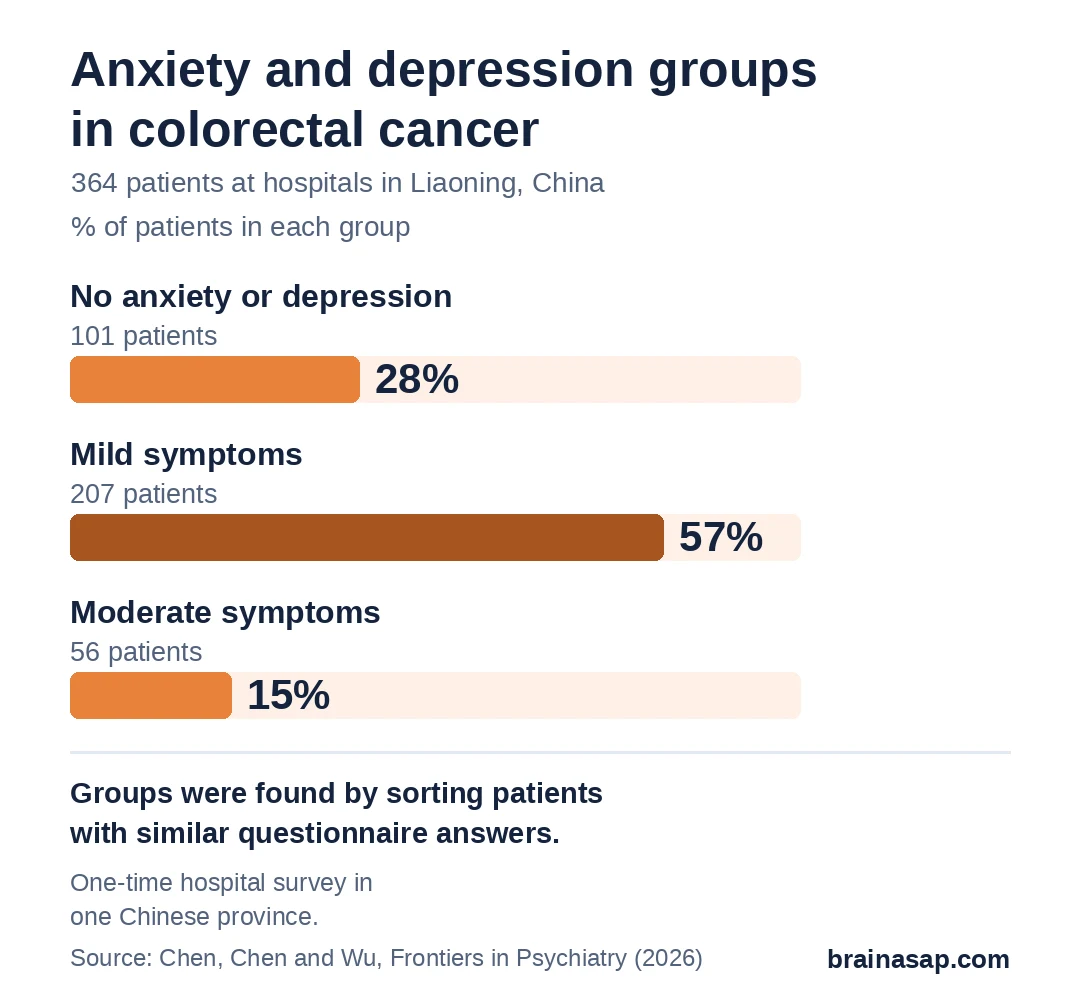
A statistical method sorted patients into groups with similar answer patterns. It found 3:
- No anxiety or depression: 101 patients (28%)
- Mild symptoms that varied from item to item: 207 patients (57%)
- Moderate symptoms, with especially high scores for slowed or restless movement: 56 patients (15%)
Average scores fell in the mild range on both questionnaires, with depression scores a little higher than anxiety scores.
Patients with a stoma, more worry about pain and more stress were more likely to be in the moderate group than in either of the other 2. Patients with constipation or diarrhea were also less likely to be in the symptom-free group than in the moderate group.
Which Symptoms Were Most Connected?
Next, the team mapped how each of the 16 symptoms went with every other, using the 263 patients in the 2 groups with symptoms. A symptom with many strong links sits at the center of the map.
- Most central: feeling down, depressed or hopeless
- Next: slowed or restless movement, then changes in appetite
- Strongest single link: feeling down and appetite changes
- Main bridge to anxiety: slowed or restless movement
A common idea in this kind of research is that a central symptom may help keep the others going. This survey could not test that.
What Changed With a Stoma?
People with and without a stoma had different-looking symptom maps. For patients without one, feeling down stayed at the center. For patients with a stoma, appetite changes became the most connected symptom, and symptoms were more tightly linked overall.
Chen and colleagues suggested that people with a stoma may change what and how much they eat to avoid gas, leaks or embarrassment, which could tie eating closely to mood. This study did not test that explanation.
Limits to Keep in Mind
- One-time survey: Shows which symptoms go together, not which cause which.
- Group sizes not given: The paper did not report how many patients had a stoma, which makes the stoma comparison hard to judge.
- Modest questionnaire reliability: Researchers noted that both questionnaires measured less consistently than usual in this group.
- One province, convenience sample: Patients came from hospitals in one region and were not randomly chosen.
- Reporting slips: The paper gives 2 different start years for data collection.
Checking Mood and Appetite Together
Chen and colleagues recommended that care teams watch for low mood, slowed or restless behavior and, in people with a stoma, eating changes. Whether easing any one of these symptoms lowers the others would need a study that follows patients over time or tests a treatment.
Citation: DOI: 10.3389/fpsyt.2026.1892567 Chen Y, Chen J, Wu D. Identifying core symptoms of anxiety and depression in colorectal cancer patients: network analysis. Frontiers in Psychiatry. 2026;17:1892567.
Study Design: Cross-sectional hospital survey with latent profile analysis, multinomial logistic regression and symptom network analysis (EBICglasso, strength and bridge expected influence, Network Comparison Test by stoma status).
Sample Size: 364 adults with colorectal cancer at tertiary hospitals in Liaoning Province, China; network built on the 263 patients in the 2 symptomatic profiles.
Key Statistic: Profiles: no anxiety/depression 101 (27.7%), mild fluctuating 207 (56.9%), moderate with behavioral changes 56 (15.4%). Strength: D2 depressed mood 3.881, D8 psychomotor 3.740, D5 appetite 3.638; bridge expected influence highest for D8 (2.567). Stoma vs no stoma: global strength difference 4.47 (p = 0.027); maximum edge difference M = 0.37 (p = 0.010); stoma core symptom D5.
Caveat: Cross-sectional; convenience sample from one province; stoma group sizes not reported; GAD-7 α = 0.705 and PHQ-9 α = 0.711; inconsistent data collection dates in the paper.