TL;DR: Among nearly 3,000 adults aged 70 and older in Japan, 8% of those who had eaten dark chocolate weekly for more than 2 years showed signs of depression, versus 12% of those who rarely ate chocolate. After adjusting for other factors the gap was borderline, and the survey can't show that chocolate was the reason.
Key Findings
- 8% vs 12%: 60 of 727 long-term dark chocolate eaters had depressive symptoms, versus 143 of 1,226 people who rarely or never ate chocolate.
- Borderline after adjustment: Odds were 0.73 times as high (95% CI 0.53 to 1.01), a result that just misses the usual cutoff for statistical significance.
- Dark, not just any chocolate: Eating chocolate that wasn't dark showed no link (OR 1.10).
- Newer habit, no gap: People eating dark chocolate for 2 years or less looked like the rarely-or-never group.
- Cross-sectional: Everything was measured once, so the study can't show which came first.
Source: Frontiers in Nutrition (2026) | Nosaka et al.
Dark chocolate has a reputation as the "healthy" chocolate. It is rich in cocoa flavanols, plant compounds studied for heart health and, more recently, for memory and mood.
But does a square of dark chocolate a few times a week go along with better mood in older age? Researchers at Japan's National Center for Geriatrics and Gerontology asked that question of a large group of older adults.
Nearly 3,000 Older Adults in Nagoya
The researchers used data from a long-running health study of people living in one ward of Nagoya. Of 35,108 residents invited, 3,910 adults aged 70 or older came in for assessment between June 2023 and August 2024. After exclusions, such as people needing long-term care, people with dementia, and people missing key answers, 2,957 were analyzed. Their average age was 78, and 48% were women.
Depressive symptoms were measured with the 15-question Geriatric Depression Scale, a standard screening questionnaire. A score of 6 or higher counted as depressive symptoms. That is a screening result, not a diagnosis.
Sorting People by Chocolate Habit
Participants filled out a questionnaire on how often they ate chocolate and, for dark chocolate (defined as 70% cocoa or more), how long they had kept up a habit of at least once or twice a week. That sorted them into four groups:
- Rarely or never: 1,226 people who rarely or never ate chocolate
- Chocolate, but not dark: 731 people who ate chocolate but hardly ever dark
- Dark for 2 years or less: 273 people eating dark chocolate weekly or more, for 2 years or less
- Dark for more than 2 years: 727 people eating dark chocolate weekly or more, for over 2 years
The 2-year line was a product of the questionnaire's answer options, not an established threshold. The survey also did not ask how much chocolate people ate, only how often.
The Long-Term Dark Chocolate Group Had Fewer Depressive Symptoms
The raw percentages with depressive symptoms were 11.7% (rarely or never), 12.2% (chocolate, but not dark), 13.2% (dark for 2 years or less), and 8.3% (dark for more than 2 years).
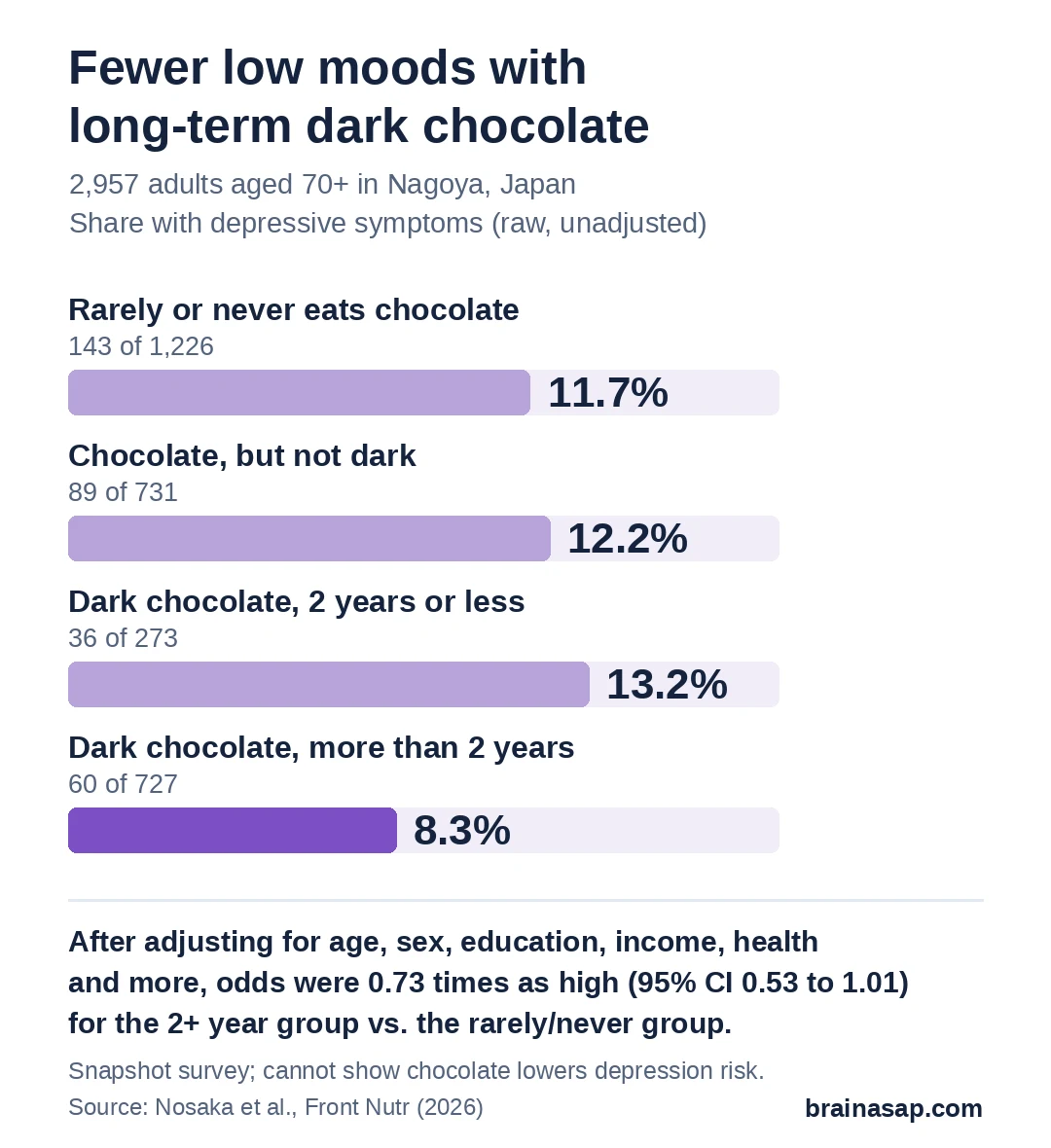
Two things in the raw numbers stand out. Only the long-term dark chocolate group sat lower. And people who ate chocolate but not dark looked like the rarely-or-never group, which fits the idea that the link, if real, belongs to dark chocolate specifically.
Adjusting for Other Factors Made the Result Borderline
People who eat dark chocolate may also differ in age, income, diet, and health. The researchers adjusted for age, sex, education, income, body weight, smoking, alcohol, diet variety, diabetes, high cholesterol, high blood pressure, heart disease, and a memory screening score.
Compared with the rarely-or-never group, long-term dark chocolate eaters had 0.73 times the odds of depressive symptoms (95% CI 0.53 to 1.01; p = 0.055). The interval touches 1.0, which means no difference is still possible, so the authors describe the result as uncertain.
Other checks leaned the same way: filling in missing data statistically gave 0.69 (0.51 to 0.94), a stricter cutoff for depressive symptoms gave 0.63 (0.42 to 0.94), and comparing only chocolate eaters gave 0.62 (0.43 to 0.88) for the long-term dark group versus non-dark eaters. Several other checks landed just short of significance.
Only a Long Habit Showed the Link
People eating dark chocolate for 2 years or less had odds about the same as the rarely-or-never group (OR 1.18, 95% CI 0.79 to 1.76). Directly comparing the two dark chocolate groups, the longer habit had 0.62 times the odds (95% CI 0.40 to 0.97).
That could mean a benefit that needs time to build. The authors caution, though, that the study doesn't establish a duration effect. Splitting duration into finer categories showed no clear trend (p = 0.157).
Why the Direction of the Link Is Unclear
- Reverse causation possible: Low mood can change appetite and food choices, so depression may reduce chocolate habits rather than the other way around.
- Self-reported and unvalidated: The chocolate questions were written for this survey and never tested for accuracy, and "how long" relied on memory.
- Unmeasured differences: Long-term dark chocolate eaters also had more varied diets and were more often women, and other habits may differ in ways the survey missed.
- Selection: Only 11% of invited residents took part, and people with missing data were dropped. Results may not apply to frail older adults or people with diagnosed depression.
- Industry funding: The chocolate maker Meiji Co. funded the work and several authors are its employees. The paper discloses this, and the funder took part in the decision to submit it for publication.
A Trial Would Settle What a Survey Can't
The finding is a clue, not advice. The survey does not establish benefit or harm from adding dark chocolate, and it does not show that chocolate treats depression.
The open question is whether dark chocolate eaten over time actually lowers depressive symptoms in older adults. Answering that needs studies that follow people forward, and ideally trials that assign chocolate and measure mood, with amounts tracked.
Citation: DOI: 10.3389/fnut.2026.1924057. Nosaka S, Nakakubo S, Abe K, et al. Self-reported dark chocolate consumption and depressive symptoms among community-dwelling older adults in Nagoya, Japan: a cross-sectional study. Front Nutr. 2026;13:1924057.
Study Design: Cross-sectional analysis of a population-based cohort; logistic regression with sensitivity analyses.
Sample Size: 2,957 adults aged 70+ (of 3,910 assessed) in Midori Ward, Nagoya.
Key Statistic: Dark chocolate for more than 2 years vs rarely or never eating chocolate: adjusted OR 0.73 (95% CI 0.53 to 1.01; p = 0.055).
Caveat: Single-time survey; cannot show cause or direction. Chocolate habits were self-reported with an unvalidated questionnaire. Funded by Meiji Co., with company employees among the authors.