TL;DR: In an online survey published in 2026, 1,222 adults across Peru rated how often they worried about being targeted by extortion, the crime of demanding money under threat, and answered a short questionnaire on recent stress, anxiety and depression symptoms.
People who worried more about extortion reported more of all 3 kinds of symptoms, most clearly stress and anxiety. A single survey can't show that the worry caused the symptoms.
Key Findings
- Stress: Worry about extortion accounted for about 31% of the differences between people's stress scores.
- Anxiety: It accounted for about 27% of the differences in anxiety scores.
- Depression: The link was weaker, at about 18% of the differences in depression scores.
- Same pattern across groups: Links did not clearly differ between men and women, between coast, mountain and jungle regions, or between employees and self-employed people.
- Unknown victim status: Nobody was asked whether they had actually been extorted.
Source: Frontiers in Psychiatry (2026) | Mamani-Benito et al.
In parts of Latin America, a phone call or note demanding "protection" money has become a familiar threat for shop owners, bus drivers and ordinary families.
The researchers described extortion as a growing public concern in Peru. People may also worry about being targeted even if they have not been victims themselves.
A 2026 study in Frontiers in Psychiatry, led by Oscar Mamani-Benito at Universidad Señor de Sipán in Chiclayo, asked whether that worry goes along with poorer mental health.
Who Answered the Survey?
Researchers shared an online form, mainly on Facebook, with adults in Peru's coastal, Andes mountain and Amazon jungle regions. It took 5 to 10 minutes to fill out.
- Final sample: 1,222 adults, after removing 53 minors and incomplete or non-consenting entries
- Average age: about 27
- Men: 59%
- Regions: 30% coast, 48% mountains, 21% jungle
That mix is younger, more male and more mountain-based than Peru as a whole, which the team pointed out.
What Did People Rate?
Each person filled out 2 questionnaires:
- Worry about extortion: 8 statements, developed in Peru, rated from "never" to "always". They cover recurring thoughts about the risk, feeling nervous about it, avoiding situations and feeling able to cope.
- Stress, anxiety and depression symptoms: a 13-question version of a widely used symptom checklist, validated in Peru.
Researchers then used a statistical model to estimate how strongly worry scores lined up with each symptom score.
How Strong Were the Links?
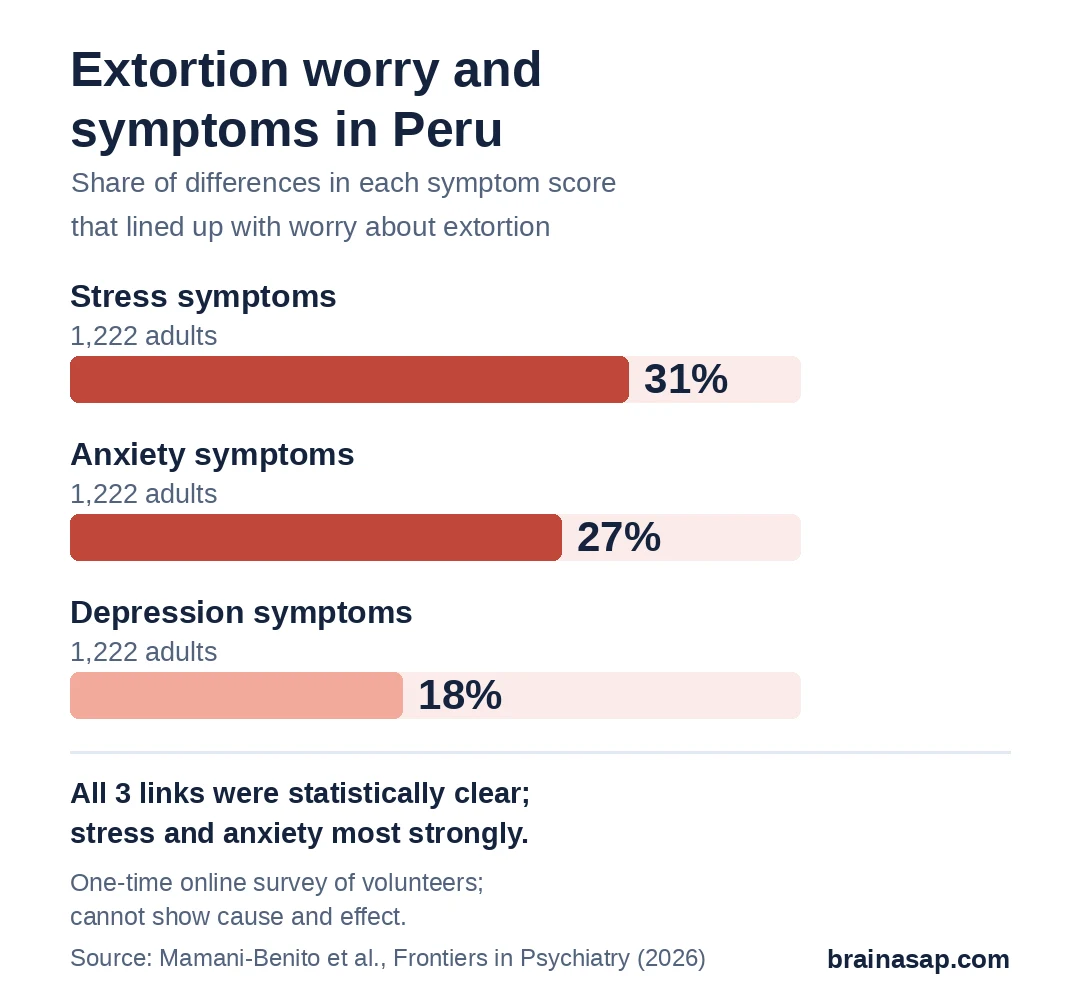
All 3 links were statistically clear, in this order:
- Stress: strongest link, about 31% of differences
- Anxiety: close behind, about 27%
- Depression: weaker, about 18%
Mamani-Benito and colleagues suggested that worry about a threat mainly keeps people tense and on alert. Low mood may take longer to build, for example as a sense of safety or support wears away.
Links looked similar for men and women, across the 3 regions, and for employees vs self-employed people such as traders. Women, jungle residents and employees showed somewhat stronger links on paper, but these differences were not statistically clear.
What Can't This Survey Tell Us?
- Cause: Everyone answered once, so it's unknown whether worry raised symptoms or anxious, stressed people simply worry more about crime.
- Victims mixed in: No one was asked if they had been extorted, robbed or attacked before, or whether they were in treatment for anxiety or depression.
- Not representative: Volunteers recruited on social media were younger and more often men than the national population.
- Self-report only: Symptoms were questionnaire scores, not clinical diagnoses.
Fear of Crime as a Mental Health Issue
Even with these limits, the survey suggests that worry about extortion is linked to how stressed and anxious people feel, not only to their wallets.
Mamani-Benito's team called for community programs to help people manage fear of crime and clear public guidance on what to do when threatened. A study that follows the same people over time, and records who has actually been extorted, could show whether easing the worry also eases the symptoms.
Citation: DOI: 10.3389/fpsyt.2026.1862134 Mamani-Benito O, Rodríguez-Díaz MG, Sánchez-Villena A, Siesquen Custodio VM, Huayta-Meza M, Cruz-Campos C, Sucapuca Mamani WO, Farfán-Solís R, Pacheco-Vizcarra M, Turpo-Chaparro JE. Concern about the possibility of being a victim of extortion and symptoms of anxiety, depression, and stress in Peruvian adults: a model of structural equations. Frontiers in Psychiatry. 2026;17:1862134.
Study Design: Cross-sectional online survey (intentional non-probability sampling via social media); Concern about Becoming a Victim of Extortion Scale (BECS, 8 items) and DASS-13; structural equation modeling (WLSMV) with invariance tests by sex, region and work type.
Sample Size: 1,222 Peruvian adults (59.25% men; mean age 26.5) from coast, mountain and jungle regions.
Key Statistic: Chosen model (CFI 0.986, RMSEA 0.067): concern → stress β = 0.553 (R² = 0.306), anxiety β = 0.519 (R² = 0.269), depression β = 0.427 (R² = 0.182), all p < 0.001; structural invariance held by sex, region and type of work.
Caveat: Cross-sectional; non-representative volunteer online sample; no data on prior victimization, current extortion or mental health treatment; self-report only.