TL;DR: A survey published in 2026 of more than 8,000 students at one Chinese university asked how much their family backed them up, and how often they had physical complaints such as headaches, fatigue and stomach trouble.
Students who felt more family support reported somewhat fewer of these complaints, and much of that link ran through lower anxiety and low mood. A one-time survey like this cannot show that family support caused the difference.
Key Findings
- Modest link with body complaints: More family support went with fewer physical complaints in both student groups, but the link was weak (correlations of −0.15 and −0.19).
- Mood carried most of it: In models considering depression alone, lower depression scores accounted statistically for roughly 7 to 8 in 10 parts of that link.
- Trained helpers fared a bit better: Peer counselors, students trained to support classmates, reported slightly more family support and slightly fewer symptoms than other students; the gaps were small.
- Overall link was similar in both groups: The total link between family support and physical complaints did not differ clearly between peer counselors and other students.
Source: Behavioral Sciences (2026) | Yu et al.
Stress doesn't always show up as worry. For many students it arrives as a pounding head, a tight chest, an upset stomach or a tiredness that sleep won't fix.
A 2026 study in Behavioral Sciences, by Jin Yu and colleagues at the Civil Aviation University of China and Tianjin Normal University, asked whether students who feel backed up by their families have fewer of these physical complaints, and whether anxiety and low mood sit in between.
Who Answered the Survey?
In spring 2025, undergraduates at one university in Tianjin filled in an online questionnaire. After removing rushed or patterned answers, 8,022 responses remained, split into 2 groups:
- Peer counselors (2,576): students who serve as class or dorm mental health contacts, after 8 hours of training in spotting distress, listening and crisis referral
- Other students (5,446): students with no such training or role
Each student rated 4 statements about family support, such as "I can get the emotional help and support I need from my family".
They also answered 7 questions each on anxiety and depression over the past week, and a 16-item yes-or-no checklist of physical complaints such as headaches, neck and shoulder pain, palpitations, stomach upset, poor sleep and fatigue.
How Strong Was the Link?
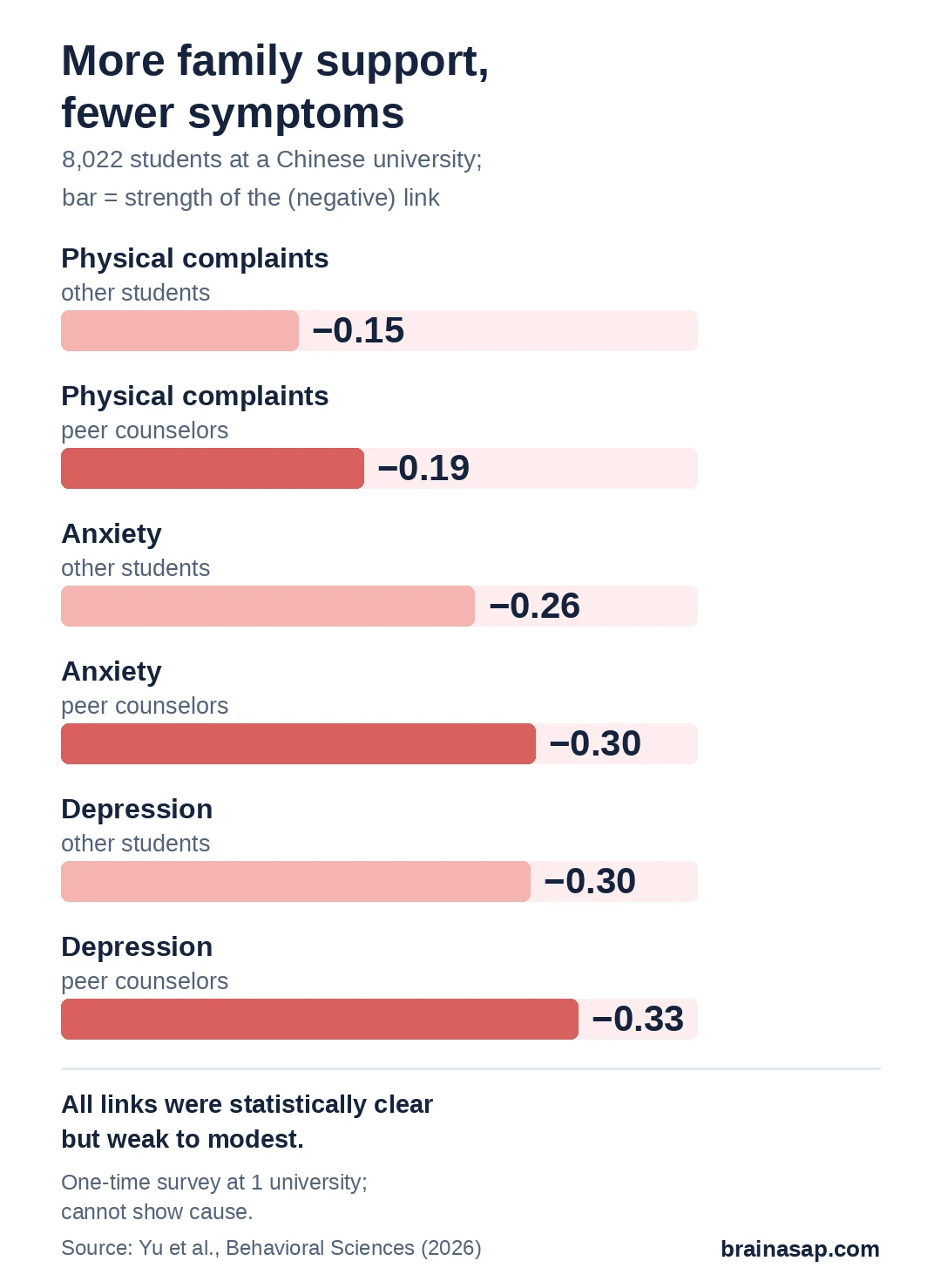
In both groups, students with more family support reported fewer physical complaints, less anxiety and less low mood. All of these links were statistically clear, but none was strong.
Physical complaints were also uncommon overall. Average scores were 1.6 (peer counselors) and 1.8 (other students) out of a possible 16.
Where Did Anxiety and Low Mood Fit In?
Researchers then used statistical models to split the link between family support and physical complaints into a part that ran through anxiety and depression scores and a part that did not.
- Depression alone: accounted for 68% of the link in peer counselors and 83% in other students; this share did not differ clearly between groups
- Anxiety and depression together: in other students, the 2 accounted for essentially the whole link; in peer counselors, a small direct link with physical complaints remained
Yu and colleagues read this as peer counselors drawing on family support in a slightly different way, possibly because of their training. Still, the total link between family support and physical complaints was not clearly different between the 2 groups.
What Can a Single Survey Show?
- One moment in time: The survey cannot say whether family support eased symptoms, or whether feeling unwell changed how students saw their families.
- Not random groups: Peer counselors volunteered or were picked for the role, so they may have been healthier or more outgoing to begin with.
- Self-report only: All measures came from questionnaires, with no medical checks.
- One university: Results may not apply to students elsewhere.
- Order assumed, not tested: Treating anxiety, depression and physical complaints as a chain is a modeling choice; anxiety and depression scores were very closely related (correlation of about 0.86), which makes their separate roles hard to pull apart.
Could Family Support Be Part of Campus Mental Health Care?
For students, the practical message is modest: feeling supported at home went with a little less anxiety, low mood and physical strain.
Whether helping families stay engaged, or training more students as peer counselors, would actually reduce physical stress symptoms is a question for a study that follows students over time or tests a program directly.
Citation: DOI: 10.3390/bs16091465 Yu J, Yang H, Liang Z. Family Support and Somatic Symptoms: The Serial Mediating Roles of Anxiety and Depression—A Multi-Group Comparison Between Peer Counselors and General Students. Behavioral Sciences. 2026;16:1465.
Study Design: Cross-sectional online survey (March–May 2025) with multigroup mediation analysis in Mplus, controlling for gender and grade; PSSS family support subscale, DASS-21 anxiety and depression, UPI somatic subscale.
Sample Size: 8,022 undergraduates at one Tianjin university: 2,576 trained peer counselors and 5,446 general students.
Key Statistic: Family support–somatic r = −0.19 (peer counselors) and −0.15 (general students). Depression-only mediation: indirect share 68.4% vs 82.6% (difference p = 0.713). Total effect −0.196 vs −0.155 (difference p = 0.123). Group differences: family support d = 0.21; somatic symptoms d = −0.06.
Caveat: Cross-sectional; non-random group membership; self-report only; single institution; measurement invariance and clustering not tested; mediation order is theoretical.