TL;DR: In a 2026 study from Beijing, 71 people in the first years of schizophrenia filled in a questionnaire about abuse and neglect in childhood and took a standard set of thinking tests, alongside 62 healthy adults of similar age.
People with schizophrenia reported more childhood abuse and neglect and scored lower on every thinking skill tested, but within the patient group, trauma did not clearly explain who had weaker thinking skills or worse symptoms.
Key Findings
- More reported trauma: People with early schizophrenia reported more emotional abuse, sexual abuse, emotional neglect and physical neglect in childhood than healthy adults; reports of physical abuse did not differ.
- Common among patients: 51 of 71 people with schizophrenia (72%) reported at least one type of trauma at a moderate-to-severe level.
- Weaker thinking skills: People with schizophrenia scored lower than healthy adults in all 7 thinking areas, with the biggest gaps in attention and processing speed.
- No clear link within the patient group: Among people with schizophrenia, overall thinking scores were lower in those who met the questionnaire’s cutoff for moderate-to-severe trauma. The difference did not meet the corrected statistical threshold.
Source: Frontiers in Psychiatry (2026) | Wang, Li and colleagues
People with schizophrenia are more likely than others to report hard childhoods, including abuse and neglect. Many also struggle with thinking skills such as attention and memory, often from the first episode of illness.
A natural question is whether the 2 are connected: does early trauma help explain who has the most trouble thinking clearly, or the most severe symptoms?
Who Took Part?
A 2026 study in Frontiers in Psychiatry by researchers at Beijing Anding Hospital, Capital Medical University, compared 2 groups recruited between 2019 and 2025:
- People with early schizophrenia (71): in their first episode, ill for less than 3 years (about 19 months on average)
- Healthy adults (62): recruited from the community and screened for mental illness
Both groups averaged about 25 years old. Healthy adults had a few more years of schooling, which the team accounted for when comparing thinking skills.
How Were Trauma and Thinking Measured?
Everyone filled in the Childhood Trauma Questionnaire, a 28-item survey covering 5 types of early adversity: emotional abuse, physical abuse, sexual abuse, emotional neglect and physical neglect.
Everyone also took the MATRICS battery, a standard set of tests covering 7 thinking areas, including processing speed, attention, working memory, learning, problem solving and understanding social situations. Scores are scaled so that an average adult scores 50.
Psychiatrists also rated the patients' symptoms, including "negative" symptoms such as low motivation, flat emotion and social withdrawal.
How Big Were the Gaps Between Groups?
On the trauma questionnaire, people with schizophrenia had a typical total score of 45, compared with 34 for healthy adults. Emotional neglect showed one of the biggest differences.
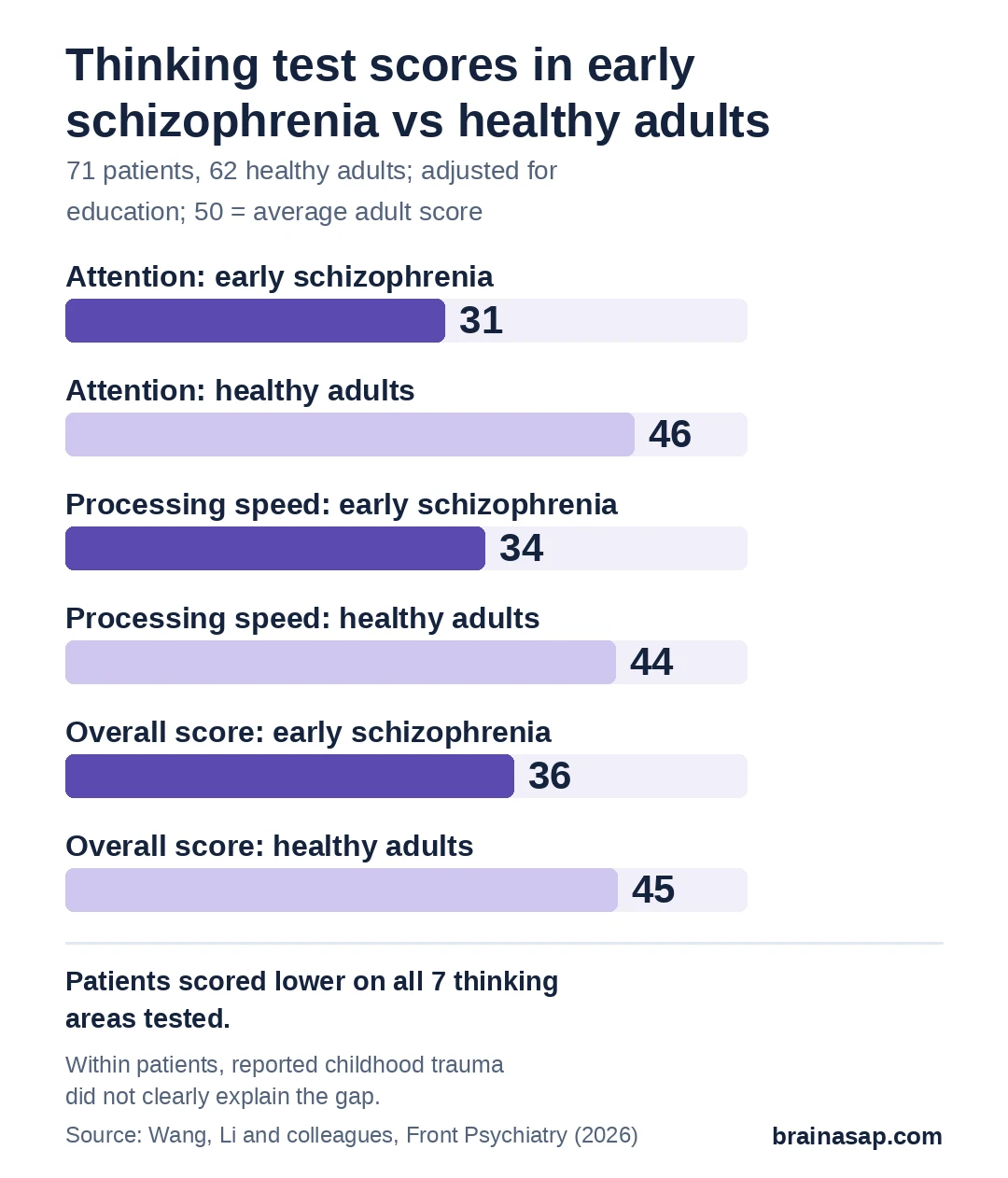
On thinking tests, people with schizophrenia scored lower in all 7 areas. Their overall score was 36 vs 45, and the largest gaps were in attention (31 vs 46) and processing speed (34 vs 44).
Did Trauma Explain Weaker Thinking Within the Patient Group?
Not clearly. Patients who reported moderate-to-severe trauma had an overall thinking score of 34, compared with 38 for patients who did not, a gap that was no longer statistically clear once the team corrected for running many comparisons.
Patients who met a trauma cutoff also tended to have more negative symptoms, but that difference was not statistically clear either.
Some individual trauma types looked linked to specific skills in a first pass, such as physical neglect with weaker attention. But those checks were exploratory and uncorrected, and when all 5 trauma types were tested together while accounting for education, age at onset and other background factors, none held up as a predictor of thinking skills or symptoms.
One link did stand out: patients with weaker attention had more negative symptoms. In the 50 patients included in that analysis, the study did not find evidence that attention accounted for a link between physical neglect and those symptoms.
Why to Hold This Lightly
- Self-reported memories: trauma was reported years later on a questionnaire, and illness, low mood or thinking problems could affect how people remember or report childhood
- Small comparison group: only 20 patients were below the questionnaire cutoffs for moderate-to-severe trauma, which limits the power to detect differences
- Medication not recorded: antipsychotic doses and how long psychosis went untreated were not collected, and both can affect thinking
- One snapshot: the study cannot show whether trauma, illness or something else came first
- Many exploratory checks: individual trauma-type links were not corrected for multiple testing
Wang, Li and colleagues suggested that programs combining trauma-informed care with training in thinking skills, especially attention, may be worth testing.
What this study shows most clearly is that both reported childhood trauma and thinking difficulties are common in early schizophrenia. Whether one drives the other needs larger studies that follow people over time.
Citation: DOI: 10.3389/fpsyt.2026.1911400. Wang R, Qin XQ, Wang XQ, Hou WP, Wang CY, Li XB. Associations between childhood trauma, cognitive function, and clinical symptoms in first-episode schizophrenia. Frontiers in Psychiatry. 2026;17:1911400. PMID: 42780338. Full text: PMC13597818.
Study Design: Case-control study; Childhood Trauma Questionnaire-Short Form, MATRICS Consensus Cognitive Battery, PANSS and Calgary Depression Scale; group comparisons (ANCOVA adjusted for education), Spearman correlations, hierarchical regression and mediation analysis.
Sample Size: 71 people with first-episode schizophrenia (illness under 3 years) and 62 healthy controls.
Key Statistic: CTQ total median 45 vs 34 (p < 0.001); MCCB total 36.1 vs 44.5 (adjusted means; partial η² = 0.37); within patients, MCCB total median 34 vs 38 for patients who met a trauma cutoff versus those who did not (p = 0.042, not significant after Bonferroni correction); no trauma subtype predicted cognition or symptoms in regression (all p > 0.05); attention/vigilance and negative symptoms β = -0.43 (p = 0.002), no mediation.
Caveat: Small subgroups; retrospective self-reported trauma; cross-sectional; medication and untreated psychosis duration not recorded; exploratory uncorrected correlations.