TL;DR: When a computer sorted about 470 people only by their thinking-test and behavior scores, two kinds of frontotemporal dementia stood out clearly. Alzheimer's and two speech-loss types blurred together, which may help explain why these diagnoses take so long.
Key Findings
- Behavior type stood out: People with behavioral-variant FTD grouped apart, mainly thanks to questionnaires filled in by family members.
- Word-meaning type stood out: Semantic aphasia showed a clear language and memory pattern.
- Alzheimer's mixed in: It separated from healthy people but blended with every patient group.
- Two speech types merged: Nonfluent and logopenic aphasia kept landing in the same groups.
- Severity drove a lot: How advanced the illness was often mattered more than its type.
Source: Frontiers in Dementia (2026) | Söntgerath et al.
Frontotemporal dementia often strikes people in their 50s and 60s, and getting the right diagnosis can take more than 3 years. Some patients are first told they have depression. Others are told it is Alzheimer's.
Doctors lean heavily on thinking tests to tell these conditions apart. A German team asked whether the test scores themselves actually fall into the groups the diagnostic rules describe.
Six Groups, One Unlabeled Pile of Scores
The researchers used first-visit data from the German FTLD Consortium, collected at 13 university clinics. Of 782 people in the relevant groups, those missing more than 20% of scores were dropped. That left 469 people for an analysis of test scores alone and 462 for one that added behavior questionnaires.
The groups were:
- Behavioral-variant FTD (bvFTD): Personality and behavior change, such as apathy or loss of inhibition.
- Semantic aphasia (svPPA): Loss of word meaning and naming.
- Nonfluent aphasia (nfvPPA): Effortful, broken speech.
- Logopenic aphasia (lvPPA): Word-finding pauses and trouble repeating; often caused by Alzheimer's disease.
- Amnestic Alzheimer's: Memory-led Alzheimer's.
- Healthy volunteers.
A clustering method called k-means then sorted everyone into 2 to 9 groups using dozens of test scores, without being told anyone's diagnosis. The researchers then checked how well the computer's groups matched the doctors' labels.
Behavior and Word-Meaning Types Stood Apart
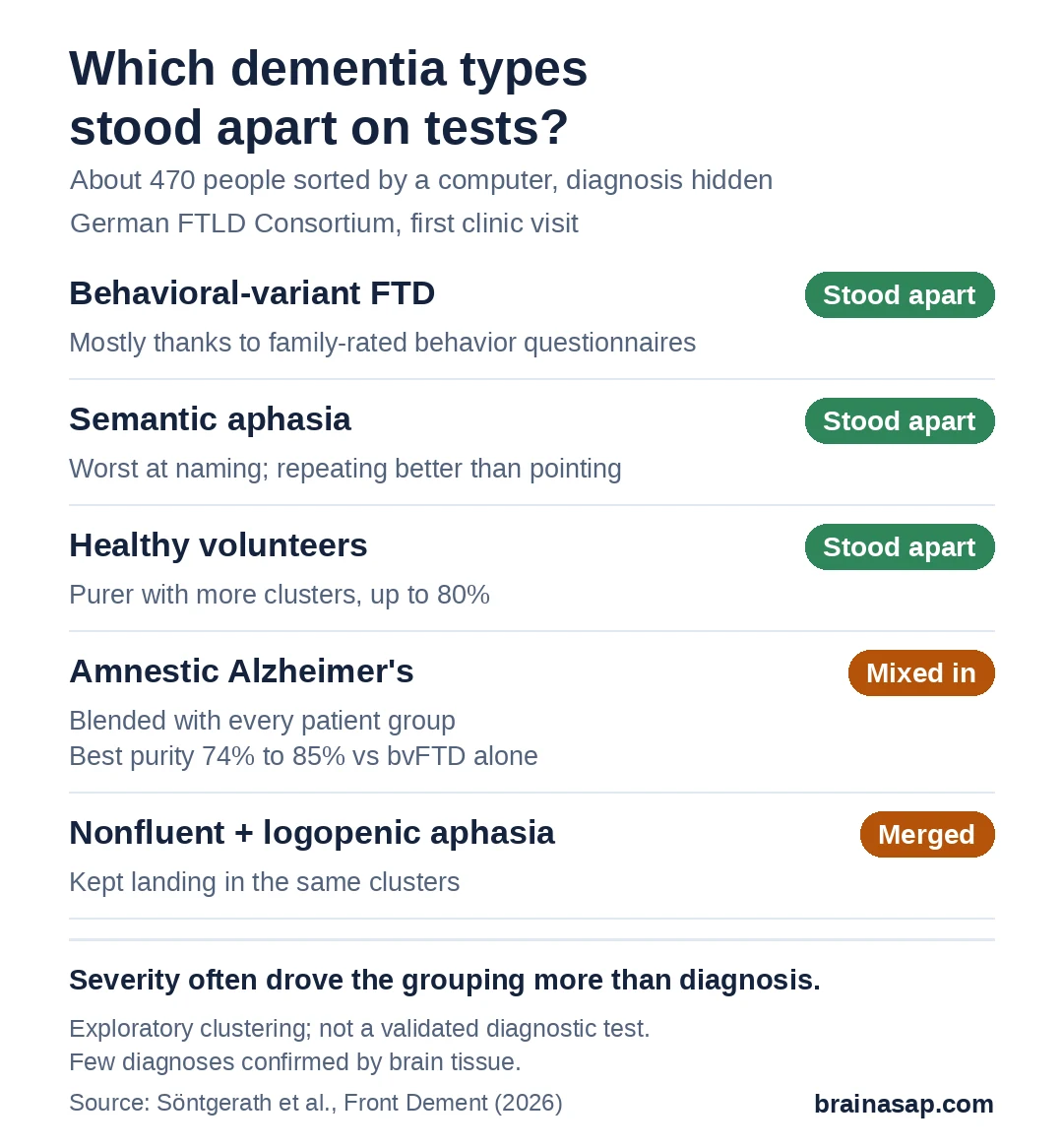
No computer group matched one diagnosis perfectly. But people with bvFTD and people with semantic aphasia, to a large extent, ended up in their own groups.
For bvFTD, the key was not the classic thinking tests. It was questionnaires filled in by a family member or companion, rating apathy, disinhibition and everyday executive problems. Adding these scores let bvFTD split off even when a person's test performance looked close to that of healthy people.
People with semantic aphasia scored worst at naming pictures and pointing to named objects. They could repeat words better than they could point to them, a known sign of this type.
Alzheimer's Blended In With Everyone
Memory-led Alzheimer's separated from healthy people but mixed with all the other patient groups to a similar extent. Even when the analysis included only bvFTD and Alzheimer's, the purest Alzheimer's group reached 74% without questionnaires and 85% with them.
One reason: memory scores in bvFTD were sometimes as poor as in Alzheimer's. The difference showed up only when memory was compared with overall severity. Alzheimer's patients had worse memory relative to how advanced their illness was.
The two non-fluent speech types, nonfluent and logopenic aphasia, kept landing together. Both groups did worse than semantic aphasia on speed, attention and short-term memory tasks, such as digit span and the Stroop test.
Severity Often Mattered More Than Diagnosis
With only 2 or 3 groups allowed, the computer mostly sorted people by how sick they were, not by type. Even with more groups, two clusters made up mostly of bvFTD often differed mainly in severity. The authors suggest test results may be easier to read when compared within the same disease stage.
Where the Approach Falls Short
- Few confirmed diagnoses: Only 6% to 7% of bvFTD and aphasia cases were confirmed by brain tissue; the rest were clinical or imaging-supported.
- Groups differed at baseline: bvFTD patients were more severely affected; nonfluent aphasia patients were seen earliest.
- Filled-in data: Missing scores were estimated by multiple imputation.
- Test choice: No tests of speech apraxia or phonological memory, which might separate the two speech types.
- Not a diagnostic tool: Clusters are exploratory, not validated in a new group of patients. Biological sex and biomarkers were not used in the sorting.
Better Tests for Behavior and Speech Are Needed
The study suggests the current rules work reasonably well for bvFTD and semantic aphasia but not for telling the two non-fluent speech types apart using standard tests. The authors call for revising the thinking-test profile in the bvFTD criteria and adding non-language tests to aphasia workups.
For families, one practical point stands out: what a spouse or companion notices about behavior can carry as much weight as test scores. The next question is whether speech and phonological memory tests, or fluid biomarkers, can finally split the two non-fluent types.
Citation: DOI: 10.3389/frdem.2026.1757680. Söntgerath M, Cutini S, Thöne-Otto AIT, et al. Evaluating the correspondence of neuropsychological profiles with clinical diagnostic criteria for frontotemporal lobar degeneration and Alzheimer's disease: insights from k-means clustering. Front Dement. 2026;5:1757680.
Study Design: Cross-sectional, exploratory unsupervised machine-learning (k-means) analysis of first-visit data from the multicenter German FTLD Consortium.
Sample Size: 782 eligible participants; 469 analyzed without and 462 with behavior questionnaires.
Key Statistic: Healthy-volunteer clusters reached up to 80% purity; Alzheimer's clusters up to 74% to 85% in a two-group analysis.
Caveat: Few pathology-confirmed diagnoses; imputed missing data; clusters not externally validated.