TL;DR: Levels of immature white blood cells, proposed as a simple blood marker of inflammation in migraine, were the same in people with migraine, during or between attacks, as in people without it. Two other blood ratios shifted slightly during attacks.
Key Findings
- 53 with migraine, 53 without: Patients tested during an attack and again a week or more later.
- Immature cell levels didn't differ: Same median in all three samples.
- Two ratios shifted during attacks: One inflammation index was higher, another ratio lower.
- Unexpected direction: Lower immature cell counts went with more frequent headaches.
- Immature cell counts: These stayed within the expected healthy range.
Source: Ideggyógyászati Szemle (Clinical Neuroscience) (2026) | Bildirici et al.
Doctors diagnose migraine from symptoms, because there is no blood test for it. Some research suggests inflammation plays a role in attacks, so researchers have looked for inflammation signals in routine blood counts that could help.
One candidate is immature granulocytes, young white blood cells released early when the bone marrow ramps up. A team in Turkey tested whether they rise in migraine.
Blood Drawn During Attacks and Between Them
The study enrolled 53 adults with episodic migraine who came to an emergency department, and 53 healthy people matched for age and sex. Most patients were women, as is typical in migraine.
- During an attack: Blood drawn within 4 hours of symptoms starting, before any pain medicine.
- Between attacks: Second sample at least 7 days after the attack ended.
- Healthy group: One morning sample after an overnight fast.
The researchers measured immature granulocytes along with several ratios built from routine blood counts that are used as inflammation indicators.
No Difference in Immature White Cells
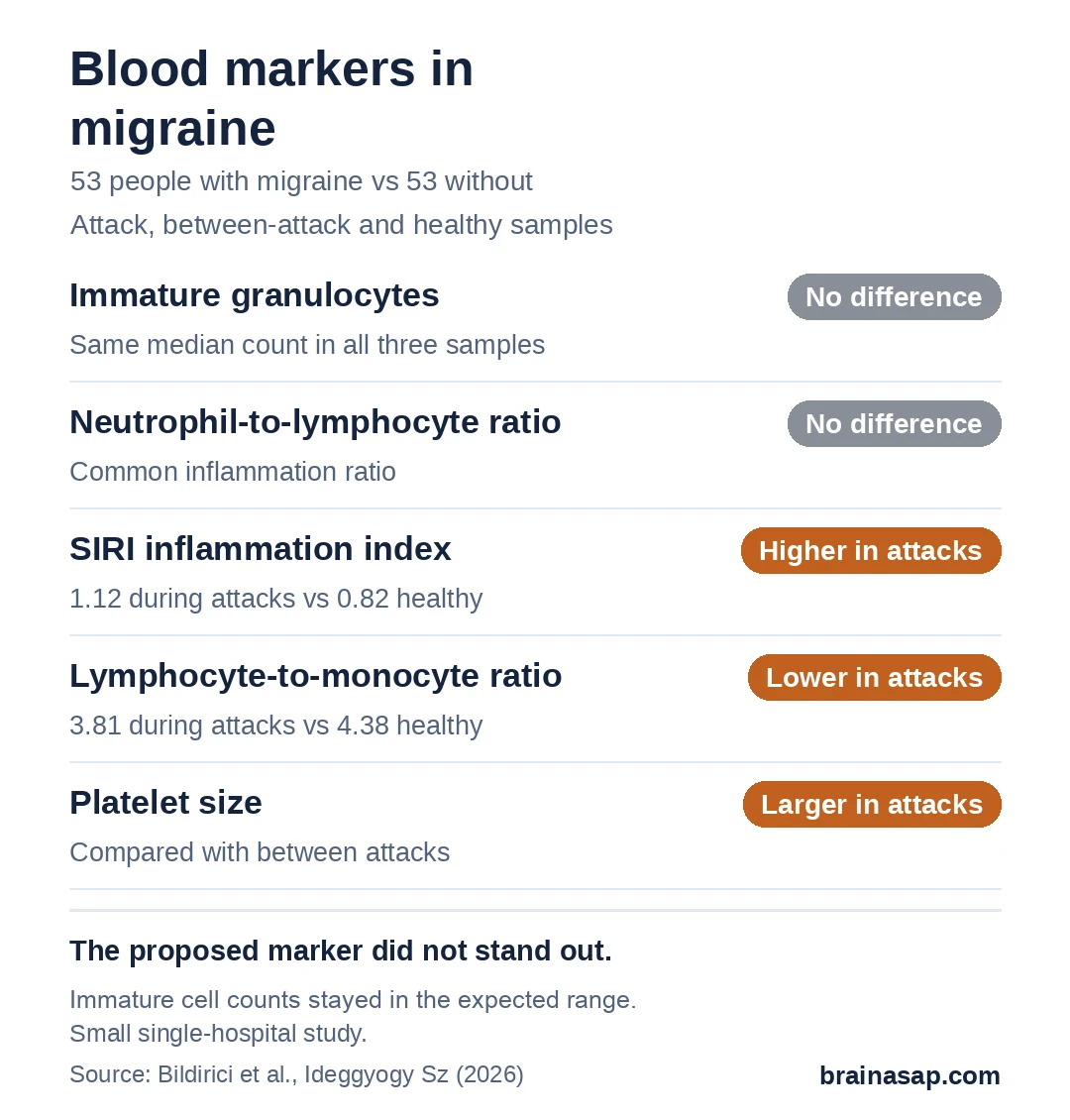
Immature granulocyte levels were essentially identical: a median of 0.02 billion cells per liter in all three samples. Common inflammation ratios, including the neutrophil-to-lymphocyte ratio, also did not differ.
Small Shifts in Other Blood Ratios
A few other measures did move during attacks:
- SIRI higher: A combined inflammation index had a median of 1.12 during attacks versus 0.82 in healthy people.
- Lymphocyte-to-monocyte ratio lower: 3.81 during attacks versus 4.38 in healthy people.
- Larger platelets during attacks: Platelet size measures were higher during attacks than between them.
Immature granulocyte counts stayed within the expected healthy range.
Fewer Immature Cells With More Frequent Headaches
Among patients, those with more frequent headaches and more disability from migraine tended to have lower immature granulocyte counts. That is the opposite of what an inflammation marker would be expected to show, and the authors treat it as exploratory.
Why the Results Need Caution
- Small, one hospital: 106 people in total.
- Different sampling times: Attack samples were taken in the emergency room; healthy samples after a morning fast.
- No control for daily or menstrual changes in blood counts.
- Many comparisons: Some findings may be chance.
Routine Blood Counts Are Not a Migraine Test
For now, this study suggests immature granulocytes are not a useful marker of migraine. The small shifts in other ratios during attacks would need larger studies with matched sampling times before anyone could read meaning into them.
Citation: DOI: 10.18071/isz.79.0329. Bildirici MA, Durgan O, Ayvalı İS. The role of immature granulocytes as a novel biomarker in migraine: a prospective tertiary-care study. Ideggyogy Sz. 2026;79(9–10):329–339.
Study Design: Prospective case-control study with paired attack and between-attack samples.
Sample Size: 53 people with episodic migraine, 53 matched healthy controls.
Key Statistic: Immature granulocytes median 0.02 ×10⁹/L in all groups (p = 0.413).
Caveat: Small single-center study; sampling conditions differed between groups.