TL;DR: Among 378 stroke patients treated with clot removal, two simple blood-count measures linked to inflammation were slightly lower in those who recovered poorly. But they predicted recovery only a little better than a coin flip, and the link faded after accounting for how well blood flow was restored.
Key Findings
- 378 patients, 2 groups: 201 recovered well at 90 days, 177 did not.
- More inflammation signs on admission in the poor-recovery group.
- Weak predictors: Two blood measures scored 0.58 and 0.57 on a scale where 0.5 is a coin flip.
- Faded with adjustment: Not significant after accounting for restored blood flow, backup circulation, age and stroke severity.
- Restored blood flow mattered most.
Source: Frontiers in Neurology (2026) | Mo et al.
Pulling a clot out of a blocked brain artery, called thrombectomy, has transformed stroke care. Yet about half of patients still end up with lasting disability. Inflammation after a stroke may be one reason, and routine blood counts carry hints about it.
Neurologists in Chongqing, China, looked back at patient records to see whether those simple numbers could help predict recovery.
Records From 378 Clot-Removal Patients
The study included 378 adults treated with thrombectomy for a large blockage in the front part of the brain's circulation between 2017 and 2021. Recovery was judged at 90 days on a standard disability scale:
- Good recovery group: Independent or only slightly disabled (201 people, 53%).
- Poor recovery group: Needing help or worse (177 people).
The team compared blood counts taken on arrival, before the procedure.
Signs of Inflammation Were Higher With Poor Recovery
The poor recovery group had slightly higher white blood cell, neutrophil and monocyte counts, and a higher neutrophil-to-lymphocyte ratio. Two other measures were lower:
- Lymphocyte-to-monocyte ratio: A balance of two immune cell types; lower values suggest a more inflammatory state (about 3.0 vs 3.5).
- Platelet distribution width: How varied platelets are in size (16.0% vs 16.3%).
The poor recovery group also had more brain bleeding (22% vs 6%), more stroke-related pneumonia (59% vs 33%), less successful reopening of the artery and weaker backup circulation.
Barely Better Than a Coin Flip
The researchers then asked how well each measure could sort patients into the two groups. On a scale where 0.5 is a coin flip and 1.0 is perfect:
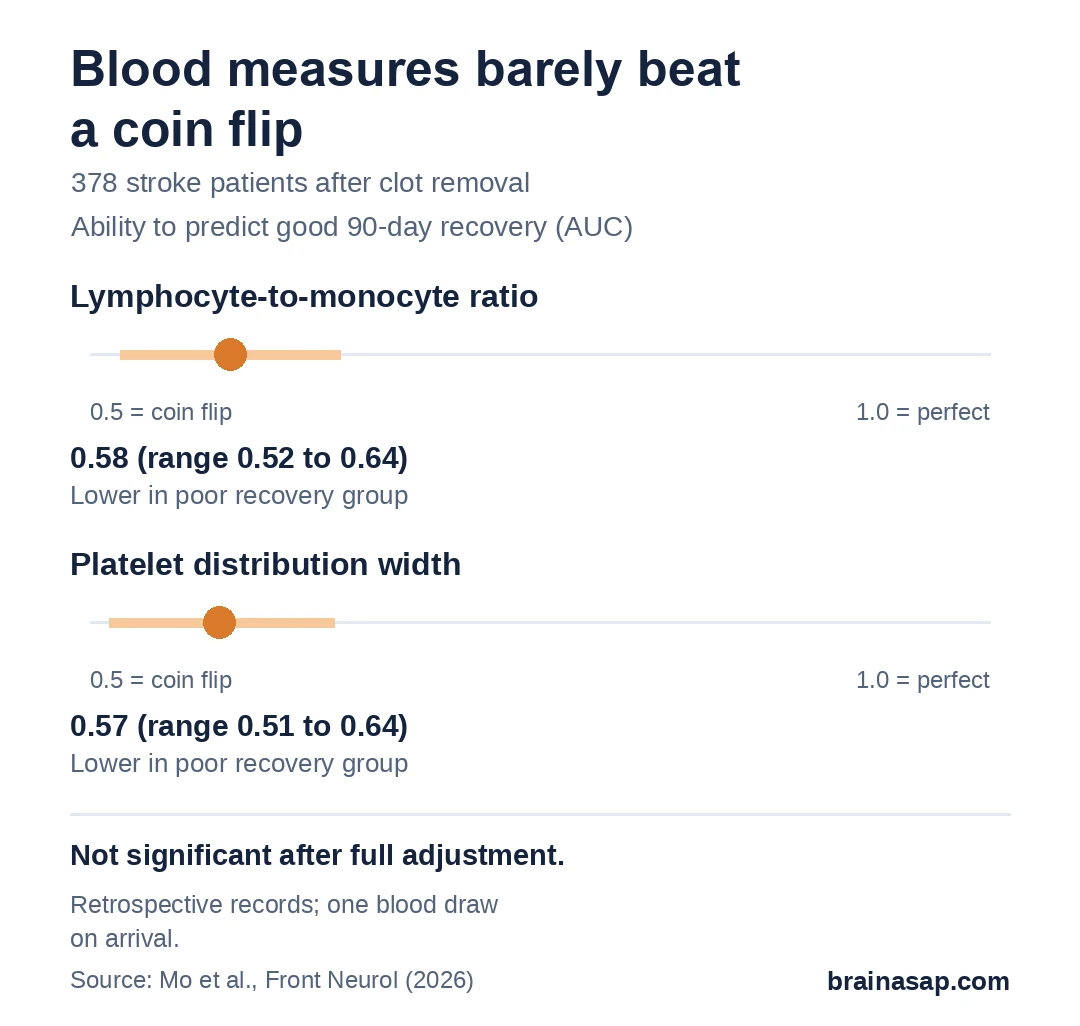
When the researchers added whether the artery was reopened, the strength of backup circulation, age and stroke severity, both measures lost statistical significance. Successful reopening and good backup circulation remained strong predictors.
Why These Measures Aren't Ready for Bedside Use
- Looking back at records: Not designed in advance to test these markers.
- Single blood draw: Inflammation changes over days.
- Treatments not recorded: Any anti-inflammatory care in hospital is unknown.
- Tiny differences: Odds ratios near 1 mean little practical impact.
- No outside validation: Results come only from participating centers in China.
Restoring Blood Flow Still Matters Most
For now, the clearest factors in recovery after clot removal remain the familiar ones: getting the artery open and having good backup blood supply. Whether tracking inflammation over several days adds anything useful is a question for future prospective studies.
Citation: DOI: 10.3389/fneur.2026.1808319. Mo Y, Guan X, He Y, Wu L, Zuo M, Zhou Z. Association of inflammatory markers with functional outcome after endovascular thrombectomy in anterior circulation stroke: a retrospective study. Front Neurol. 2026;17:1808319.
Study Design: Retrospective cohort study.
Sample Size: 378 patients (201 favorable, 177 unfavorable 90-day outcome).
Key Statistic: AUC: LMR 0.578 (95% CI 0.517 to 0.639), PDW 0.572 (0.511 to 0.636); after adjusting for recanalization, collaterals, age and NIHSS, LMR aOR 1.130 (0.982 to 1.299), PDW aOR 1.066 (0.968 to 1.174).
Caveat: Retrospective, single baseline sample, modest discrimination, residual confounding.