TL;DR: In a small 21-day trial of 30 people with Parkinson's, insulin sprayed into the nose caused no low blood sugar and only mild side effects, mostly nasal irritation and nosebleeds. It did not improve thinking more than placebo.
Key Findings
- 30 people, 4 groups: Placebo or 20, 40 or 80 units of insulin for 21 days.
- No low blood sugar: No reading under 70 mg/dL within 30 minutes of a dose.
- Nose problems were common: 83% to 100% in every group, placebo included, and one person quit over nosebleeds.
- No clear thinking benefit: Two memory and attention tests improved in the 40-unit group, but not significantly more than placebo.
- Mood, apathy and movement unchanged.
Source: Frontiers in Neurology (2026) | Johnson et al.
Insulin is best known for diabetes, but the brain has insulin receptors too. Brain scans of people with Parkinson's often show weaker glucose use, which led researchers to wonder if insulin could help. The catch is getting it to the brain without affecting blood sugar, so the idea is to spray it up the nose.
Before anyone tests whether that works, they have to show it is safe. That was the main goal of this trial from a Parkinson's center in Minnesota.
A Small Trial With Three Doses and a Placebo
The phase II trial randomized 30 adults with Parkinson's (aged 41 to 89) to saline spray as a placebo or to 20, 40 or 80 international units of regular insulin. Everyone used a nasal delivery device for 21 days while staying on their usual Parkinson's medicine. Neither participants nor staff knew who got what.
Groups were uneven because of the way the researchers balanced sex and baseline thinking scores: 6 people got placebo, 6 got 20 units, 7 got 40 units, and 11 were assigned to 80 units. All 30 began treatment, and 29 finished. The 28 people with a full set of follow-up tests went into the thinking and movement analyses.
Blood Sugar Stayed Safe
The main safety worry with insulin is low blood sugar. Blood sugar checks 15 and 30 minutes after doses found no reading under 70 mg/dL. Average blood sugar dipped by about 3.5 mg/dL across all groups, which the authors call clinically meaningless. Weight and blood insulin levels did not change.
Only one severe side effect occurred, in a person taking placebo.
The Nose Took the Brunt
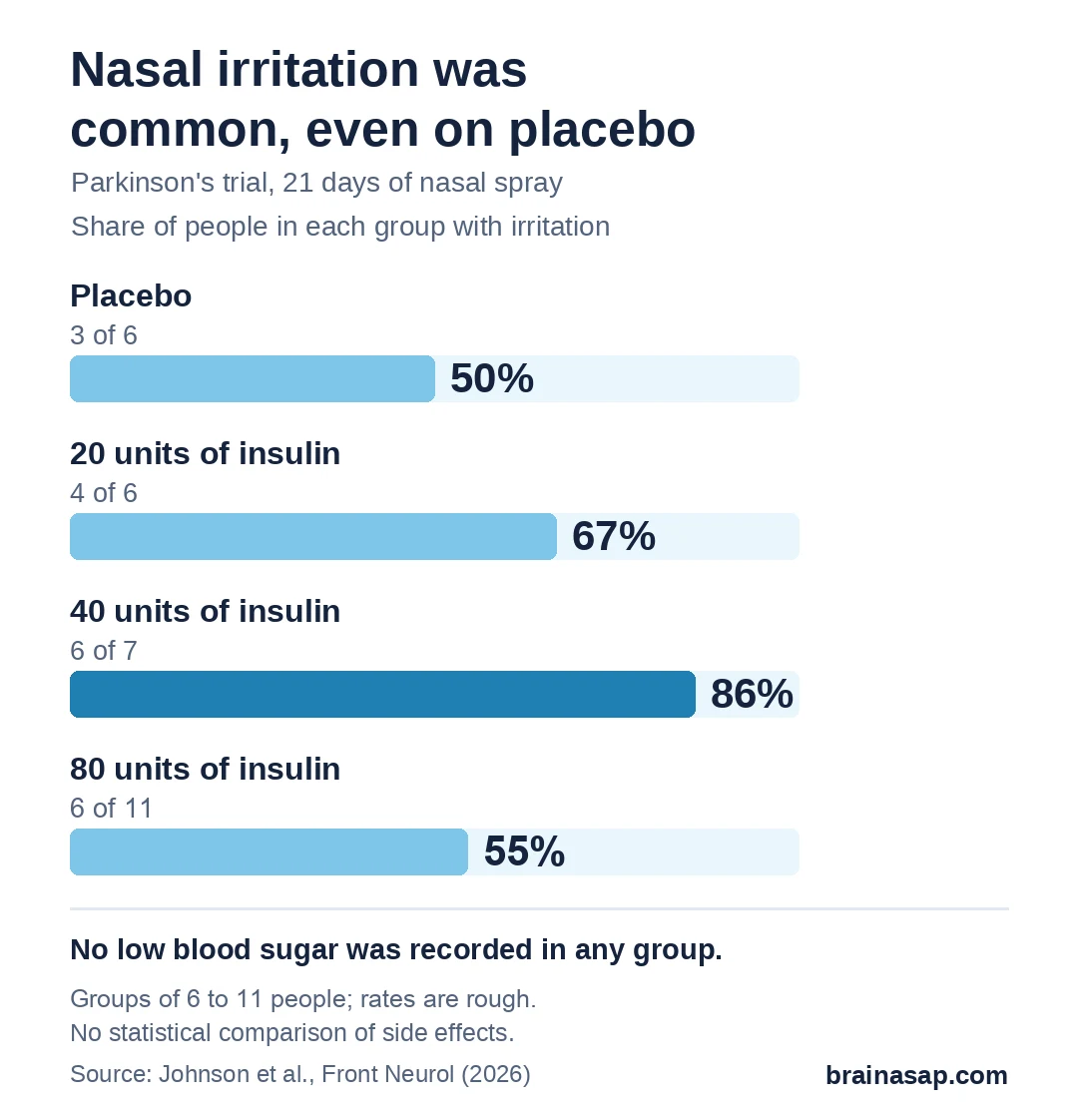
The most common side effects were nasal irritation and nosebleeds, and nearly everyone had some. Nasal irritation showed up in 3 of 6 people on placebo, 4 of 6 on 20 units, 6 of 7 on 40 units and 6 of 11 on 80 units, with no steady rise by dose. One person with a history of nasal problems left the trial early after repeated minor nosebleeds.
No Clear Gain in Thinking, Mood or Movement
The trial was not built to prove benefit, but the researchers looked. After correcting for testing many outcomes, only two scores rose from baseline, both in the 40-unit group: delayed recall on a memory test (+4.0 points) and Stroop word reading, a measure of attention and processing speed (+9.9). The placebo group also improved on delayed recall (+2.5), though that was not significant after correction.
Crucially, the gains were not significantly larger than placebo. Depression, apathy and motor scores did not change in any group. On a separate memory test, the placebo group actually got worse, which the authors could not explain.
Why Four Small Groups Can't Say Much
- Tiny groups: 6 to 11 people each, so modest benefits could be missed.
- Uneven baselines: Average baseline thinking scores differed between groups despite balancing efforts.
- Short follow-up: Only 21 days.
- Safety, not efficacy: Safety was the main goal; thinking results were secondary.
Safe Enough to Justify a Longer, Larger Trial
The early signal is reassuring on safety, with one caution for anyone with nasal problems. Nothing here supports using insulin spray for Parkinson's symptoms, and it is not an approved treatment.
The question left for the next trial is whether a dose like 40 units, given for months to a bigger group, can improve thinking beyond what placebo does.
Citation: DOI: 10.3389/fneur.2026.1875165. Johnson JC, Kashyap B, Gustafson SK, et al. Safety and tolerability of intranasal insulin in Parkinson's disease. Front Neurol. 2026.
Study Design: Single-center, randomized, double-blind, placebo-controlled phase II dose-finding trial (NCT04251585).
Sample Size: 30 started treatment, 29 completed; 28 in secondary analyses.
Key Statistic: No glucose readings under 70 mg/dL after doses; no insulin-versus-placebo cognitive difference significant after correction.
Caveat: Very small phase II safety study; thinking results exploratory; uneven group sizes and baselines.