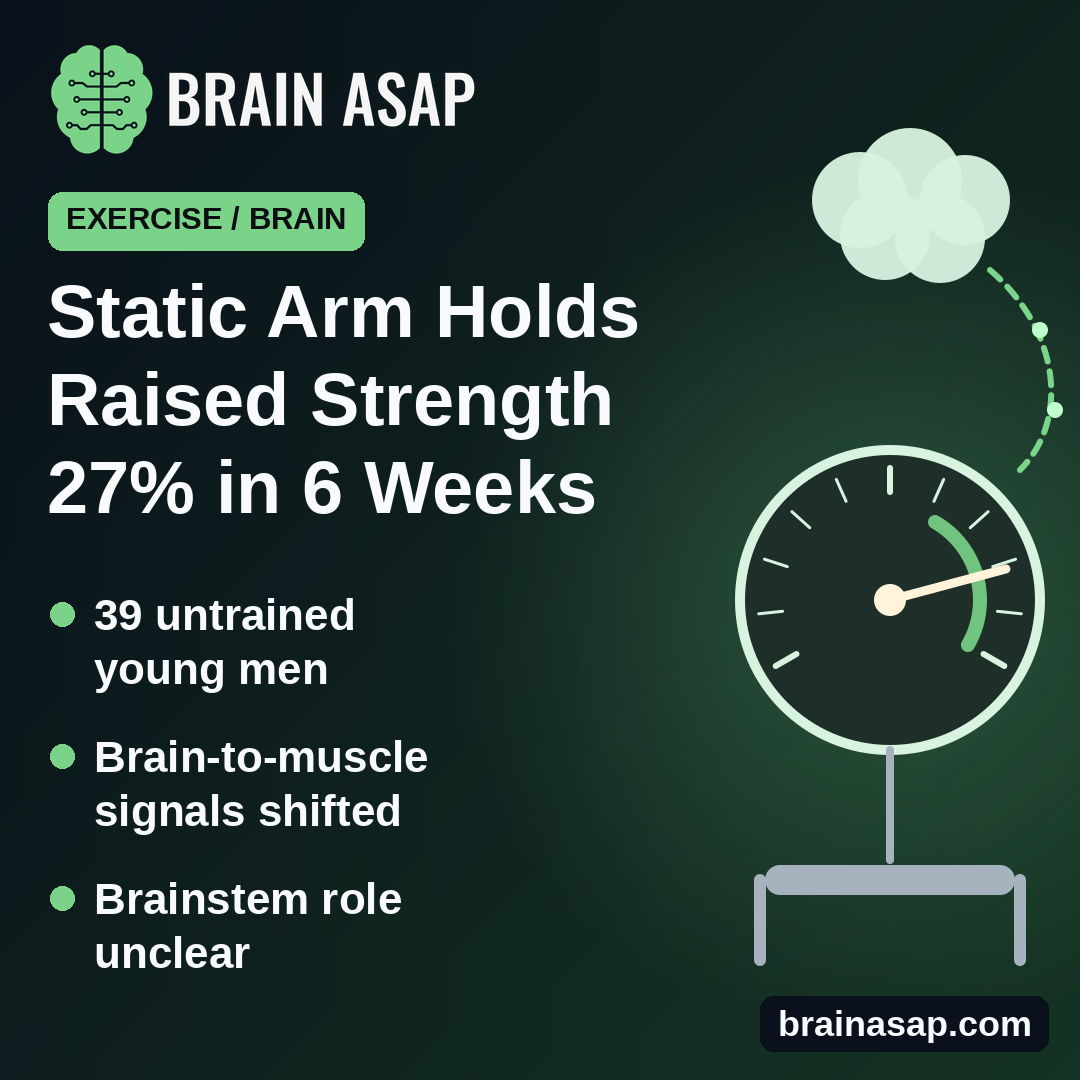
TL;DR: Six weeks of home “static hold” arm training made untrained young men about 27% stronger and increased how fast they built up force by about 60%. Brain-to-muscle signals changed too, but tests of a proposed brainstem pathway gave mixed results.
Key Findings
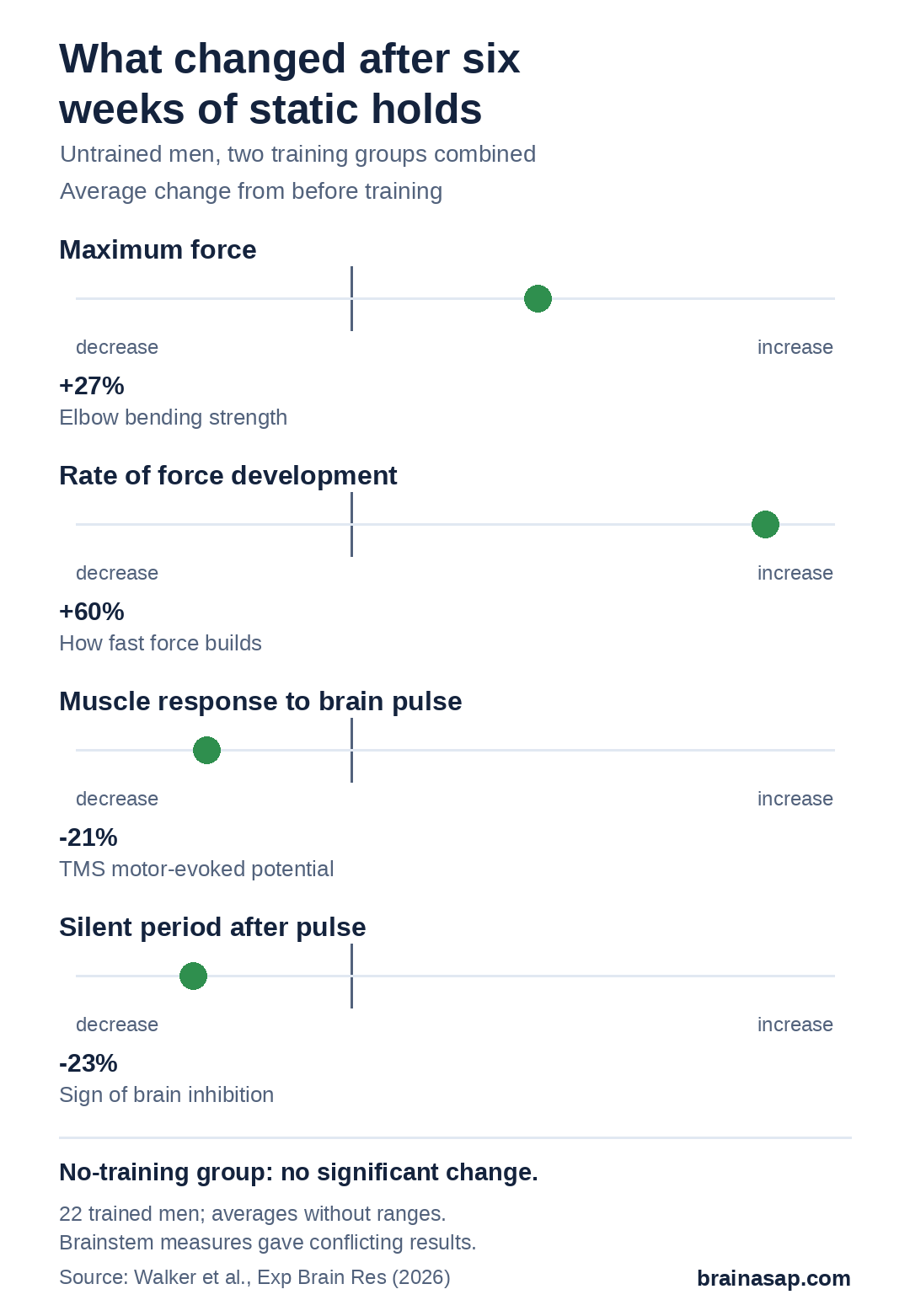
- Stronger fast: Maximum elbow-bending force rose about 27% in trained groups.
- Quicker force: Rate of force build-up rose about 60%.
- Brain signals shifted: Responses to brain stimulation shrank 21% and a “quiet period” shortened 23%.
- Brainstem pathway: Evidence was conflicting.
- No-training group: No meaningful change.
Source: Experimental Brain Research (2026) | Walker et al.
The first few weeks of strength training bring big gains before muscles grow much. Scientists agree that the nervous system drives these early gains, but not on where. The classic answer is the corticospinal tract, the direct path from the brain’s movement area to the spinal cord. A newer idea points to the reticulospinal tract, an older route through the brainstem.
Researchers in Finland and the UK ran a controlled training study to test both.
Pushing Against an Immovable Bar
The team assigned 48 healthy, untrained men to three groups; 39 (average age about 23) completed the study. Only the first 15 were assigned at random; later assignments were matched by group size and starting strength:
- Sustained-hold group (13): Held long, steady elbow-bending contractions.
- Explosive group (9): Did short, fast, all-out contractions.
- No-training group (17): Kept their usual activity.
Training was isometric, meaning the arm pushes against something that does not move. Trainees used a home device three times a week for 18 unsupervised sessions.
Strength and Speed Jumped
Both training groups got clearly stronger, while the no-training group did not change meaningfully. The authors note the 27% strength gain is larger than typical early gains from weight training, likely because the testing matched the training and the men were untrained.
Brain-to-Muscle Signals Changed
Using transcranial magnetic stimulation (TMS), a magnetic pulse over the brain’s movement area, the researchers measured two signals in the biceps during a light contraction:
- Muscle response to the pulse: Down 21%.
- Silent period afterward (a sign of brain inhibition): 23% shorter.
The authors read this as training reducing both inhibition in the brain’s movement area and the excitability of the brain-to-spinal-cord pathway.
Mixed Signs From the Brainstem
To probe the brainstem route, the team used a loud 120-decibel sound, which speeds up reactions through that pathway. In the sustained-hold group, the sound sped reactions less after training and suppressed the brain-stimulation response more. Those shifts pointed in conflicting directions, so the study found no clear evidence that training strengthened the brainstem pathway.
Limits to Keep in Mind
- Men only, young and untrained.
- Small groups: 9 to 17 per group.
- One muscle, one type of training: Elbow flexion, isometric only.
- Indirect measures: Brainstem function in people can only be inferred from tests like the startle sound.
Where the Early Strength Comes From
For anyone starting out, the practical message holds: even simple static holds can bring quick strength gains. The science question remains open. Longer training, other exercise types and other muscles are needed to see whether the brainstem pathway joins in later.
Citation: DOI: 10.1007/s00221-026-07391-x. Walker S, Keogh KEJ, Tanel M, Baker ASW, Baker AME, Kidgell DJ, Baker SN. Six weeks of isometric resistance training led to evidence of corticospinal but not reticulospinal adaptation in previously untrained adult males. Exp Brain Res. 2026;244:191.
Study Design: Partly randomized controlled training study with TMS and StartReact testing.
Sample Size: 39 untrained men completed (13 sustained, 9 explosive, 17 control).
Key Statistic: MVC +27% and RTD +60% in training groups (both P < 0.01).
Caveat: Small, male-only sample; indirect and conflicting reticulospinal measures.