TL;DR: A newborn with severe brain bleeding had seizures that three standard drugs could not stop. After doctors added ketamine, visible seizures stopped, and brain-wave seizures ended once phenytoin was added too, so ketamine's own role is unclear.
Key Findings
- One baby born 4 weeks early: Bleeding in several parts of the brain.
- Seizures resisted 3 drugs: Phenobarbital, levetiracetam and midazolam.
- After ketamine: Visible seizures stopped; shorter brain-wave-only seizures continued.
- After adding phenytoin: All seizures stopped on EEG.
- No blood pressure or breathing problems were blamed on ketamine.
Source: Frontiers in Pediatrics (2026) | Gulisano et al.
Seizures are more common in the first days of life than at any other age, usually because of a brain injury around birth. When the standard drugs fail, doctors have few tested options left.
Ketamine, best known as an anesthetic, works on a different brain signaling system than most seizure drugs. A team at the Gaslini children's hospital in Genoa, Italy, describes using it as an add-on in one critically ill newborn.
A Very Sick Newborn
The boy was born at 35 weeks, a twin, small for his age and in poor condition at birth. Ultrasound showed bleeding into the fluid spaces of the brain, and MRI later found bleeding in several regions, including near the cerebellum. He also had blood-clotting problems that needed transfusions. Tests for infection, metabolic disease and genetic causes came back normal.
On his second day, continuous video-EEG picked up seizures, at first visible and then increasingly happening only in brain waves.
Three Drugs Failed, Then Ketamine Was Added
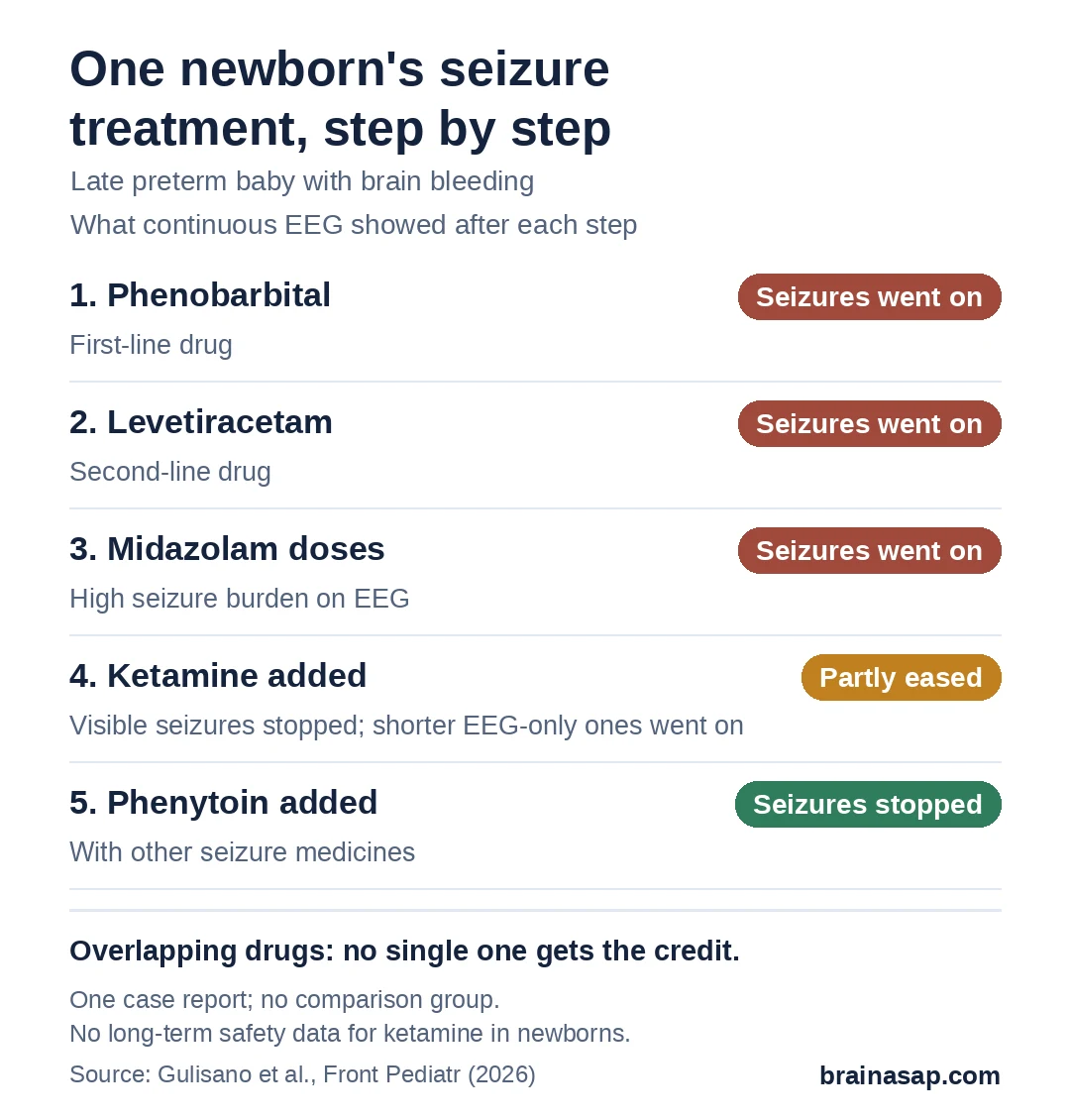
Doctors gave phenobarbital, then levetiracetam, then repeated doses of midazolam. The EEG still showed frequent seizures, a condition called refractory status epilepticus.
They then gave ketamine into a vein, followed by a continuous drip increased up to 5 mg/kg per day.
Visible Seizures Stopped, Hidden Ones Took Longer
After ketamine, the visible seizures stopped and the brain-wave seizures became shorter, but they did not disappear. Doctors then added phenytoin and a continuous midazolam drip. Only after that did the EEG show no seizures at all.
The authors stress that this is why continuous EEG matters in newborns. Judging by appearance alone would have suggested the seizures were over when they were not.
No drops in blood pressure or breathing problems were linked to ketamine. By about 2 months, the baby was on a single seizure drug, levetiracetam, with no seizure recurrence on follow-up EEGs, though his brain scans and EEG background still showed the effects of severe injury.
What One Case Can and Cannot Show
- One baby: No comparison group.
- Many drugs at once: Ketamine's effect can't be separated from phenytoin and midazolam.
- Short-term safety only: No information on long-term effects on the developing brain.
- Severe brain injury: Outcome reflects the underlying damage, not just seizure control.
A Reason for Trials, Not a New Standard
The case suggests ketamine can be given to a critically ill newborn as an add-on without obvious short-term harm. Whether it actually helps stop seizures, at what dose and with what long-term effects, needs proper studies in newborns across several hospitals.
Citation: DOI: 10.3389/fped.2026.1949800. Gulisano C, Pepe A, Amadori E, et al. Clinical utility and tolerability of ketamine as adjunctive rescue therapy for refractory neonatal status epilepticus: a case report of a late preterm infant with multifocal hemorrhagic brain injury. Front Pediatr. 2026;14:1949800.
Study Design: Single case report with continuous video-EEG monitoring.
Sample Size: 1 late preterm infant.
Key Statistic: Ketamine 2 mg/kg loading dose, infusion up to 5 mg/kg/day; complete EEG seizure cessation after phenytoin was added.
Caveat: Single case; multiple concurrent drugs; no long-term safety data.