TL;DR: A Japanese study published in 2026 reviewed the records of 22 people who first developed delusions or hallucinations after age 60, sorted by whether brain scans or spinal fluid tests showed signs of Alzheimer's disease or Lewy body disease.
Within about 2 years, 8 of 15 people with those signs had developed dementia, compared with 1 of 7 without them. With so few patients, that gap was not statistically clear.
Key Findings
- Dementia within about 2 years: 8 of 15 patients with Alzheimer's or Lewy body signs vs 1 of 7 patients without them, a gap that was not statistically clear.
- Matching diagnoses: 5 of 8 with Alzheimer's signs developed Alzheimer's dementia; 2 of 7 with Lewy body signs developed dementia with Lewy bodies.
- Thinking tests: At follow-up, patients with the signs scored clearly lower on a standard memory and thinking test and showed more everyday impairment.
- Different from the start: Patients with the signs first had symptoms later in life (median age 82 vs 65) and already scored lower on memory tests.
Source: Psychogeriatrics (2026) | Satake et al.
When an older person suddenly becomes convinced that neighbors are sneaking into their home or following them, doctors face a hard question. Is this a psychiatric illness on its own, or an early sign of a disease like Alzheimer's?
Psychosis that starts after age 60, with delusions or hallucinations but no established dementia, has a long name: very late-onset schizophrenia-like psychosis. Earlier research suggests people with it develop dementia more often than their peers.
A 2026 study in Psychogeriatrics, led by Yuto Satake and Manabu Ikeda at the University of Osaka, asked whether tests for brain disease can tell which of these patients are on that path.
Who Was in the Study?
Researchers searched records of 1,241 patients seen at the university hospital's memory and thinking clinic from 2018 to 2023. 67 met criteria for late-onset psychosis:
- Delusions or hallucinations starting at age 60 or later
- A score of at least 24 out of 30 on a global thinking test and no dementia on a clinical rating scale
- No mood disorder, stroke, brain tumor or other medical cause found
Only 22 had both the needed brain tests and a follow-up visit within about 2 years, so the study included those 22. 19 were women.
How Were Patients Grouped?
Each person was sorted by whether any test showed signs of 2 common causes of dementia:
- Alzheimer's signs (8 people): amyloid buildup on a PET brain scan, or high levels of the protein tau in spinal fluid.
- Lewy body signs (7 people): reduced dopamine activity on a brain scan, or a heart scan pattern typical of Lewy body disease.
Together these 15 formed the "signs present" group. Another 7 people, whose tests showed neither, formed the "no signs" group.
Dementia at follow-up meant a doctor rating of at least mild dementia on a standard scale of daily functioning and memory.
Who Developed Dementia?
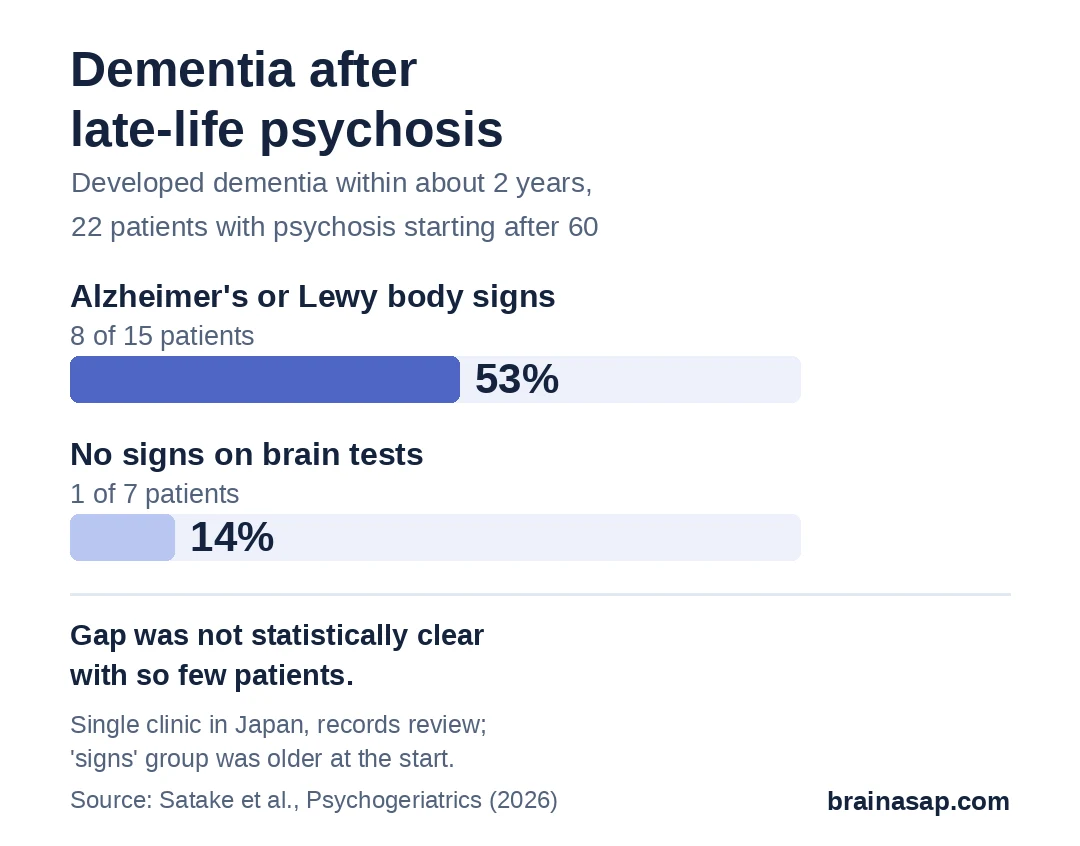
Dementia developed in:
- Signs present: 8 of 15 (53%)
- No signs: 1 of 7 (14%)
That looks like a big difference, but the estimate from only 22 patients was too imprecise to establish a clear difference. Estimated odds were about 6 times higher in the "signs present" group, with a plausible range from about half as likely to 350 times as likely.
Diagnoses tended to match the test results. 5 of 8 patients with Alzheimer's signs developed Alzheimer's dementia. Of 7 with Lewy body signs, 2 developed dementia with Lewy bodies and 1 another condition.
At follow-up, the "signs present" group scored lower on the memory and thinking test (median 24 vs 27 out of 30) and showed more problems in daily life. Those gaps were statistically clear, even though they weren't at the first visit.
Why Be Cautious?
- Very small: 22 patients, and many comparisons without correction.
- Older to begin with: The "signs present" group was older and had weaker memory at the start, and the sample was too small to adjust for that. Brain test results can't be called an independent predictor.
- Who got tested: Only 22 of 67 eligible patients had the needed tests and follow-up, which may skew results.
- Uneven timing: Tests and follow-up visits happened at different times for different people.
- One clinic in Japan: Results may not apply elsewhere.
Should Brain Tests Be Part of the Workup?
Satake and colleagues suggested that checking for Alzheimer's and Lewy body signs could help doctors judge which older patients with new psychosis are more likely to develop dementia.
For families, the practical point is that new delusions late in life deserve a careful medical look, not just a psychiatric label. A larger study that follows patients on a regular schedule would show how much these tests really add.
Citation: DOI: 10.1111/psyg.70205 Satake Y, Kanemoto H, Taomoto D, Takeda K, Katakami S, Kobayashi M, Matsunaga K, Isohashi K, Suehiro T, Yoshiyama K, Ikeda M. Progression to Dementia in Very Late-Onset Schizophrenia-Like Psychosis Stratified by Alzheimer's Disease and Lewy Body Disease Biomarkers: A Retrospective Cohort Study. Psychogeriatrics. 2026;26:e70205.
Study Design: Single-center retrospective cohort, University of Osaka Hospital neuropsychology clinic (2018–2023); biomarkers: amyloid PET or CSF p-tau (AD), FP-CIT SPECT or MIBG myocardial scintigraphy (LBD); follow-up within 775 days; Fisher's exact and Mann–Whitney U tests.
Sample Size: 22 patients with VLOSLP (15 biomarker-positive, 7 biomarker-negative) of 67 eligible.
Key Statistic: Progression to dementia (global CDR ≥ 1): 8/15 (53.3%) vs 1/7 (14.3%), p = 0.165; OR 6.31 (95% CI 0.55–353.18). Follow-up MMSE median 24 vs 27 (p = 0.030); CDR-SB 4.5 vs 1 (p = 0.010).
Caveat: Very small sample, no multivariable adjustment, uncorrected multiple comparisons; selection bias (22 of 67 with data); non-uniform timing; older age and lower baseline memory in biomarker-positive group; retrospective chart-based diagnoses.